
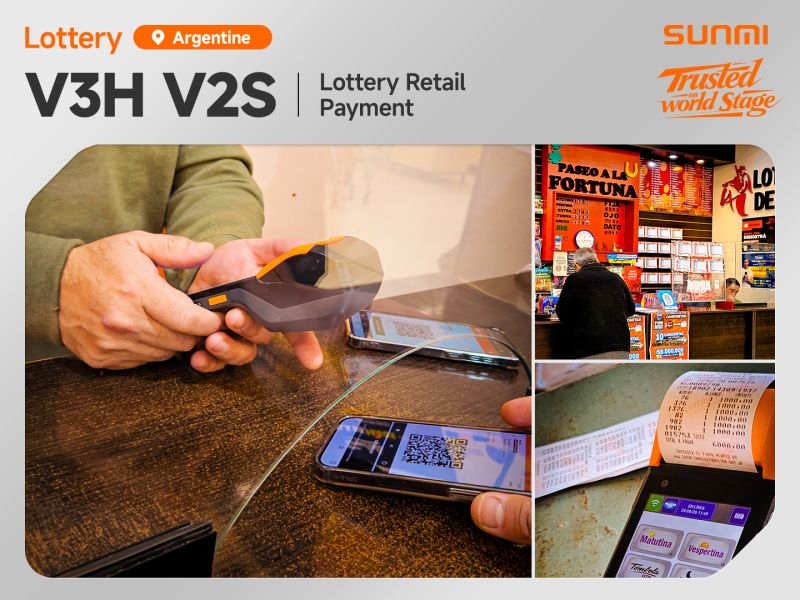
Lottery retailers and retail sports betting operators run a distinctive counter workflow that ordinary POS hardware struggles to serve efficiently. Every transaction involves either scanning a player-selection slip, printing a ticket, reading an existing ticket for prize redemption, or handling a compliance-heavy cash transaction with age verification. When the counter is also selling convenience merchandise, cigarettes, alcohol, and coffee, the operator needs a single handheld that clears all of these workflows without swapping between devices. This guide covers how the SUNMI V3H handheld, the SUNMI V2s entry-level counter device, and the K2 Mini self-serve kiosk cover lottery agent, retail sportsbook, and combined convenience-plus-lottery locations across the North American market in 2026.
Key takeaways
- For lottery retailers and sports betting kiosk operators in 2026, the SUNMI V3H handheld covers the counter-plus-scanner workflow with an integrated 2D barcode scanner, NFC contactless tap-to-pay, and a built-in receipt printer for lottery slips and betting tickets.
- For entry-level convenience retailers and secondary counter workflows, the SUNMI V2s handheld provides a 58mm detachable printer plus NFC in a lower price point, suited to lottery-only counters at small format stores.
- For self-serve sports betting kiosks in retail locations (convenience stores, gas station corners, hotel lobbies with sportsbook partnership), the K2 Mini 10.1-inch countertop kiosk provides an Android platform for the operator app plus a paired ticket printer and payment terminal.
- Barcode scanning speed is the throughput bottleneck for high-volume lottery counters, especially during Powerball and Mega Millions jackpot runs where the counter processes hundreds of tickets per hour; the V3H integrated scanner clears this pattern without a paired external scanner.
- State lottery commission suppliers and retail sportsbook operators typically require chain-wide device standardization; Rosper handles fleet MDM, pre-configuration, and warranty coordination across 500 to 15,000-store convenience chain rollouts through 8 US and Canadian warehouses.
Why lottery and sports betting hardware is a different problem
The lottery counter has three specific workflows that no generic retail POS terminal fully covers. First, the player-selection slip: the customer hands over a paper slip with their number choices, the cashier scans it into the lottery agent application, and the app generates the ticket. This workflow requires a fast, accurate 2D barcode scanner because the slip barcode format is specific to each state lottery and the read has to work first time under counter lighting conditions.
Second, existing ticket read: customers bring in tickets for prize redemption (small prizes paid at the counter, larger prizes referred to the state office), and the cashier scans the ticket to look it up in the lottery agent application. Again, 2D barcode scanning speed and accuracy is the throughput driver. Third, printed ticket output: after the agent application processes the wager, the ticket has to print immediately, because the customer is standing at the counter waiting for it. A built-in receipt printer on the same handheld device removes the paired-external-printer failure point and keeps the workflow inside one device.
Retail sports betting adds two more requirements on top: age and identity verification at the wager point (state sportsbook regulations require age check for every wager), and settlement ticket read for winning bet redemption. Both of these workflows also benefit from an integrated scanner rather than a paired external device.
The V3H handheld: integrated scanner, printer, and payment for the lottery counter
The V3H is the SUNMI handheld sized for the lottery agent counter and the retail sportsbook counter. The relevant hardware profile for lottery and sports betting:
- Integrated 2D barcode scanner with fast read on lottery slips, ticket redemption, driver license PDF417 (for age verification), and product UPC where the counter handles convenience checkout.
- Built-in receipt printer for the printed lottery ticket, sports betting slip, and transaction receipt output on the same device.
- NFC contactless tap-to-pay on the handheld for lottery and convenience checkout, with a P3 family terminal where EMV chip and magnetic stripe card-present acceptance is required.
- Android platform to run the state lottery agent application, the sportsbook operator app, or the standard convenience store back-of-house software.
- Handheld form factor sized for either counter-mount cradle or full handheld operation, depending on the retailer configuration.
- Battery life sized for a full retail shift with hot-swap options for double-shift operation at high-volume urban lottery counters.
The consolidation onto one handheld device is the operational payback for the lottery counter. A separate scanner plus separate PIN pad plus separate receipt printer has three failure surfaces, three cables to manage, and three MDM baselines to maintain across the chain. The V3H replaces all three with one device, cuts the counter footprint materially, and reduces the training overhead for the cashier who no longer has to remember which device handles which step.
V2s for entry-level lottery counters and secondary retailers
For entry-level retailers running lottery as a secondary category (small format convenience stores, gas station cashier counters with lottery-only side terminals, liquor stores adding lottery to an existing register), the V2s covers a lower price point with a smaller device footprint. The V2s pairs a 58mm detachable receipt printer with NFC contactless tap-to-pay and a compact handheld form factor. For a store doing under 100 lottery tickets per day where the primary throughput driver is not the lottery counter, the V2s is a workable entry point that fits the retailer’s device budget without over-provisioning.
The tradeoff versus the V3H: the V2s does not include an integrated 2D barcode scanner, so lottery slip scanning requires either the built-in camera (workable for low volume but slower than a dedicated scanner) or a paired external scanner. For retailers where lottery is the primary counter workflow at scale, the V3H integrated scanner is worth the price delta. For retailers where lottery is secondary and volume is modest, the V2s trims the counter cost without breaking the operational pattern.
K2 Mini for retail sports betting kiosks: convenience store, gas station, hotel lobby
Retail sports betting is expanding across US states as regulatory legalization continues, and the retail sportsbook model in convenience stores, gas station corners, and hotel-lobby partnerships is one of the fastest-growing distribution channels. The K2 Mini countertop kiosk covers this deployment pattern: 10.1-inch Android touchscreen for the customer-facing operator app, paired PCI PTS terminal for payment, paired receipt printer for the bet slip output. The kiosk footprint fits the small-format retail counter without displacing the primary merchandise or cashier flow.
Retail sportsbook flow on the K2 Mini kiosk: customer walks up, browses the current betting menu on the 10.1-inch screen (spread, over-under, moneyline, prop bets, futures, live betting where the operator supports it), builds the bet slip by tapping selections, confirms the wager, taps age verification (scanning driver license barcode on the paired scanner where the state requires ID capture, or on the built-in camera where slower read is acceptable), completes payment on the paired terminal, receives the printed bet slip. Settlement redemption after the game result is handled at the retail counter using the V3H or V2s handheld to scan the bet slip and pay out.
Deployment patterns across the North American lottery and sportsbook retail base
Working baseline device counts by retailer format and volume:
| Retailer format | Volume profile | Recommended stack |
|---|---|---|
| Small convenience store, lottery as secondary | 20 to 80 lottery tickets / day | 1 V2s at the counter, doubles as convenience POS |
| Standard convenience store, lottery as primary | 100 to 300 lottery tickets / day | 1 V3H at the counter, integrated scanner clears jackpot-run pattern |
| High-volume urban lottery retailer | 300 to 800 tickets / day, higher during jackpots | 2 to 3 V3H handhelds across dedicated lottery counter + convenience counter |
| Gas station with retail sportsbook partnership | Lottery volume + sportsbook volume | 1 V3H at counter + 1 K2 Mini self-serve sportsbook kiosk |
| Hotel lobby retail sportsbook partnership | Sportsbook only | 1 K2 Mini self-serve kiosk + settlement at hotel guest services counter using V3H |
| State lottery commission fleet rollout | 500 to 15,000 store network | Standardized V3H fleet with staged regional deployment |
For state lottery commission suppliers and retail sportsbook fleet operators, the standardization argument is decisive. Mixed-vendor fleets across a 5,000 to 15,000 store network create IT support overhead, training complexity, spare parts inventory bloat, and warranty pipeline fragmentation. Standardizing on the V3H handheld across the fleet lets the operator maintain one MDM baseline, one training program, one spare parts channel, and one warranty pipeline.
Age verification and compliance workflow on the lottery counter
Lottery, sports betting, tobacco, and alcohol all require age verification at the counter. The workflow on the V3H handheld with integrated 2D scanner:
- Cashier taps the restricted category item (lottery ticket, cigarette purchase, alcohol purchase) on the counter application.
- The application prompts for age verification.
- Cashier scans the driver license barcode (PDF417 format used on US and Canadian licenses) using the integrated 2D scanner.
- The application parses the birth date from the barcode, validates it against the jurisdiction threshold for that category (21 for alcohol in most US states, 19 in most Canadian provinces, 18 or 21 for tobacco depending on jurisdiction, 18 or 19 for lottery), and approves or blocks the item.
- The verification event is logged to the transaction record for audit purposes where required by regulation.
For sports betting kiosks, the same barcode-scan-plus-parse workflow applies at the wager point. The K2 Mini self-serve kiosk with paired scanner captures the driver license before the customer completes the wager, and the sportsbook operator application validates the age plus jurisdictional eligibility (some states require the wager to be placed within state boundaries, which the app handles through geolocation but which supplements the ID read).
Jackpot run capacity: what the V3H integrated scanner unlocks
Jackpot runs (Powerball or Mega Millions crossing 500M USD and above) transform the volume profile at lottery retailers. Counter throughput during a jackpot-run week can hit 5 to 10 times the baseline daily volume at high-traffic urban lottery retailers, with lines sometimes stretching out the door. The bottleneck at the counter during a jackpot run is almost always the scanner-plus-print cycle time per ticket, not the payment step.
The V3H integrated scanner drops the scan step time by removing the paired-scanner reach-and-aim workflow that a separate device requires. Combined with the built-in printer that outputs the ticket immediately at the same device, the per-ticket cycle time compresses materially. For a retailer clearing 400 tickets in a peak jackpot-run hour, the difference between a 8-second scan-and-print cycle versus a 12-second cycle is 400 tickets versus 300 tickets in the same hour, a 33 percent throughput lift with no added labor.
State lottery commission fleet rollouts: standardization and staging
For state lottery commissions or their appointed lottery agent suppliers rolling out terminal refresh across a 500 to 15,000 store retailer network, the operational pattern:
- Standardize on one V3H SKU across every retailer in the fleet, so the MDM baseline, training program, spare parts channel, and warranty pipeline are single-track.
- Pre-configure the terminals at Rosper warehouses: state lottery agent application installed, MDM enrollment complete, retailer-specific profile pushed. Ship ready-to-run devices to regional distribution hubs.
- Wave the retailer rollout across the fleet in tranches sized to what the field installer team can turn without breaking retailer service continuity.
- Position regional spare inventory across the state to protect retailer uptime during jackpot runs when a dead terminal creates immediate revenue impact.
- Coordinate warranty claims at the fleet level through a single Rosper account manager, so retailer-level ticket handling does not create a bottleneck for the commission.
For retail sportsbook operators expanding into a new state as regulatory legalization opens, the same rollout pattern applies with the K2 Mini kiosk at the retail partner locations plus V3H handhelds at the settlement counters. Rosper handles fleet MDM, pre-configuration, and staged shipping across the 8-warehouse footprint (City of Industry CA times 2, Ontario CA, Tracy CA, The Colony TX, McLean VA, Allentown PA, Brampton ON).
Warranty and event-day support for high-volume lottery retailers
For high-volume urban lottery retailers, a dead terminal during a jackpot run week is a direct revenue impact of thousands of dollars per day. Rosper stocks V3H, V2s, and K2 Mini inventory across 8 US and Canadian warehouses with a 2 to 5 business day standard warranty swap SLA. For retailers within the 500-mile radius of any of our warehouses, ground shipping typically clears the swap inside 2 business days.
Gen 3 SUNMI handheld and kiosk units carry a 3-year manufacturer warranty; Rosper assists with warranty claims, helping you connect with SUNMI faster and coordinating the swap through our in-country stock. For state lottery commission fleets, we set up regional spare pools that let the commission field team pull a swap unit from the local pool without waiting on cross-country shipping.
Related Rosper deployment guides: for stadium and arena concession checkout with 60-120 transactions per hour per lane, see T3 80MM stadium and arena concession checkout. For taxi, rideshare, and hotel shuttle fleet in-vehicle EMV payment terminals, see CPad Pay for taxi and rideshare in-vehicle payment.
Get a lottery and sportsbook fleet deployment plan
Rosper is a US and Canadian stocking authorized SUNMI partner handling state lottery commission fleet rollouts, retail sportsbook chain deployments, and independent lottery retailer procurement across 8 warehouses. For a 500-store or 15,000-store rollout plan, MDM pre-configuration, or regional spare positioning consultation, talk to a Rosper lottery and sportsbook specialist.
When SUNMI handheld POS is not the right call for your lottery or sportsbook location
Two scenarios where the math does not work in 2026. Very small independent lottery retailers doing under 30 tickets per day (small liquor stores, cornershop bodegas with only occasional lottery activity) often do not save enough on integrated scanning and printing to justify the hardware refresh, since the counter workflow is manageable on existing older devices for that volume. Tribal casino sportsbook operations where the sportsbook is a full casino floor with staffed windows and dedicated betting terminals typically need a different device category sized for the casino floor environment; the K2 Mini countertop kiosk is sized for the retail sportsbook model, not the full casino floor.
Frequently asked questions
What is the best handheld POS for a lottery retailer in 2026?The best handheld POS for a lottery retailer is a device with an integrated 2D barcode scanner (for reading player-selection slips and playing existing tickets), NFC and EMV for payment, a built-in receipt printer for the printed lottery ticket or transaction receipt, and Android OS to run the state lottery agent application. The SUNMI V3H covers this baseline in a single handheld unit, so the lottery counter does not need a separate scanner, separate PIN pad, and separate printer occupying three ports and three failure surfaces.
Can the SUNMI V3H run the state lottery agent application?The V3H runs Android, which is the standard application platform for the state lottery agent applications distributed by lottery commission suppliers in 2026. The lottery agent app is typically installed via mobile device management (MDM) enrollment before shipment or via a supervised install at the retailer counter. Once installed, the agent app handles the lottery draw menu, quick-pick generation, player slip scanning, ticket printing, cash-in-cash-out reconciliation, and end-of-day close. The V3H hardware is the platform; the app is provided by the lottery commission or their appointed vendor.
How does a retail sports betting kiosk work with the SUNMI K2 Mini?A retail sports betting kiosk on the K2 Mini runs the sportsbook operator application (the platform the retail location is partnered with for the sportsbook program) on the 10.1-inch Android touchscreen. The customer walks up to the kiosk, browses the current betting menu (spread, over-under, moneyline, prop bets, live betting where available), builds their bet slip on-screen, taps to confirm, and pays on the paired PCI PTS certified terminal. The kiosk then prints the ticket on the paired receipt printer for the customer to redeem at the counter after settlement.
What barcode scanning capability does the V3H handheld provide?The V3H includes an integrated 2D barcode scanner sized for the lottery retailer counter workflow: fast read on player-selection slips (Powerball, Mega Millions, state game slips), existing ticket barcode read for prize redemption and check-ticket queries, and product barcode read where the counter also handles convenience store checkout. The 2D scanner reads standard 1D UPC as well as 2D formats (PDF417, QR, Aztec, Data Matrix), which covers driver license barcode read for age verification when the retailer sells alcohol, tobacco, or lottery to jurisdictions with age-check requirements.
How many devices does a lottery-plus-convenience retailer typically need?Working baseline by store size and lottery volume: a single-counter convenience store with lottery averaging under 100 lottery tickets per day runs one V3H handheld at the counter, handling both lottery and convenience checkout on the same device. A high-volume lottery retailer (200 to 500 tickets per day during jackpot runs) runs a dedicated lottery-only counter with a V3H handheld plus a separate convenience checkout counter to keep the lottery line from blocking merchandise sales. Multi-counter lottery locations at busy urban stores may run 2 to 3 V3H handhelds during peak jackpot windows.
What warranty and support does Rosper offer for state lottery and sportsbook fleet deployments?Rosper stocks SUNMI V3H, V2s, and K2 Mini units in 8 US and Canadian warehouses (City of Industry CA times 2, Ontario CA, Tracy CA, The Colony TX, McLean VA, Allentown PA, Brampton ON) with a 2 to 5 business day standard warranty swap SLA. For state lottery commission suppliers and retail sportsbook chains rolling out across hundreds or thousands of stores, Rosper coordinates the fleet MDM enrollment, pre-configuration, and staged shipping to distribution regional hubs. Gen 3 units carry a 3-year manufacturer warranty; Rosper assists with warranty claims, helping you connect with SUNMI faster.