
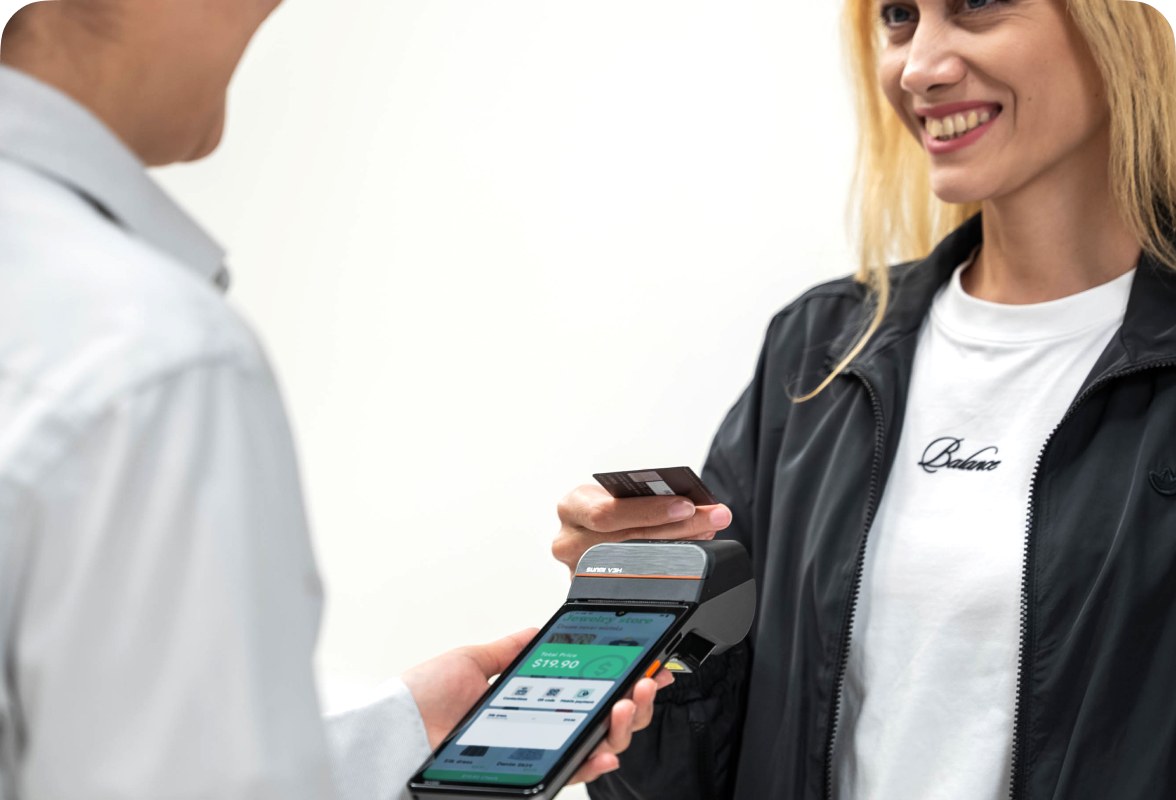
The traditional payment setup at most businesses involves two separate pieces of equipment: a POS terminal or tablet for order management, and a dedicated payment terminal from a payment processor for card transactions. SoftPOS eliminates the second device by turning the screen of your Android POS terminal into a contactless payment reader.
For merchants, this means fewer devices on the counter, lower hardware costs, and simpler setup. For SUNMI users specifically, several current-generation devices already support SoftPOS capability, making it possible to accept Apple Pay, Google Pay, tap-to-pay cards, and other contactless methods directly on the POS screen.
This guide explains what SoftPOS is, how it works, which SUNMI devices support it, and what considerations apply for businesses in the US and Canada.
What Is SoftPOS?
SoftPOS (Software Point of Sale) is a technology that allows an NFC-enabled device to accept contactless payments through software, without requiring a dedicated hardware payment reader. Instead of connecting an external payment terminal, the merchant’s existing Android tablet or terminal acts as the payment acceptance device.
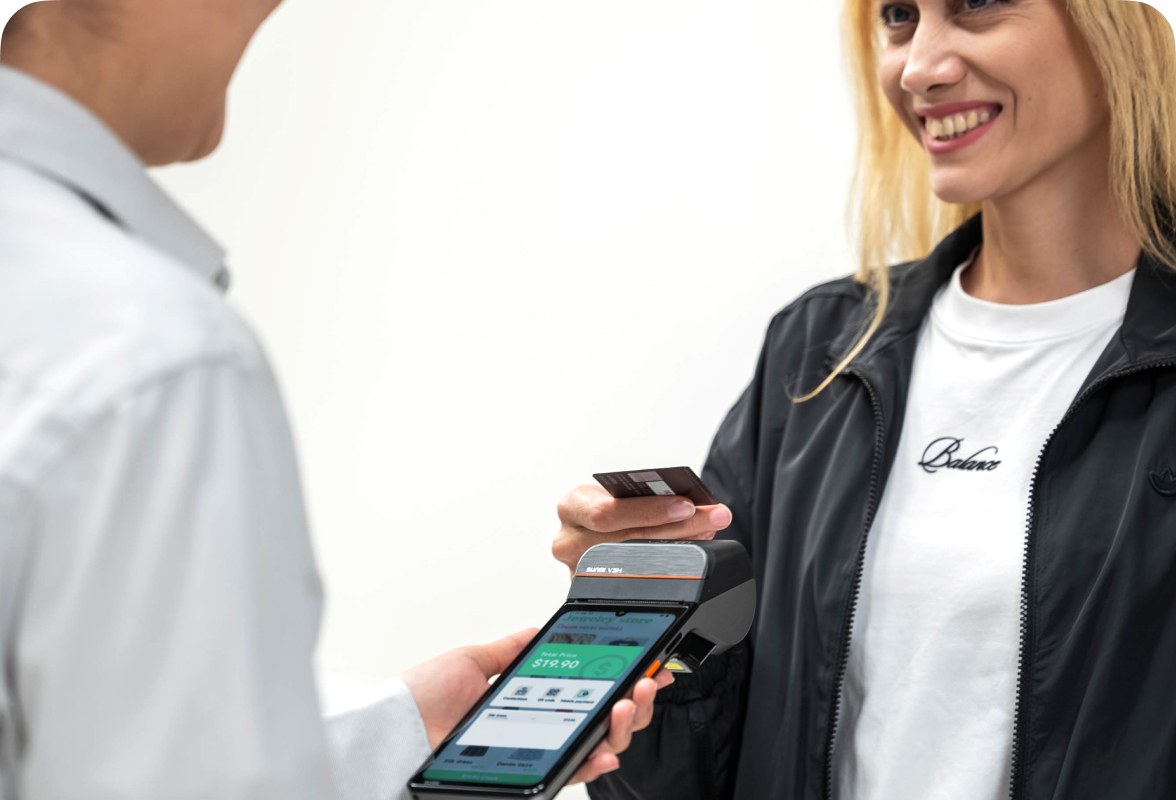
When a customer taps their contactless card or phone on the SoftPOS-enabled screen, the NFC chip in the device reads the payment credential, the SoftPOS application processes the transaction through the merchant’s payment processor, and the payment is completed, all on one device.
The technology has been gaining traction for several reasons:
Lower hardware cost. A dedicated payment terminal typically costs $200-500 per unit. SoftPOS removes this cost by using the POS terminal you already own.
Simpler counter setup. One device handles both order management and payment acceptance. Less cable clutter, fewer power outlets needed, and more counter space.
Flexibility. Any NFC-capable Android device in your business can become a payment terminal. This is useful for pop-up sales, tableside payment, and mobile checkout scenarios.
Faster checkout flow. Staff do not need to hand the customer to a separate payment device or redirect them to a different terminal. The entire transaction happens on one screen.
How SoftPOS Works Technically
The process is straightforward from the merchant’s perspective but involves several technical layers behind the scenes:
-
NFC hardware. The POS terminal or tablet needs an NFC chip that can communicate with contactless cards and phones. This is the same NFC hardware used for pairing Bluetooth devices or reading NFC tags.
-
SoftPOS application. A software application provided by your payment processor or a third-party SoftPOS vendor runs on the Android device. This application manages the secure payment flow and communicates with the payment network.
-
Payment processor integration. The SoftPOS app connects to your existing payment processing account. When a customer taps to pay, the transaction routes through the same payment network and processor you would use with a dedicated terminal.
-
Security certifications. For SoftPOS to be commercially viable, the hardware and software must meet payment industry security standards. This includes EMVCo Contactless Level 1 (for the NFC hardware) and CPoC (Contactless Payments on COTS) certification for the software.
The customer experience is simple: tap the card or phone on the screen, wait for confirmation (usually 1-3 seconds), and the transaction is complete.
Which SUNMI Devices Support SoftPOS
SUNMI has been integrating NFC capability into its product line, and several current-generation devices have the hardware and certifications required for SoftPOS:
SUNMI Flex 3 (18.5″ / 22″ / 27″)
Flex 3 is the only SUNMI product with an under-screen NFC reader that carries EMVCo PCD L1 certification, which means it can act as a SoftPOS acceptance device without any external payment terminal. This makes it the go-to pick for self-checkout lanes, kiosks, and counter POS setups where the customer taps directly on the interactive display.
SUNMI CPad 14 and CPad 11
The CPad 4G and Hyper Wi-Fi variants ship with built-in under-screen NFC (NXP7220) and a modular Quick-Lock system, so one device can serve as a POS terminal, a customer-facing display, and a payment acceptance point on the same screen. Wi-Fi-only CPad SKUs do not include the NFC reader and are not SoftPOS-capable — confirm the variant when ordering.
In a restaurant setting, a server can take the order, show it to the customer on the CPad screen, and accept payment with a single tap, all without handing the customer off to a separate checkout terminal.
SUNMI V3 Plus
The V3 Plus handheld terminal includes NFC with optional SoftPOS support. It carries EMVCo PCD L1 certification and supports contactless payment on screen. For tableside payment in restaurants or curbside pickup in retail, the V3 Plus offers full mobility without needing a separate payment reader.
SUNMI V3 Mix and V3e
These handheld models also include NFC hardware. The V3 Mix is designed for multi-scenario use in logistics and retail, while the V3e offers a cost-effective option for basic mobile POS. Both support contactless payment capabilities.
SUNMI D3 Pro and D3 Mini
The desktop terminals include NFC modules for card and device communication. While primarily used as order management terminals, the built-in NFC means these devices can participate in SoftPOS workflows when paired with compatible payment software.
Note: SoftPOS capability depends on both hardware and software. The devices listed above have the necessary NFC hardware and certifications. However, you still need a SoftPOS application from your payment processor to enable contactless payment acceptance.
SoftPOS vs. Traditional Payment Terminals
Understanding the trade-offs helps you decide whether SoftPOS is right for your business.
Where SoftPOS excels:
– Small businesses with limited counter space
– Mobile and pop-up sales scenarios
– Tableside payment in restaurants and cafes
– Businesses looking to reduce hardware costs
– Operations that want to consolidate to fewer devices
Where a traditional payment terminal may still be needed:
– Businesses that primarily process chip-and-PIN transactions (SoftPOS typically handles contactless only; chip transactions still require a dedicated reader in most implementations)
– High-volume locations where a dedicated payment terminal can process transactions faster with its own dedicated screen
– Merchants whose payment processor does not yet offer a SoftPOS solution
In practice, many businesses find that a combination works best: SoftPOS on their main POS terminal for quick tap-to-pay transactions, with a companion payment terminal available for chip-and-PIN or swipe transactions.
Payment Processors Offering SoftPOS
The availability of SoftPOS depends on your payment processor. Several major processors and platforms have launched or are developing SoftPOS solutions:
- Stripe – Has been expanding terminal software capabilities that include contactless payment on device
- Adyen – Offers a SoftPOS platform for merchants using Android devices
- Global Payments and Worldpay – Have SoftPOS solutions available in select markets
- Moneris (Canada) – Offers SoftPOS capability for Canadian merchants
The landscape is evolving rapidly. If your current payment processor does not offer SoftPOS yet, it is worth checking their roadmap, as most major processors are working on or have released SoftPOS solutions.
For businesses in both the US and Canada, the key question to ask your payment processor is: “Do you support contactless payment on Android devices, and which Android devices are certified for your SoftPOS solution?”
SoftPOS for Different Business Types
Restaurants and Cafes
SoftPOS is a natural fit for tableside payment. A server can bring the SUNMI CPad to the table, show the bill, and accept payment with a customer tap. This reduces the need for customers to wait at a central terminal and speeds up table turnover. For counter-service cafes, the SUNMI D3 Pro with SoftPOS lets customers tap to pay directly on the order screen.
Retail Stores
In small retail environments, SoftPOS on the main POS terminal reduces counter equipment. The SUNMI D3 Mini, for example, can handle product lookup, inventory management, and payment acceptance on one screen. For larger stores, mobile POS with SoftPOS on the SUNMI V3 Plus enables line-busting during peak hours.
Hospitality
Hotels, event venues, and service businesses benefit from mobile payment acceptance. A concierge or event staff member can check in guests or process payments anywhere on the property using a SoftPOS-enabled handheld device.
Food Trucks and Pop-ups
These environments have the most to gain from SoftPOS. A single SUNMI V3 Mix or CPad handles the entire transaction from order to payment, with no external hardware required. This is ideal for businesses that set up and tear down frequently.
SoftPOS FAQ
Q: Is SoftPOS the same as a mobile wallet?
A: No. A mobile wallet (like Apple Pay or Google Pay) is what the customer uses to pay. SoftPOS is the merchant-side technology that accepts that payment on an Android device instead of a dedicated payment terminal. They are two sides of the same contactless payment ecosystem.
Q: Does SoftPOS work with chip cards?
A: Most SoftPOS implementations handle contactless (tap) transactions only. For chip-and-PIN transactions, you still need a payment terminal with a card slot and PIN pad. Some businesses use SoftPOS for quick tap payments and keep a companion terminal for chip transactions.
Q: Is SoftPOS secure?
A: When implemented correctly with certified hardware and software, SoftPOS meets the same security standards as dedicated payment terminals. SUNMI devices with SoftPOS capability carry EMVCo PCD L1 certification and CPoC compliance. The actual security also depends on your payment processor’s SoftPOS implementation.
Q: Do I need a special app for SoftPOS?
A: Yes. You need a SoftPOS application provided by your payment processor. This app manages the secure payment flow on your Android device. The app connects to your existing merchant account, so transaction records and reporting work the same way as with a traditional terminal.
Q: Can I use SoftPOS and a traditional payment terminal at the same time?
A: Yes. Many businesses run both simultaneously. SoftPOS handles quick contactless taps on the main POS, while a companion terminal is available for chip-and-PIN or other payment methods. Your payment processor routes all transactions to the same merchant account regardless of which acceptance method was used.
Q: Does SoftPOS work in Canada with Interac Flash?
A: Interac Flash is Canada’s contactless debit payment method and operates on the same NFC infrastructure as other contactless payment types. If your payment processor supports Interac Flash through their SoftPOS solution, SUNMI devices with NFC capability can accept Interac Flash taps. Check with your processor for Canadian-specific SoftPOS support.
Q: What happens if the internet goes down?
A: Most SoftPOS implementations require an active internet connection to authorize transactions. Some payment processors offer offline modes for a limited number of transactions, but this varies by provider. If reliability is a concern, consider keeping a backup payment terminal that supports offline authorization.
Ready to Explore SoftPOS?
SoftPOS is changing how businesses think about payment acceptance. Instead of investing in separate payment terminals for every counter and checkout position, businesses can use the Android POS devices they already own to accept contactless payments.
SUNMI devices like the Flex 3 (EMVCo PCD L1 certified), CPad 14 and CPad 11 (4G or Hyper Wi-Fi variants), V3 Plus, and V3 Mix have the NFC hardware and certifications needed for SoftPOS. Whether you run a restaurant, retail store, hospitality venue, or mobile business, the right hardware combined with your payment processor’s SoftPOS app can simplify your checkout flow and reduce your equipment costs.
Rosper stocks the full SUNMI product line at warehouses across the US and Canada, including the Brampton, Ontario warehouse serving Canadian businesses. Most orders arrive in 2-7 business days, and every device comes with SUNMI Care Standard 3-year warranty.
If you want to explore which SUNMI device is the right fit for your SoftPOS setup, requesting a quote is a good starting point. Rosper’s team can help you match the right hardware to your payment processor and business needs.