
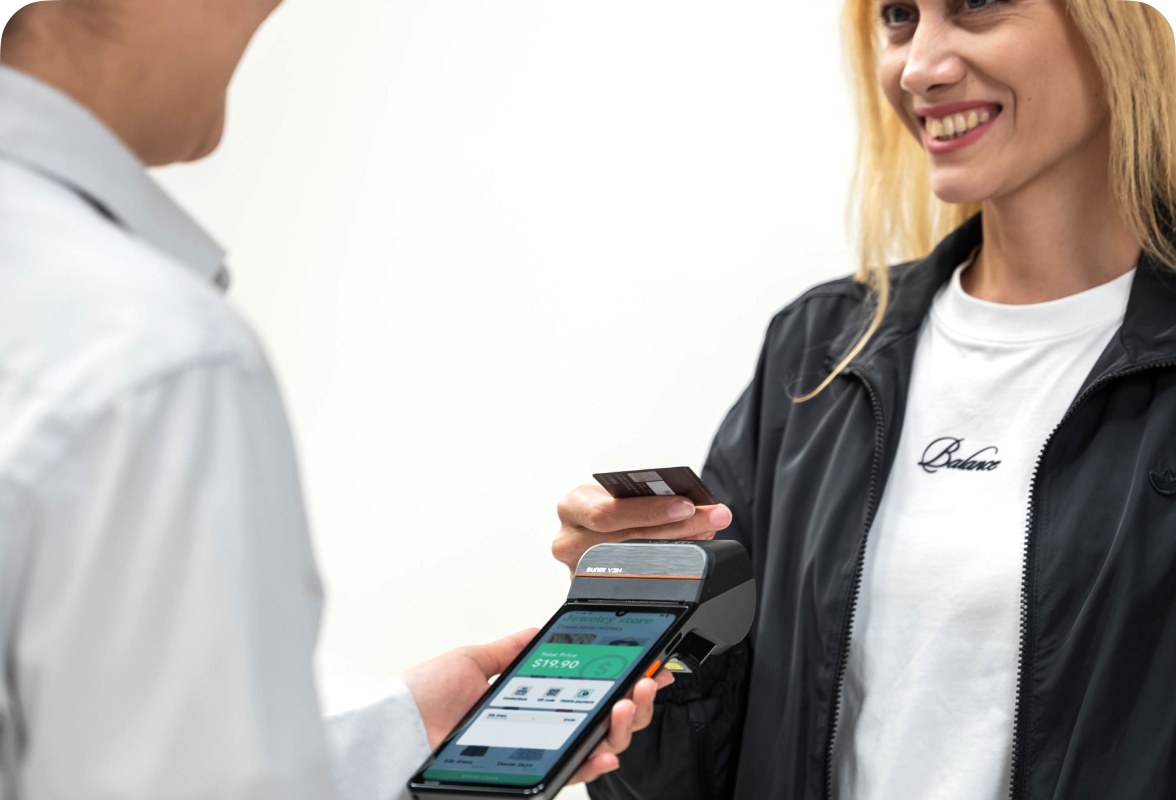
For ISVs (Independent Software Vendors) building payment applications, SoftPOS represents a significant shift in how merchants accept contactless payments. Instead of requiring businesses to purchase and connect a dedicated payment terminal, SoftPOS lets your application turn the merchant’s existing Android POS device into a contactless payment reader.
SUNMI has been building NFC capability into its product line with SoftPOS in mind. Several current-generation devices meet the hardware certification requirements that payment networks demand, with the new SUNMI V3H emerging as the 2026 purpose-built handheld for SoftPOS-first deployments. This guide covers the technical requirements, supported devices, SDK access, and deployment considerations for ISVs integrating SoftPOS with SUNMI hardware.
The short answer: yes, an ISV can build a compliant SoftPOS product on SUNMI hardware, because the CPad Pay tablets and V3H handheld already carry the EMVCo Contactless Level 1 (PCD L1) and CPoC certifications that tap-on-glass acceptance requires. The work that remains is your software layer and payment network certification, not the device hardware.
If you are deciding whether to commit engineering time, the fastest way to de-risk it is a structured pilot. A 30-60-90 day pilot lets you validate NFC read reliability, SDK integration, and certification readiness on real devices before you scale to a merchant fleet. For a full framework, see our ISV pilot program blueprint, which lays out the 30-60-90 day decision path for testing Android POS hardware.
What ISVs Need to Know About SoftPOS Architecture
SoftPOS applications operate at the intersection of three layers:
Hardware layer. The Android device needs an NFC controller that meets EMVCo Contactless Level 1 (PCD L1) certification. This is a hardware specification that ensures the NFC chip can reliably read contactless cards and phones at the required distance and speed. The device must also comply with CPoC (Contactless Payments on COTS) standards, which define security requirements for consumer-grade devices processing payment transactions.
Software layer. The ISV’s SoftPOS application manages the payment flow: detecting a tap, reading the card or phone credential, communicating with the payment network, and returning an approval or decline response. This layer must be certified by the relevant payment networks (Visa, Mastercard, Interac, etc.) through their respective vendor certification programs.
Payment processor layer. The SoftPOS application connects to the merchant’s payment processor to authorize and settle transactions. The processor handles the actual movement of funds and provides merchant reporting.
As an ISV, your primary development work happens in the software layer, but understanding the hardware requirements is critical for recommending the right devices to your merchant customers.
SUNMI Devices Certified for SoftPOS
SUNMI has pursued payment industry certifications across its product line. The following devices meet the hardware requirements for SoftPOS integration:
SUNMI CPad 14 and CPad 11
The CPad series is SUNMI’s flagship SoftPOS-capable line. Key certifications:
– EMVCo PCD L1 (Contactless Level 1)
– CPoC compliance
– ISO/IEC 14443 and 15693 (Type A/B, MIFARE, FeliCa)
– NFC on-screen (customers tap directly on the display)
The CPad’s on-screen NFC is a differentiator. Instead of tapping on a separate reader module, the customer taps directly on the tablet screen. This creates a more seamless payment experience and reduces the physical footprint at the point of sale.
SUNMI V3H (2026 release)
The V3H is SUNMI’s purpose-built handheld for SoftPOS-first deployments. Key certifications and hardware:
– EMVCo PCD L1 (Contactless Level 1)
– CPoC compliance
– Dual PSAM slots for hardware-secured key injection (important for processors requiring physical security modules)
– eSIM support for streamlined fleet deployment
– Built-in 58mm thermal printer for receipt issuance directly on the same device
– Built-in fingerprint sensor for operator authentication and shift changes
– 4G LTE + Wi-Fi 5 + Bluetooth 5.0 + GPS
– Qualcomm octa-core 2.4 GHz, 4GB RAM + 64GB ROM
– GMS-EDLA certified, Android 13
For ISVs building handheld SoftPOS applications, the V3H is the strongest fit in the SUNMI line. The combination of dual PSAM slots, EMVCo PCD L1 NFC, on-device receipt printing, and a 419g chassis makes it the natural recommendation for mobile vendors, delivery operations, and field service workflows where the merchant needs one device for both payment and receipt.
SUNMI V3 Plus
The V3 Plus handheld terminal includes NFC with EMVCo PCD L1 certification and CPoC compliance. It is suited for mobile payment scenarios where staff carry the device to the customer.
SUNMI V3 Mix and V3e
These handheld models also include certified NFC hardware. The V3 Mix targets multi-scenario use in logistics and retail, while the V3e is a cost-effective option for basic mobile POS.
SUNMI P3 Family (P3, P3 Air, P3 Mix)
The P3 payment terminal series includes NFC for standard payment acceptance. While primarily designed as dedicated payment terminals, the NFC hardware meets SoftPOS certification requirements for ISVs building custom payment flows.
| Device | EMVCo L1 | CPoC | On-Screen NFC | Form Factor |
|---|---|---|---|---|
| CPad 14 | Yes | Yes | Yes | Tablet |
| CPad 11 | Yes | Yes | Yes | Tablet |
| V3H | Yes | Yes | No (side NFC, dual PSAM) | Handheld |
| V3 Plus | Yes | Yes | No (side NFC) | Handheld |
| V3 Mix | Yes | Yes | No (side NFC) | Handheld |
| V3e | Yes | Yes | No (side NFC) | Handheld |
| P3 Family | Yes | Yes | No (side NFC) | Payment terminal |
Certification status is based on SUNMI official documentation. ISVs should verify current certification status with SUNMI or Rosper before beginning development.
Technical Requirements for ISV Integration
Android Version and GMS
SUNMI devices run Android with GMS-EDLA (Google Mobile Services Enterprise Device Licensing Agreement). Your SoftPOS application should target Android 12 or later as the minimum SDK version. GMS certification ensures compatibility with Google Play Store distribution and enterprise MDM deployment.
NFC API Access
Android’s standard android.nfc API provides access to the NFC hardware. For SoftPOS specifically, your application needs access to the NFC controller in reader/writer mode to detect and communicate with contactless payment cards. The SUNMI SDK may provide additional NFC APIs for device-specific features like the on-screen NFC antenna configuration.
Payment Network Certification
This is the most significant technical hurdle for ISVs. Before your SoftPOS application can process live transactions, it must be certified by the payment networks whose cards you intend to accept. This typically involves:
- Laboratory testing with approved test cards at a certified EMVCo or payment network lab
- Integration testing with your payment processor
- Pre-certification and formal certification submissions to each payment network
The certification process can take several months and requires access to certified test card sets. ISVs planning SoftPOS projects should factor this timeline into their development roadmap.
Security Requirements
SoftPOS applications must meet PCI DSS requirements and implement secure communication protocols for payment data. Key security considerations include:
- Encrypting card data in transit and at rest
- Implementing secure key management
- Using Trusted Execution Environment (TEE) where available on the device
- Preventing screen capture and debugging in production builds
- Supporting secure app updates and tamper detection
SUNMI devices provide hardware-level security features including secure boot, TEE support, and encrypted storage that your application can leverage.
SoftPOS Certification Data Points ISVs Should Verify
SoftPOS acceptance rests on a specific stack of certifications and standards. The table below summarizes the concrete data points to confirm against SUNMI documentation and your payment networks before you commit to a device and a timeline.
| Requirement | Standard or spec | What it governs |
|---|---|---|
| Contactless reader hardware | EMVCo Contactless Level 1 (PCD L1) | NFC chip reads cards and phones at required range and speed |
| Software-based reader security | PCI CPoC (Contactless Payments on COTS) | Security baseline for tap-on-glass on off-the-shelf devices |
| Data protection | PCI DSS | Encryption of card data in transit and at rest |
| Card scheme acceptance | Visa and Mastercard vendor certification | Live acceptance of each scheme, typically 3 to 6 months |
| Canadian debit | Interac Flash certification | Domestic contactless debit, expected by Canadian merchants |
| Card technology support | ISO/IEC 14443 Type A/B | Contactless card and wallet compatibility |
The consistent theme across these data points is that the SUNMI hardware clears the device-level bars, EMVCo PCD L1 and CPoC, out of the box, while PCI DSS and scheme certification sit in your software and processor relationship. Confirming each row up front is what keeps a SoftPOS project on a predictable timeline.
SUNMI Developer Resources
ISVs building on SUNMI hardware have access to several development resources:
SUNMI Developer Center
The SUNMI Developer Center (developer.sunmi.com) provides documentation, SDK downloads, and API references for SUNMI hardware. This includes APIs for peripheral devices like printers, scanners, and cash drawers that commonly accompany POS installations.
SDK Components Relevant to SoftPOS:
– SUNMI Peripheral SDK for device management
– SUNMI NFC extension APIs for on-screen NFC configuration
– Device identification and authentication APIs
– Enterprise deployment and MDM integration guides
Rosper Support for ISV Partners
As a SUNMI authorized distributor in the US and Canada, Rosper works with ISVs who need SUNMI hardware for development and deployment. This includes:
– Providing evaluation devices for testing and certification
– Supplying production hardware for merchant deployments
– Connecting ISVs with SUNMI’s developer relations team
– Assisting with device configuration and MDM deployment
ISVs interested in SUNMI hardware for SoftPOS development can reach out through Rosper’s ISV partner program.
Deployment Considerations for ISVs
Multi-Device Support
Your SoftPOS application will likely run on multiple SUNMI device models. While the core SoftPOS functionality is similar across devices, differences in screen size, NFC antenna position (on-screen vs. side-mounted), and form factor affect the user experience. Design your application to adapt to different screen sizes and input methods.
Device Provisioning and MDM
For merchant deployments, consider how devices will be provisioned and managed. SUNMI devices support standard Android Enterprise MDM profiles, which allow you to:
– Remotely install and update your SoftPOS application
– Configure device settings and restrict unauthorized apps
– Monitor device health and battery status
– Push configuration updates to deployed devices
Companion Hardware Integration
Most SoftPOS deployments still include companion hardware like receipt printers, cash drawers, and barcode scanners. The SUNMI peripheral SDK provides APIs for integrating these accessories with your POS application. The CPad’s Quick-Lock accessory system simplifies hardware integration by providing a standard physical connection interface.
Testing Across Devices
Before deploying to merchants, test your SoftPOS application across all supported SUNMI devices with real payment cards and test card sets. Pay attention to:
– NFC read range and angle (on-screen NFC on CPad vs. side-mounted NFC on handhelds)
– Transaction success rate across different card types (Visa, Mastercard, Interac, Apple Pay, Google Pay)
– Error handling for declined transactions, network timeouts, and device disconnections
– Performance under load (multiple rapid successive taps)
Canadian Market: Interac Flash
For ISVs targeting the Canadian market, Interac Flash compatibility is essential. Interac is Canada’s domestic debit network, and Interac Flash is its contactless payment method. Ensure your SoftPOS application supports Interac Flash in addition to Visa, Mastercard, and other international card networks. Canadian merchants expect Interac contactless alongside Visa and Mastercard, and processors such as Moneris and Global Payments commonly require it.
Frequently Asked Questions
Do I need to be certified by SUNMI to develop SoftPOS on their devices?
You do not need SUNMI-specific certification, but you do need to register as a SUNMI developer to access the developer SDK and documentation. The payment network certification (Visa, Mastercard, Interac) is a separate process managed through each network’s certification program.
How long does payment network certification take?
Certification timelines vary by network and the complexity of your implementation. Plan for 3-6 months from initial lab testing to formal certification. New payment networks and regional certifications may add additional time.
Can I get SUNMI evaluation devices for testing?
Yes. Rosper provides SUNMI evaluation devices to ISV partners in the US and Canada for development and testing purposes. Contact Rosper through the ISV partner program for device availability and terms.
Does SoftPOS on SUNMI devices support both contactless cards and mobile wallets?
Yes. The NFC hardware reads both contactless bank cards and mobile wallets (Apple Pay, Google Pay, Samsung Pay). The card or phone must support contactless payment (look for the contactless symbol).
What happens if a merchant’s device is lost or stolen?
Your SoftPOS application should implement remote device management to disable payment acceptance on lost or stolen devices. SUNMI devices support Android Enterprise MDM profiles that enable remote wipe and lock capabilities.
Can I use SoftPOS alongside a traditional payment terminal?
Yes. Many merchant setups use both. SoftPOS handles contactless taps on the POS screen, while a companion terminal handles chip-and-PIN and other payment methods. Your application can route transactions based on the available hardware at each location.
Is there a SUNMI-specific SoftPOS SDK, or do I use standard Android NFC APIs?
Both. The core SoftPOS functionality uses standard Android NFC APIs. SUNMI provides additional APIs through their developer SDK for device-specific features like peripheral management, on-screen NFC optimization, and hardware identification.
Build Your SoftPOS Solution on SUNMI Hardware
For ISVs building the next generation of payment applications, SUNMI’s certified hardware provides a reliable foundation. The CPad series with on-screen NFC, the V3 handheld line for mobile payment, and the P3 payment terminal family cover the full range of merchant deployment scenarios.
Rosper stocks the complete SUNMI product line at warehouses in the US and Canada, with most orders arriving in 2-7 business days. As a SUNMI authorized distributor, Rosper provides ISV partners with evaluation devices, production hardware, and technical support throughout development and deployment.
If you are planning a SoftPOS integration project, reaching out through Rosper’s ISV partner program is a good starting point. The team can help you identify the right SUNMI devices for your use case, coordinate evaluation hardware, and connect you with SUNMI’s developer resources.