
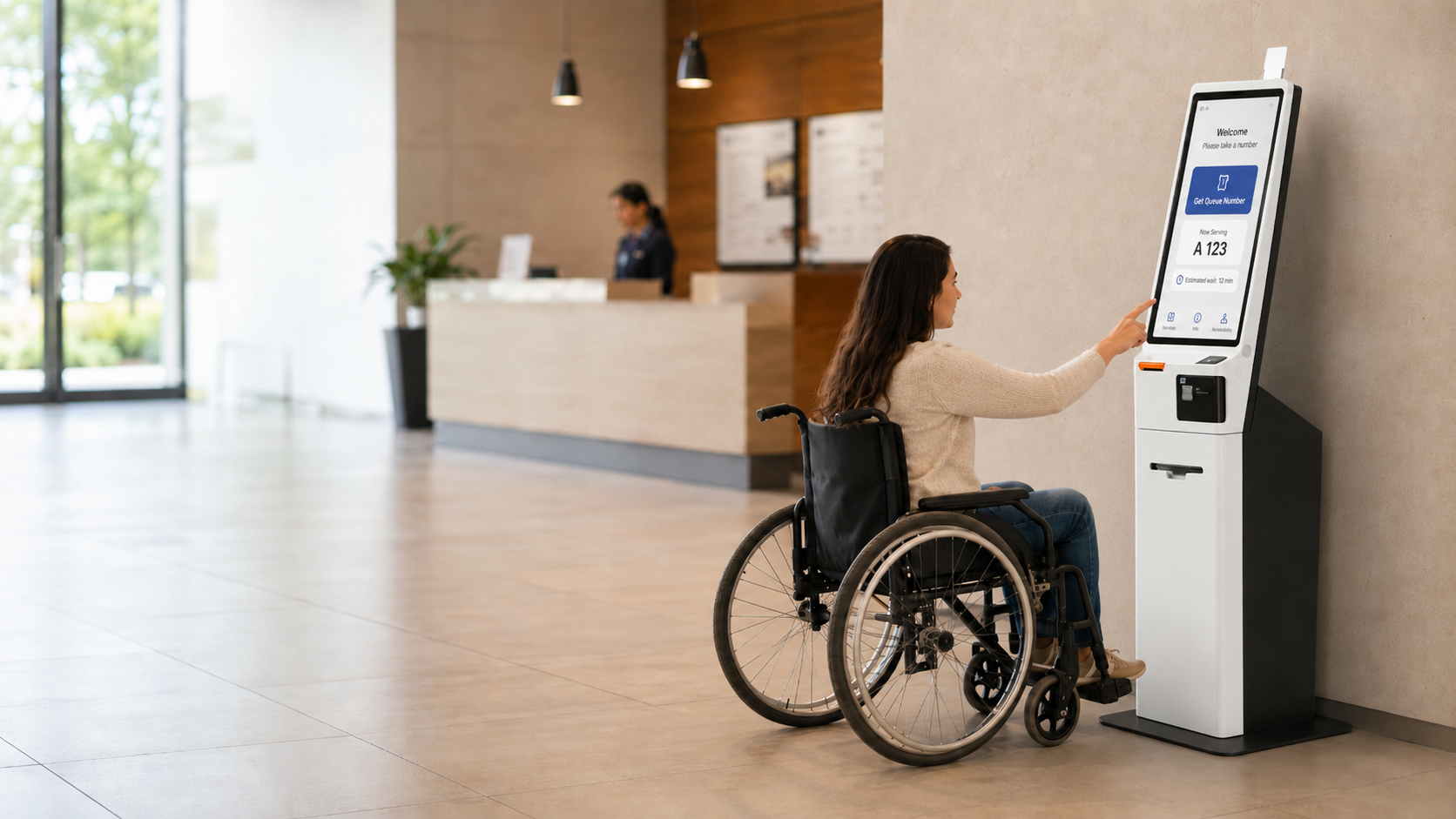
The US Department of Justice closed more than 4,000 ADA Title II and Title III enforcement actions in fiscal year 2024, and Rosper ships the SUNMI K2 self-service kiosk with ADA and Section 508 conformance documentation for every 2026 public-sector procurement.
The US Department of Justice closed more than 4,000 ADA Title II and Title III enforcement actions in fiscal year 2024, and the General Services Administration’s Section 508 ICT Testing Baseline now applies to every federal procurement that touches a public-facing self-service device. State and municipal procurement offices, hospital networks, and higher-education campuses are layering the same accessibility requirements on top of their own RFPs. A self-service kiosk that fails ADA reach ranges, lacks a tactile or audio path for users with visual impairment, or runs a non-accessible software layer is not just a poor user experience. It is a procurement risk that can stall a contract award, trigger a Section 508 audit finding, or force a hardware swap after deployment.
The public sector self-service kiosk market in North America is growing through 2026 across DMV walk-in offices, Veterans Affairs check-in lobbies, public health screening sites, university registration halls, and municipal services counters. Procurement teams in these channels are not chasing the lowest sticker price. They are scoring vendors on accessibility certification, North American warranty coverage, deployment lead times from an in-country warehouse, and the ability to coordinate a multi-site fleet rollout. SUNMI’s K2 standing kiosk and Flex 3 interactive display family are commercial-grade Android kiosk platforms that map to public sector requirements when paired with the right accessibility accessories, stand height, and software accessibility layer.
This ADA-compliant self-service kiosk guide is written for the buyer who has to justify a kiosk hardware choice to a procurement committee. The audience is a federal contracting officer scoping a public-facing kiosk for a GSA schedule order, a state or municipal procurement lead writing an RFP for DMV or city-services lobby kiosks, a hospital or health-system IT director rolling out patient check-in stations across multiple campuses, a higher-education campus IT lead deploying student services kiosks, or a prime contractor passing accessibility requirements down to a hardware vendor on a federal or state award. It is also written for the operations buyer at a nonprofit or workforce-development agency who needs an accessible kiosk for constituent intake.
Rosper Technology is the authorized SUNMI distributor for the United States and Canada and stocks the SUNMI K2 kiosk family and the Flex 3 interactive display family across 8 warehouses in North America. The footprint covers Los Angeles, Ontario CA, Dallas, Atlanta, New Jersey, Chicago, and a Brampton ON warehouse for Canadian customers. Public sector kiosk orders ship from a domestic warehouse within one business day for stock SKUs and arrive at the deployment site in 2 to 7 business days under the SUNMI manufacturer warranty, which is 3 years for current Gen 2 and Gen 3 kiosk platforms. Rosper supports federal, state, and local procurement through formal RFP and GSA workflows with an authorized distributor letter on letterhead, a parts list with stock keeping units, current lead times by warehouse, and accessibility documentation for the K2 and Flex 3 product lines.
What you’ll learn in this guide:
- What ADA and Section 508 actually require from a self-service kiosk, covering reach ranges, tactile and audio navigation, captioning, and operable controls.
- How public sector procurement scores a kiosk vendor across accessibility certification weight, warranty coverage, lead time, and fleet deployment capability.
- The SUNMI K2 standing kiosk specification mapped against ADA and Section 508 criteria, with accessory and stand configuration notes for public sector deployments.
- The SUNMI Flex 3 interactive display family as the secondary public sector kiosk option, including wall-mount and counter-top configurations.
- How Rosper supports public sector procurement, fleet warranty coordination, and multi-site deployment across the United States and Canada.
- FAQ on Section 508 audit findings, GSA schedule procurement, and accessibility accessory options.
Key takeaways
Quick definition: An ADA compliant self-service kiosk is a public-facing device that meets both ADA accessibility design guidelines (reach ranges, tactile controls, screen-reader audio jack) and Section 508 software accessibility for federal, state, and municipal procurement.
- An ADA compliant self-service kiosk requires more than a touch screen. It needs reachable controls, tactile or audio navigation for users with visual impairment, captioning or visual feedback for users with hearing impairment, and operable controls that do not require fine motor skills.
- For public sector RFP work, the kiosk hardware is one variable. Warranty coverage, lead time, North American stock, and the ability to coordinate fleet deployment across multiple sites are equally weighted in most procurement scoring rubrics.
- SUNMI’s K2 kiosk and Flex 3 interactive display family are commercial-grade, Android-based kiosk platforms that map to public sector requirements when paired with the right accessibility accessories, stand configuration, and software layer.
- Rosper is the authorized SUNMI distributor in the United States and Canada. We stock the kiosk lineup across 8 warehouses (8 warehouses across the US and Canada), coordinate SUNMI’s manufacturer warranty (3 years for Gen 2 and Gen 3 products), and support prime contractors and federal, state, and local agencies through formal procurement channels.
What an ADA Compliant Self-Service Kiosk Must Meet (ADA & Section 508)
Before evaluating hardware models, it helps to fix the regulatory baseline. Three frameworks govern accessible self-service kiosks in the United States.
The Americans with Disabilities Act (ADA) applies to public accommodations. For self-service kiosks, the relevant accessibility expectations come from the 2010 ADA Standards for Accessible Design and from the proposed and emerging kiosk-specific guidance under Title II and Title III. The high level requirement is that any service offered through a self-service kiosk must be accessible to people with disabilities.
Section 508 of the Rehabilitation Act applies to federal agencies and any contractor delivering technology to a federal customer. Section 508 references the Revised 508 Standards, which incorporate WCAG 2.0 Level AA for software and define hardware-level accessibility for self-contained closed products like kiosks.
State and local accessibility statutes in many states layer on top of ADA and Section 508. California’s Unruh Civil Rights Act and accessibility codes in New York, Illinois, and Massachusetts are common examples that come up in RFPs.
The practical translation for a hardware buyer is that a self-service kiosk used by the public should provide:
- Reach and height compliance: operable controls must be reachable from a wheelchair, generally within a 15 to 48 inch reach range, with the screen positioned to accommodate users who are seated.
- Operable controls without fine motor skill: large touch targets, optional physical buttons or a tactile keypad, and an option to avoid requiring simultaneous multi-touch gestures.
- Visual accessibility: high contrast display modes, support for assistive software, and an option to navigate the interface through audio with private listening.
- Hearing accessibility: visual confirmation of every audio cue, optional captioning, and a private headphone jack to deliver audio to users who would otherwise need a public speaker.
- Speech accessibility: where voice input is offered, an alternative text input path.
- Privacy of input: PIN entry and personal information input must be obscured from view, which generally translates to a tactile keypad or a privacy screen with audio cues.
A kiosk hardware platform that is going to clear these requirements needs a flexible chassis, multiple stand and mount options, an audio jack for private listening, a camera or sensor for height accommodation, a barcode or document scanner that does not require precise alignment, and a software environment that supports accessibility APIs.
How Public Sector Procurement Scores an ADA Compliant Self-Service Kiosk Vendor
ADA and Section 508 compliance is the floor, not the ceiling. Most government, healthcare, and education RFPs apply a weighted scoring rubric that evaluates several additional categories before awarding a contract. Understanding the rubric helps the prime contractor and the hardware vendor align on what to put in the proposal.
The categories that come up in nearly every public sector kiosk RFP we see are:
- Manufacturer warranty length and structure – the federal preference is for a multi-year manufacturer warranty, not a third-party extended plan. SUNMI’s Gen 2 and Gen 3 products carry a 3-year manufacturer warranty. Wear parts such as printer components, batteries, and chargers carry a 1-year warranty. The warranty is provided by SUNMI, and Rosper coordinates RMA on the buyer’s behalf.
- Lead time and US-based stock – many federal and state RFPs include a delivery clause that excludes vendors who cannot ship from domestic stock. Rosper operates 8 warehouses across the United States and Canada, with most in-stock orders shipping within 2 business days and arriving in 2 to 7 business days.
- Fleet management and remote maintenance – public sector kiosks are usually deployed across multiple sites and managed by a small central IT team. SUNMI hardware ships with SUNMI’s commercial device management platform included.
- Compliance documentation – FCC ID, UL listing, energy consumption disclosure, country of origin documentation, and the spec sheet for the bid response. Rosper provides these documents on request as part of the procurement workflow.
- Past performance and references – government RFPs commonly require evidence of similar deployments. Rosper has supported prime contractors delivering hardware to municipal, transit, healthcare, and education end customers across the United States and Canada.
The hardware alone does not win the procurement. The hardware plus the supporting documentation, warranty structure, and distribution capability is what gets a kiosk through a scoring rubric.
The SUNMI K2 ADA Compliant Self-Service Kiosk for Public Sector
The SUNMI K2 is SUNMI’s flagship floor-standing and countertop self-service kiosk. The base configuration runs on a Qualcomm octa-core processor up to 2.7 GHz, with 6 GB of RAM and 128 GB of storage, dual-band Wi-Fi covering 2.4 GHz, 5 GHz, and 6 GHz, and a built-in receipt printer with a Japanese Seiko print engine rated at up to 250 mm per second. The K2 is published in several configurations – a retail version, a restaurant version, a healthcare version, and an extendable version.
For public sector procurement, the configurations that come up most often are:
- Healthcare version – the healthcare configuration includes QR code scan, card payment via a paired SUNMI P-series terminal, receipt printing, optional medical card reading, and optional A4 or A5 laser printing. This is the configuration typically specified for patient check-in, pharmacy queue management, and hospital wayfinding.
- Extendable version – the extendable configuration adds passport reading, RFID identification, label printing, perforated invoice printing, ticket printing, automatic IC card issue, and IC card reading and writing. This is the configuration that fits municipal services, DMV-style transactions, library card issuance, and student ID workflows.
- Standard NFC and SoftPOS – the K2 ships with NFC and SoftPOS support, which lets the kiosk accept contactless payment for transactional government services without a separate physical card terminal.
The K2 is designed to accept a paired SUNMI P-series payment terminal in a customizable holder, which keeps the certified payment device separate from the kiosk display and lets the buyer specify a PCI PTS certified pin entry path. This matters for ADA compliance because a separate tactile pin pad is a common way to satisfy the “operable controls without sight” requirement for payment entry.
For accessibility, the K2 stand height, the screen size, and the option to specify a countertop or floor stand variant give a procurement team the flexibility to meet ADA reach and height ranges. A typical accessible deployment positions the floor stand K2 with the screen center between 40 and 48 inches above the floor, the receipt output above 15 inches above the floor, and a separate tactile pin pad positioned within reach of a seated user.
SUNMI Flex 3 as the interactive display layer
The SUNMI Flex 3 is SUNMI’s modular interactive display lineup. Flex 3 ships in three sizes – 18.5 inch, 22 inch, and 27 inch – and supports a 1920 by 1080 full HD bezel-less panel, 400 nits brightness, and an anti-fingerprint coating. The display runs on the same Qualcomm octa-core platform as the SUNMI K2, with up to 8 GB of RAM and 256 GB of storage. The Flex 3 has an integrated AI accelerator with up to 13 TOPS of computing power, which enables AI-powered voice interaction and AI-powered facial recognition as accessibility options.
For public sector deployment, the Flex 3 plays two roles:
- Standalone interactive display kiosk – the Flex 3 can be deployed in a retail stand, a floor stand, or a desktop stand configuration. Stand options include a POS stand for adding a payment terminal, a 3-in-1 NFC reader and MSR and barcode scanner, and a camera option for monocular, binocular, or 3D camera. This makes Flex 3 a strong choice for visitor registration, queue check-in, voter information, and library or campus information stations.
- Companion display for the K2 – the Flex 3 can be paired with the K2 or with another SUNMI device family to provide a larger secondary display for accessibility. A user who needs a larger viewport, higher contrast, or a different positioning can be served by the Flex 3 paired with audio output and a separate tactile control surface.
The AI-powered voice interaction on Flex 3 is the feature that turns this into an accessibility advantage. A blind or low-vision user can navigate the interface through natural language voice commands with private headphone output. The procurement team specifies the private listening jack as a hardware requirement in the bid, and the software layer activates voice navigation when a user inserts a headphone or selects an accessibility mode at the welcome screen.
A practical RFP-ready vendor checklist
A prime contractor scoping an ADA compliant self-service kiosk for a federal, state, healthcare, or education RFP can use this checklist when evaluating SUNMI hardware sourced through Rosper. Each item below maps to a clause that commonly appears in a public sector kiosk solicitation.
| Procurement requirement | Hardware feature | Rosper deliverable |
|---|---|---|
| ADA reach and height range | Multiple stand and mount options for K2 and Flex 3 | Configuration consultation pre-bid |
| Operable controls without sight | Audio jack, voice interaction, paired tactile pin pad | Spec sheet and accessory list |
| Operable controls without fine motor skill | Large touchscreen targets, large physical buttons on stand options | Hardware specification document |
| Visual accessibility | High brightness display, AI-powered voice interaction on Flex 3 | Datasheet excerpt and demo unit |
| Hearing accessibility | Visual feedback, audio jack for private listening, stereo speakers | Spec sheet |
| Privacy of input | Paired SUNMI P-series terminal with PCI PTS certified pin pad | LOA list and certification documentation |
| Manufacturer warranty | SUNMI 3-year warranty on Gen 2 and Gen 3 products, 1 year for wear parts | Warranty letter on Rosper letterhead |
| US-based stock and lead time | 8 warehouses across US and Canada, 2 to 7 day delivery | Stock confirmation letter |
| Compliance documentation | FCC ID, UL listing, country of origin, spec sheet | Document package on request |
| Fleet management | SUNMI commercial device management platform included | Deployment consultation |
| Past performance | Rosper deployments across municipal, healthcare, education | References on request |
The checklist is what the prime contractor should expect from the hardware vendor in the bid response package. Rosper can provide the corresponding documentation for any solicitation in the United States and Canada.
Warranty and post-deployment support
Warranty terms in a public sector contract are read carefully. The hardware buyer should know exactly what is covered, for how long, and who handles the claim.
For SUNMI hardware purchased through Rosper, the warranty structure is:
- Gen 1 products include a 1-year manufacturer warranty.
- Gen 2 products include a 3-year manufacturer warranty.
- Gen 3 products include a 3-year manufacturer warranty. Gen 3 products include the CPad, Flex 3, L3, D3 MINI, D3 PRO, P3, P3 MIX, T3, T3 PRO, V3, and V3 MIX.
- Wear parts such as printer components, batteries, chargers, and other consumable or wear parts are covered for 1 year regardless of product generation.
The warranty is provided by SUNMI. Rosper assists with warranty claims, helping the buyer connect with SUNMI faster. For multi-site public sector deployments, Rosper coordinates fleet warranty across all sites under a single point of contact, which removes the need for individual facility managers to navigate the manufacturer claim process. When downtime is not acceptable, Rosper can ship an emergency replacement from in-stock inventory once a warranty ticket is open.
How to start a public sector procurement conversation with Rosper
A prime contractor or agency buyer evaluating an ADA compliant self-service kiosk can start the conversation with Rosper at any stage of the procurement cycle. The fastest path is to share the solicitation document, the target deployment count, the deployment timeline, and the accessibility requirements list. Rosper will return a parts list, indicative pricing, lead time from US stock, the warranty letter, and the SUNMI documentation package required to complete the bid response.
For a small pilot before a large rollout, Rosper can ship a single K2 or Flex 3 configured to the target accessibility spec for evaluation under an existing purchase order or a pilot purchase. The pilot unit ships from US stock and can be returned or rolled into the larger order once the agency confirms the configuration.
Contact Rosper for a public sector kiosk procurement consultation – share your solicitation number, agency, and accessibility requirements, and we will respond with a parts list, documentation package, and a stock confirmation letter.
For the full SUNMI kiosk and self-service product lineup distributed by Rosper, see the product index. For other public sector and industry solutions, browse the Rosper industry solutions page.
Frequently asked questions
Is the SUNMI K2 ADA compliant out of the box?
The K2 is a configurable kiosk platform. ADA compliance depends on the stand height, the accessibility accessories specified, the software layer, and the deployment positioning. SUNMI publishes the hardware spec sheet, and Rosper helps the procurement team match the configuration to the ADA reach, height, and operable controls requirements for the specific deployment. A K2 configured with a paired tactile pin pad, audio jack output, and the correct floor stand variant is the configuration most procurement teams specify for ADA compliant public sector deployment.
What is the warranty on a SUNMI K2 or Flex 3 kiosk ordered through Rosper for a federal contract?
SUNMI’s official manufacturer warranty applies. The K2 is part of SUNMI’s Gen 2 family and includes a 3-year manufacturer warranty. The Flex 3 is a Gen 3 product and includes a 3-year manufacturer warranty. Wear parts such as printer components, batteries, and chargers are covered for 1 year. Rosper provides a warranty letter on letterhead suitable for the bid response and coordinates RMA across all deployed sites.
Can Rosper support a multi-site fleet deployment for a state or municipal agency?
Yes. Rosper coordinates multi-site fleet deployment across the United States and Canada from 8 warehouses, ships pre-configured devices to each end site, and manages warranty coordination across the entire fleet under a single point of contact. For accessibility-related re-configuration after deployment, Rosper can support remote re-imaging through SUNMI’s device management platform without dispatching a technician.
Does the SUNMI K2 kiosk accept federal payment cards and EBT?
The K2 accepts payment through a paired SUNMI P-series terminal. The P-series is PCI PTS certified for major card schemes. EBT acceptance depends on the payment processor and the EBT processor relationship – this is a software and processor decision, not a kiosk hardware decision. Rosper can recommend payment processor partners that have integrated with the SUNMI payment terminal for federal and state payment acceptance scenarios.
How long does it take to deliver a SUNMI kiosk for a federal or state agency?
Rosper stocks the SUNMI K2 and Flex 3 in US warehouses with most in-stock orders dispatching within 2 business days and delivery in 2 to 7 business days. For an order that requires a configuration outside the in-stock SKU set, lead time depends on configuration – share the spec with Rosper and we will return a confirmed lead time before the bid response is finalized.
Does Rosper provide a Letter of Authorization for SUNMI hardware in a federal RFP?
Yes. Rosper is the authorized SUNMI distributor in the United States and Canada and provides a Letter of Authorization confirming the distribution relationship and the warranty pass-through to the agency or prime contractor. The LOA, the spec sheet, the FCC and UL documentation, and the warranty letter are the documentation package that typically completes the hardware response in a federal solicitation.
For agencies ready to procure an ADA compliant self-service kiosk in 2026, contact Rosper to start a compliant procurement conversation.