
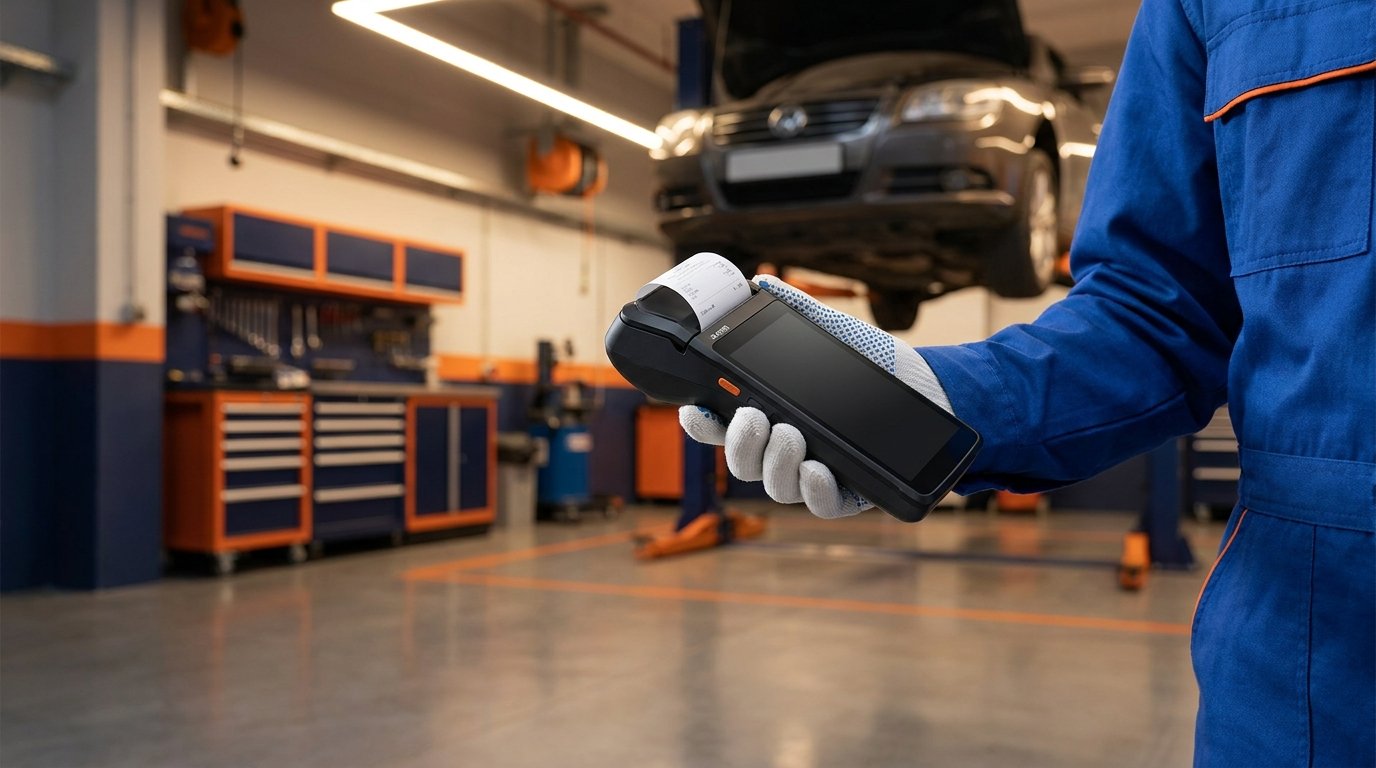
SUNMI POS auto repair hardware in 2026 is the operational lever for shops that moves the two metrics every independent shop owner watches: average tickets per bay per day, and customer wait time at pickup. A single in-bay V3 family handheld with EMV chip, contactless tap, and a built-in 80mm thermal printer eliminates the 8 to 15 minutes that customers historically spend in line at the front counter, which directly compounds bay throughput. For Rosper customers running 4-bay independent shops up through 25-location multi-shop franchise networks, this guide walks the device-count math, the in-bay payment workflow, shop management software integration, and the PCI compliance pattern that keeps audit scope tight.
Key takeaways
- A 4-bay independent auto repair shop in 2026 typically benefits from 1 counter terminal (T3 Pro) plus 2 to 3 handheld units (V3 family) for in-bay technician work orders and customer pickup payment.
- In-bay handheld payment with EMV chip and contactless tap eliminates the 8 to 15 minutes per ticket that customers historically spend waiting at the front counter, which directly compounds bay throughput in shops doing 20-plus tickets per day.
- A built-in 80mm thermal printer on the V3 Mix produces work-order and inspection slips at the bay without dispatching to the counter printer, which is the operational pattern that scales bay count cleanly past 6 bays.
- PCI semi-integrated payment architecture (POS calls a separate PCI-certified payment device for the card) keeps the shop management software out of PCI scope and constrains the merchant compliance burden to the payment device alone.
- Hardware payback for a 4-bay independent shop typically lands at 8 to 14 months, driven by faster ticket close-out and reduced counter-line wait times that lift technician billable hours per shift.
Why auto repair shops are upgrading POS hardware in 2026
Two structural pressures have pushed auto repair shops from “the credit card terminal at the counter is fine” to active POS hardware procurement in 2026. First, customer expectation has shifted: a customer who tapped their phone to pay at a coffee shop the morning of their service appointment expects the same tap-and-go experience when they pick up the vehicle. Shops still running magnetic-stripe-and-paper-receipt at the counter look 5 years behind the fast-casual-restaurant experience customers already live in. Second, PCI PTS device generation in service at most US auto shops is aging into mandatory replacement windows over the next 18 months, which creates a forced refresh cycle for shops that have not budgeted for it.
Best SUNMI POS auto repair hardware: 4-bay independent baseline
The working hardware baseline for an independent 4-bay shop doing 15 to 30 tickets per day:
- One SUNMI T3 Pro family counter terminal at the service writer desk for ticket creation, parts ordering, customer scheduling, and back-office report generation. The 15.6 inch touchscreen is large enough for the parts-lookup-plus-customer-record split-screen workflow that service writers run continuously.
- Two to three SUNMI V3 family handheld units positioned for in-bay work order printing, customer-facing card payment at the vehicle, and inspection slip printing. The built-in 80mm thermal printer eliminates the dispatch-to-counter-printer step that historically slows bay throughput.
- Optional: one SUNMI V3 Mix as a dedicated mobile checkout unit for customer pickup payment, which keeps the technician handhelds free for in-bay work orders.
For shops with 6-plus bays or 2-shift operations, add one handheld per additional 2 bays, and consider a second counter terminal at the parts desk to separate parts ordering from customer check-in workflow. For franchise networks running 10 or more locations, standardize on this same hardware lineup across every shop to consolidate device management, technician training, and warranty pipeline.
In-bay handheld payment: the 8-to-15 minute customer wait elimination
The single highest-impact operational change a shop owner can make in 2026 is moving customer payment from the front counter to the bay. The historical workflow: technician finishes the job, pulls vehicle to the lot, walks customer to the front counter, service writer pulls up the ticket, customer waits in line behind other customers, payment processes at the counter, customer leaves. Total wait time: 8 to 15 minutes per ticket in a typical 4-bay shop during the lunch and end-of-day rush.
The V3 family in-bay workflow: technician finishes the job, walks to the customer at the vehicle, presents the handheld with the ticket total on the customer-facing side of the screen, customer taps their phone or inserts their card on the handheld, transaction authorizes in 3 to 8 seconds, handheld prints the receipt on the built-in 80mm thermal printer, customer drives away. Total customer touch time at payment: 45 to 90 seconds. The reclaimed counter-line time directly returns to bay throughput because the service writer can focus on ticket creation and parts ordering instead of running a queue at the counter.
Rugged handheld POS for oil, grease, and drop-prone workshop environments
A standard handheld POS does not survive an auto repair shop for long. Coolant spray, oil on the tech’s gloves, brake dust from a rotor turn, and the 4-foot drop off a rolling tool cart are daily events. Auto repair shops need a handheld class that lasts the shop lease, not a 12-month consumer POS device.
The SUNMI P3H is the rugged Android handheld built for shop-floor abuse. IP65 rating handles brake-cleaner overspray and coolant mist, and the 1.5-meter drop spec covers the standard cart-height fall onto epoxy or concrete. The 6.75-inch handheld body has a built-in 2D scanner for VIN or work-order barcode capture, NFC for tap-to-pay, and a 3100 mAh hot-swap battery for a full 10-hour shift with one battery change.
The SUNMI V3 Mix is the bay-side ticket-close handheld: 80mm thermal printer prints the same work order and inspection receipt as the front counter T3 Pro, EMV plus NFC plus PCI PTS 6.x for the customer swipe or tap, and 1D/2D scanner for VIN and parts SKU capture. A V3 Mix at each 2-bay cluster lets the tech close the ticket in the bay, present the printed inspection report to the customer at the vehicle, and take payment without walking back to the counter.
The typical 4-bay shop fleet blueprint that combines rugged and standard handheld: 1 T3 Pro at the counter, 1 CPad Pay for customer signature and after-hours drop-off, 2 V3 Mix (one per 2-bay cluster) for bay-side ticket close, and 1 P3H for parts intake and receiving-dock stock verification. Total 5-device fleet on one SUNMI OS and one MDM console, ships from Rosper US warehouses in 3 to 5 business days.
Shop management software integration: semi-integrated payment
SUNMI hardware runs Android, which is the standard application platform for the major US auto shop management software in 2026. The integration model is standard semi-integrated payment and follows the same pattern used by every major Android POS deployment in restaurants, retail, and services:
- The shop management application (installed on the SUNMI device or accessed via a browser session) calculates the work order total and calls the payment device for the customer card.
- The payment device (a SUNMI V3 family handheld or a paired PCI-certified payment terminal) prompts the cardholder, captures and tokenizes the card, runs the authorization through the processor, and returns an approval token to the shop application.
- The shop application records the approval token against the work order and prints the customer receipt on the built-in 80mm thermal printer.
- No card number ever touches the shop management software or the shop Wi-Fi. PCI DSS audit scope is constrained to the payment device and the network segment that carries payment traffic.
For shop management software vendors offering an Android-native app, the application installs directly on the SUNMI device using the same Android package the vendor ships for any other Android POS deployment. For vendors running a web app or cloud console, the SUNMI device runs the browser and pairs with the payment device on the local shop network.
PCI compliance for auto repair shops: the semi-integrated advantage
PCI DSS compliance for an auto repair shop in 2026 is dramatically simpler when the shop runs a semi-integrated payment architecture instead of a payment-application-on-the-POS architecture. The relevant PCI authoritative reference is the PCI Security Standards Council PIN transaction device directory, which lists every payment-class device currently certified to the PCI PTS standard. Specifying SUNMI payment-class hardware (P2 handheld payment terminal or CPad Pay tablet payment device) by PCI PTS listing number in the merchant agreement constrains the shop’s annual compliance burden to the listed device and its network segment.
For an independent shop, this maps to a short PCI self-assessment questionnaire (SAQ B-IP or SAQ C-VT depending on the deployment configuration) rather than a full PCI DSS audit. For a multi-shop franchise, the same architecture lets the franchise corporate office run one PCI compliance program across every shop with the same questionnaire and the same evidence package, instead of per-shop audits that scale linearly with franchise size.
ROI math: 4-bay shop hardware payback in 8 to 14 months
Working ROI numbers for a 4-bay independent auto repair shop doing 20 tickets per day at a 350 USD average ticket:
- Hardware capex: 1 T3 Pro counter terminal + 3 V3 family handhelds + bench config + install lands in the four-to-low-five figure range depending on payment terminal pairing and shop management software setup costs.
- Bay throughput effect: reclaimed counter-wait time returns roughly 30 to 60 minutes of service writer time per shift, which lets the shop process 1 to 2 additional tickets per day at the same staffing level. At 350 USD average ticket and a typical 60 percent gross margin, that adds 60,000 to 130,000 USD of annual gross profit.
- Customer experience effect: shops report a 0.3 to 0.6 point Google review average uplift in the 12 months following an in-bay payment rollout, driven by reduced customer wait time and the “tap-and-go” experience that matches what customers expect from every other service they pay for in 2026.
- Hardware payback: 8 to 14 months for an independent 4-bay shop, with the remaining 4 to 5 years of hardware life compounding gross profit.
Multi-shop franchise rollout: 5 to 25 location playbook
For auto service franchises rolling out POS hardware across multiple shops, the operational pattern that protects franchise unit economics:
- Standardize on one hardware platform (counter + handheld) across every shop. Mixed-vendor fleets double the IT and training overhead and create payment terminal pairing gaps that surface as failed transactions at the worst possible moment.
- Specify in-country US stock and a 2 to 5 business day warranty swap SLA in the franchise vendor agreement. Auto shop floors are tough on consumer-grade hardware; warranty turnaround is what protects shop-level unit economics.
- Run the rollout in waves of 4 to 8 shops, 4 to 8 weeks per wave, with a coordinated rollout PM aligning to each shop’s slow-period schedule (typically Tuesday or Wednesday morning).
- Standardize the technician training video and the in-bay payment workflow so that staff turnover between shops does not break the in-bay workflow at any individual location.
- Anchor the procurement RFP on the distributor’s in-country stock position, warranty turnaround SLA, and ability to coordinate multi-shop wave installs – not on the unit price alone. For the US market, Rosper Technology is the authorized SUNMI distributor of record handling multi-shop auto service deployments.
When SUNMI POS hardware is not the right call for your shop
Two scenarios where the in-bay POS hardware math does not work in 2026. Single-bay independent shops doing 5 or fewer tickets per day rarely save enough counter-wait time to clear the hardware payback inside 18 months; the existing counter terminal usually covers the workflow. Quick-lube and oil-change-only operations with a 10 to 15 minute total customer dwell time often do not benefit from in-bay handheld payment because the customer is already at the counter by the time the work finishes; the counter-terminal-only configuration usually wins on TCO for these concepts.
Frequently asked questions
What is the best POS for an independent auto repair shop in 2026?
The best POS hardware platform for an auto repair shop is one that supports both counter and in-bay payment on the same OS with one device management console. The working baseline for an independent 4-bay shop is one full-size counter terminal (a SUNMI T3 Pro family unit at the service writer desk) plus 2 to 3 handheld terminals (SUNMI V3 family handheld with built-in thermal printer) for in-bay work order printing and customer pickup payment without dispatching back to the counter. Both devices run Android and integrate with the shop management software through a standard semi-integrated payment SDK.
Can I take payment at the bay with a SUNMI handheld?
Yes. The SUNMI V3 family handheld supports EMV chip, magnetic stripe, contactless tap (Apple Pay, Google Pay, Samsung Pay), and a built-in 80mm thermal printer for the customer receipt. The shop’s service writer or technician brings the handheld to the customer at the vehicle, completes the payment on the customer-facing side of the device, and prints the receipt on the spot. The standard workflow eliminates the 8 to 15 minutes per customer that historically gets spent waiting at the counter, which is one of the highest-impact ROI levers for shops doing 20-plus tickets per day.
How many POS devices does a 4-bay auto repair shop need?
Working baseline for an independent 4-bay shop: one full-size counter terminal at the service writer desk for ticket creation, parts ordering, customer scheduling, and report generation; two to three handheld terminals positioned for in-bay technician work orders, customer pickup payment, and inspection slip printing. For shops with 6-plus bays or multi-shift operations, add one handheld per additional 2 bays and consider a second counter terminal at the parts desk. For franchise networks running 10-plus locations, standardize on the same hardware platform across every site to consolidate device management, training, and warranty pipeline.
Does the SUNMI POS integrate with my shop management software?
SUNMI hardware runs Android, which is the standard application platform for the major US auto shop management software in 2026. The integration model is standard semi-integrated payment: the shop management application calculates the work order total and calls the payment device for the customer card, which returns an approval token. The shop application records the approval token against the work order and prints the receipt. For shop management software running an Android-native app, the application installs directly on the SUNMI device. For software running a web app or cloud console, the SUNMI device runs the browser and pairs with the payment device on the local network.
What is the warranty turnaround for SUNMI hardware in an auto repair environment?
Auto repair shop floors are tough on consumer-grade hardware: dust, fluids, drop hazards, and continuous shift use shorten the life of devices that were not built for the environment. The SUNMI V3 and T3 Pro hardware platforms are designed for the continuous shift duty cycle. Through an authorized US-stocking distributor (Rosper Technology for the US market), the standard warranty turnaround for hardware swap is 2 to 5 business days from claim approval to replacement on-site, with stocked units physically in-country to avoid the multi-week shipping delay that breaks shop operations.
What about PCI compliance for auto repair payments?
PCI DSS scope for an auto repair shop is constrained when the shop uses a semi-integrated payment architecture: the SUNMI Android device (counter or handheld) does not handle card data directly; instead, a separate PCI PTS certified payment device prompts the cardholder, captures and tokenizes the card, runs the authorization, and returns an approval token. The shop management software and the Android OS environment stay outside PCI cardholder data environment. The shop’s annual PCI compliance burden then covers the payment device and the network segment carrying payment traffic, not the entire shop IT environment. For most independent shops this maps to a short PCI self-assessment questionnaire rather than a full audit.
How long does deployment take for a 4-bay shop?
A typical 4-bay independent shop deployment through an authorized US distributor runs 2 to 4 weeks from PO to live: 1 week PO and hardware ship from US stock, 1 week shop management software install and payment terminal pairing, 1 week soft launch with staff training and bay workflow tuning. For multi-location auto service chains (5 to 25 locations), wave deployment runs 6 to 10 weeks across the full fleet with a coordinated rollout PM aligning to shop schedule constraints.
Talk to a SUNMI auto repair POS specialist
Rosper Technology is a US-stocking authorized SUNMI distributor handling auto repair, oil change, tire, and automotive service shop POS deployments across independent and franchise shop networks. For a 1-shop or 25-shop hardware quote, in-bay payment workflow consultation, or shop management software integration support, contact Rosper for an auto repair deployment plan and unit pricing.