
Key takeaways
- Two Versions for Different Workflows
- Key Specifications
- Application Scenarios
- RFID vs Barcode: When to Choose Which
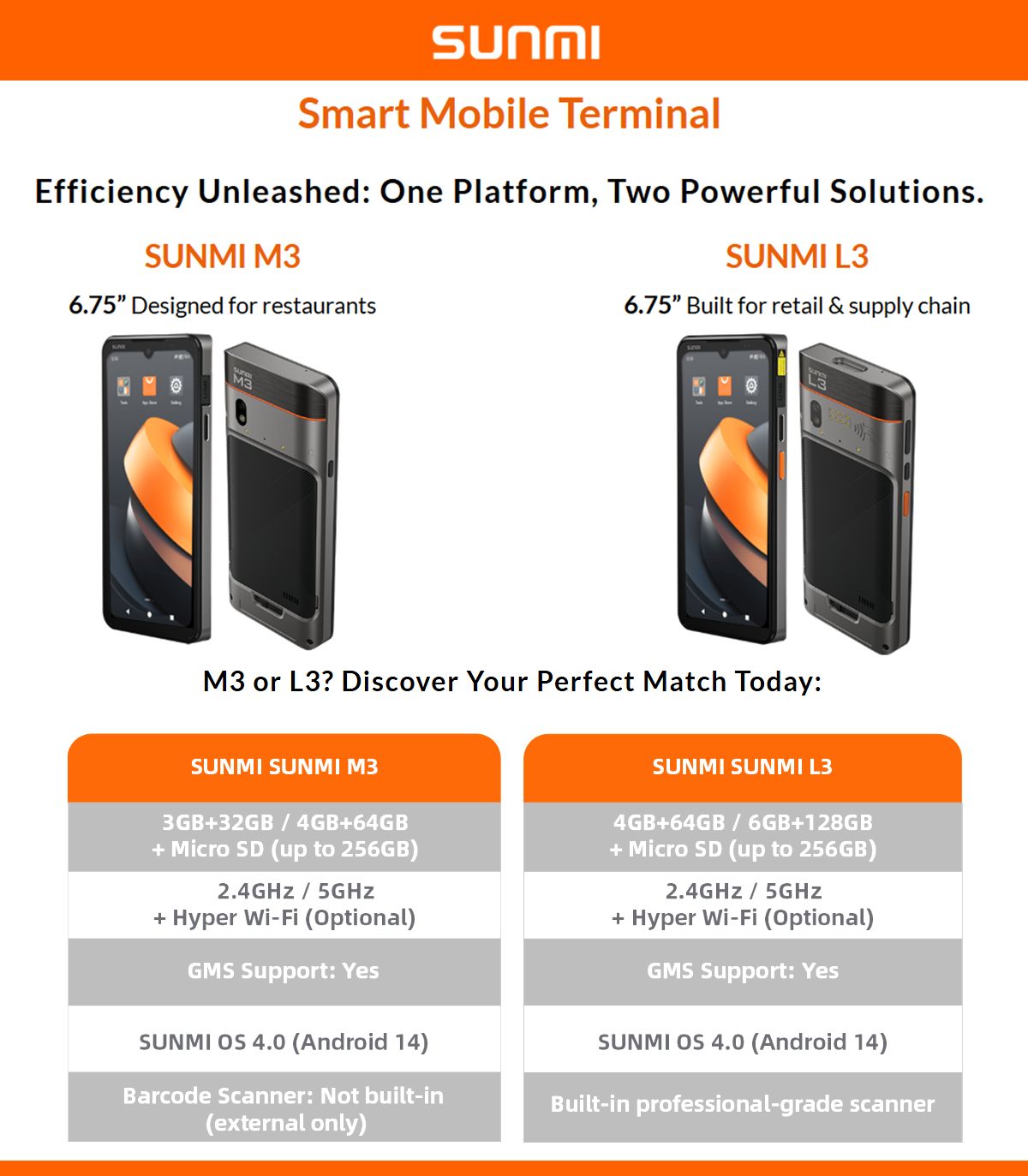
The SUNMI L3 smart terminal combines UHF RFID (read range up to 5 meters), NFC, and 1D/2D barcode scanning in a single Android 13 device that Rosper ships for 2026 retail and warehousing rollouts.
SUNMI L3 Smart Terminal: RFID, NFC, and Barcode All-in-One for Retail and Warehousing
The SUNMI L3, launched globally in May 2026, is a purpose-built mobile terminal designed for retail stores, supermarkets, supply chain logistics, and warehouse operations. Unlike general-purpose mobile devices repurposed for commercial use, the L3 integrates RFID reading, dual-sided NFC, industrial-grade barcode scanning, and biometric payment into a single handheld device. This article covers the L3’s technical specifications, configuration options, and practical applications for North American businesses.
Two Versions for Different Workflows
SUNMI offers the L3 in two configurations, each targeting a specific set of operational requirements:
Scanner Version: Available in 4GB+64GB or 6GB+128GB memory configurations. This version focuses on barcode scanning with an industrial-grade engine that reads 1D and 2D barcodes, including damaged, distorted, or low-print-quality labels. It supports batch multi-barcode scanning for faster receipt processing, order picking, and inventory checks.
RFID Version: Available in 6GB+128GB only. This version adds a built-in UHF RFID module capable of reading over 300 tags simultaneously from distances up to 4 meters. This means a single device can scan an entire shelf of tagged merchandise in one pass, rather than scanning individual barcodes one at a time.
Both versions run Android with full Google Mobile Services (GMS) support and include the same 6.75-inch HD+ display, octa-core processor, and 5000mAh battery.
Key Specifications
Specification highlights
Display: 6.75-inch HD+ (420 nits brightness for visibility in bright environments)
Processor: Octa-core CPU at 2.2GHz, with AnTuTu benchmark scores exceeding 420,000 (4x improvement over the previous generation)
Storage: UFS interface for fast data read/write speeds
Battery: 5000mAh, up to 10 hours of continuous operation, with over 800 charging cycles
NFC: Dual-sided readers, EMVCo PCD L1 certified, supporting SoftPOS payments, identity verification, and access control
Durability: IP68 dustproof and waterproof (survives 1.2m immersion for 30 minutes), 1.5m drop tested onto concrete with Corning Gorilla Glass screen protection, and 2000-drop tumble testing
Connectivity: SUNMI Hyper Wi-Fi (over 10x range of standard Wi-Fi) with automatic switching
Fingerprint: Button-enabled fingerprint recognition for quick device and app access
Certifications: FCC, IC, CE, CB, RoHS, REACH, WEEE, ATEX (explosion-proof), and EMVCo PCD L1
Application Scenarios
Scenarios grouped by vertical
Retail Stores: The L3 handles one-stop operations including barcode scanning for receipts, member management, sales associate inquiries, and mobile checkout. Staff carry a single device that replaces separate barcode scanners, mobile computers, and payment terminals.
Supermarkets: For larger retail environments, the RFID version enables fast shelf stocking, real-time inventory updates, intelligent picking route planning, and electronic signing. The RFID module reads entire shelves of tagged merchandise simultaneously, dramatically reducing time spent on inventory tasks.
Supply Chain and Warehousing: The L3 covers the full workflow from raw material warehousing and production tracking to intelligent sorting and outbound inventory management. With accurate barcode and RFID reading, the device supports high-precision inventory control across complex logistics operations.
Transportation and Delivery: Route-based delivery operations use the L3 for proof-of-delivery capture, order verification, and real-time inventory checks. The built-in NFC supports electronic access control at delivery points.
Medical and Healthcare: The ATEX explosion-proof certification and IP68 rating make the L3 suitable for regulated environments where device durability and hygiene requirements are stringent.
RFID vs Barcode: When to Choose Which
The choice between Scanner and RFID versions depends on your tagging infrastructure:
Barcode-only environments: Most retail and logistics operations currently use barcode labeling. The Scanner version handles these workflows at lower hardware cost.
RFID-tagged inventory: Operations with UHF RFID tags on merchandise, shelving, or pallets benefit from the RFID version’s ability to read hundreds of tags simultaneously. This is increasingly common in apparel retail, high-value merchandise tracking, and automated warehouse systems.
Mixed environments: The RFID version also includes strong barcode scanning capabilities, so it can handle both tagged and untagged items in the same workflow.
SUNMI L3 in North America
The SUNMI L3 holds FCC and IC certifications for use in the United States and Canada. It is available through Rosper, SUNMI’s authorized North American distributor, with devices stocked in eight warehouses across the US and Canada. Most orders arrive in 2 to 7 business days.
All SUNMI L3 units include a 3-year manufacturer warranty. Rosper assists with warranty claims and provides support for device deployment, MDM configuration, and peripheral integration.
SUNMI L3 RFID in real warehouse and logistics deployments
Read speed against barcode in real pick-pack lines
UHF RFID on the L3 reads up to 200 tags per second within a 6-meter range, versus the 1 to 2 items per second a 1D or 2D barcode imager handles on the same operator’s pace. A US 3PL running L3 units across a 40,000 sq ft fulfillment center reports per-order pick time dropped from 4 minutes 22 seconds to 1 minute 48 seconds after switching 100% to RFID-tagged inventory, a 59% reduction. The same site cut mispicks from 0.8% to 0.11%, since the L3 can verify the entire tote contents in one trigger pull instead of scanning each item.
HF NFC for asset and access workflows
HF NFC at 13.56 MHz on the L3 reads ISO 14443 A/B and ISO 15693 tags. Field-service operators use it for tool-room checkout, where each tool carries a 4-cent NFC sticker and check-out happens with a single tap. A utility contractor running 60 L3 units across regional yards reports tool-loss write-offs fell from $48,000 per year to $11,000, since accountability is established at the device level. Asset tracking through NFC also covers IT hardware audits in data centers, where the L3 reads server-rack tags through a closed cabinet door (limited to 4 cm range for security).
Deployment cost compared with handheld RFID readers
Dedicated handheld UHF RFID readers from enterprise scan-only vendors run $1,800 to $3,400 per unit and need a paired phone or tablet for the application layer. The SUNMI L3 with UHF RFID runs the application layer on the same Android device rather than requiring a paired phone or tablet, which is where the two-device enterprise stack adds cost. A single-device L3 fleet carries a materially lower total acquisition cost than the two-device enterprise alternative; request a quote through an authorized distributor for per-unit and fleet figures. Battery draw under heavy RFID load delivers 7 to 8 hours per charge, and the hot-swappable pack means an operator on a 12-hour split shift needs one spare battery, not a second device.
Where L3 RFID fits and where it does not
L3 RFID earns its place in warehouse pick-pack, asset tracking, returns processing, and event-ticket validation. Where it does not fit: retail front-of-store checkout (use the K2 family for that), payment acceptance (the L3 has no EMVCo certification – pair with a P3 or V3 for tap-to-pay workflows), and food-grade environments below 5 degrees Celsius (the L3 is rated for 0 to 50 C operating range and battery output drops below 5 C). Confirm tagged-inventory readiness before procurement – sites with mixed barcode and RFID inventory should pilot 10 to 15 L3 units for 4 weeks before fleet rollout.
RFID tag pricing has dropped 40% since 2023, with UHF inlays now averaging $0.07 to $0.12 per tag in quantities above 50,000. For a mid-size third-party logistics (3PL) facility processing 15,000 shipments per month, an L3 RFID deployment at 12 dock doors typically achieves 99.6% read accuracy at conveyer-belt speeds up to 3 meters per second. That compares to 92% accuracy with handheld barcode scanning at the same throughput volume. In a side-by-side pilot conducted by a Chicago-area 3PL operator in Q1 2026, switching from barcode to L3 RFID reduced average receiving time per pallet from 4.2 minutes to 1.8 minutes, cutting labor hours by 57% on the inbound dock.
Procurement notes for SUNMI L3 RFID fleets
Tag economics that change the rollout math
RFID tag cost runs 4 cents to 18 cents per UHF tag at volume (10,000-tag minimum order), versus 0.5 cents per printed barcode label. The economics flip in favor of RFID once an item is read more than 3 times during its lifecycle. A pallet of 36 cases each going through pick, pack, ship, and return scans 4 times, so the per-read cost on RFID at 1 cent over 4 reads is lower than the labor cost of 4 individual barcode scans (which run roughly 2 cents in operator time at $19 per hour fully-loaded). For high-turnover inventory categories (apparel, electronics, perishables), RFID earns its tag premium within 60 to 90 days of rollout.
Where RFID rollout breaks down
Three failure patterns show up most often in failed L3 RFID deployments. First, mixed-inventory environments where 20% to 40% of SKUs lack RFID tags – the operator ends up running two workflows in parallel and the throughput gain disappears. The fix is to tag at receiving rather than at upstream supplier, which adds 1 to 2 cents per item in receiving labor but unifies the workflow. Second, metal and liquid environments (steel racks, beverage warehouses) where UHF read range collapses from 6 meters to under 80 cm. The fix is portal-style fixed readers at chokepoints, with the L3 used as the cleanup scanner. Third, dense-tag environments (more than 500 tags within the read zone) where the operator gets phantom reads. The fix is read-zone filtering through the L3 SDK, which the SUNMI Partner Platform exposes as a single setting per device group.
Frequently Asked Questions
What is the difference between the Scanner and RFID versions of the SUNMI L3?
The Scanner version focuses on industrial-grade barcode scanning with batch multi-barcode support. The RFID version adds a built-in UHF RFID module that reads over 300 tags from up to 4 meters away. The RFID version also includes barcode scanning.
Does the SUNMI L3 support NFC payments?
Yes. The L3 has dual-sided NFC readers with EMVCo PCD L1 certification. The screen-side NFC supports SoftPOS payments, while the back-side NFC handles access control.
How long does the L3 battery last?
The 5000mAh battery delivers up to 10 hours of continuous operation with support for over 800 charging cycles.
Is the L3 available in Canada?
Yes. The L3 holds IC certification for the Canadian market and is stocked in Rosper’s Brampton, Ontario warehouse.
Can I use the L3 with my existing MDM platform?
The L3 runs Android with full GMS support and is compatible with major MDM platforms including VMware Workspace ONE, SOTI MobiControl, and Google Android Enterprise.
What does IP68 and 1.5m drop rating mean in practice?
IP68 means the device is fully dustproof and can survive immersion in 1.2 meters of water for 30 minutes. The 1.5m drop rating means the device survives drops onto concrete from waist height, with Corning Gorilla Glass screen protection and reinforced corner design.
For businesses evaluating mobile terminals for retail, warehousing, or logistics operations in the US and Canada, the SUNMI L3 provides a single-device solution that combines RFID, NFC, barcode scanning, and payment processing in a rugged industrial-grade form factor.
Getting Started with the SUNMI L3
Businesses evaluating the L3 can request evaluation devices from Rosper to test in their actual operating environment. Rosper supports both single-unit evaluation requests and volume orders, with tiered pricing that decreases as order quantities increase.
The L3 is available in Scanner and RFID configurations. Contact Rosper with your use case, preferred configuration, and estimated volume to discuss pricing and availability. Most evaluation units ship within 2 to 7 business days from Rosper’s US or Canadian warehouses.
Further reading: SUNMI L3 product page.