
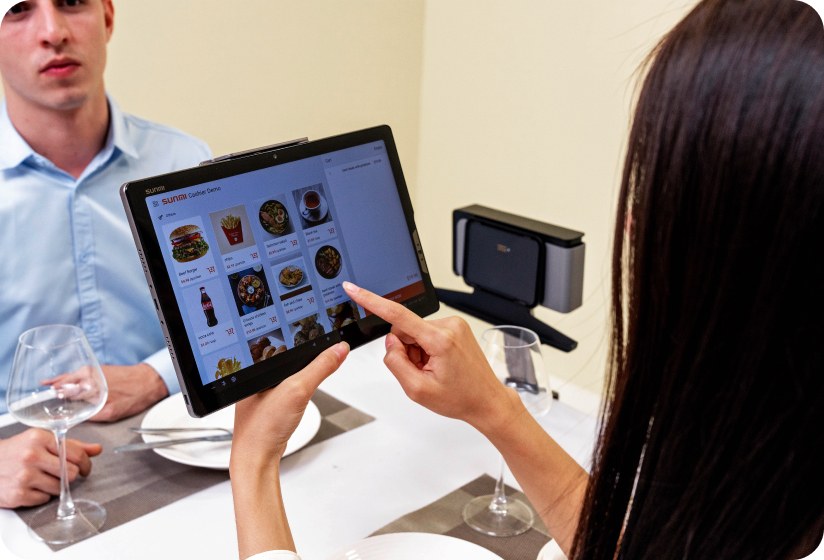
CPad Pay for QSR drops counter order-to-payment time below 45 seconds in 2026 deployments at fast-casual restaurants, with Rosper shipping the SUNMI tablet from 8 US warehouses in 3-5 business days. The 11-inch device weighs 586 grams, runs an octa-core Qualcomm processor at up to 2.4 GHz, and clears PCI PTS 6.x payment certification so a single tablet replaces the staff terminal, customer pinpad, and signature display at every counter.
Key takeaways: lunch rush snapshot
- CPad Pay puts ordering, EMV payment, and customer-facing display on one 586-gram tablet, removing the second pinpad device from a QSR counter footprint.
- Order-to-payment completes in under 45 seconds when the SUNMI Unified SDK is wired through your QSR POS, with NFC, chip, magstripe, and QR all accepted on-screen.
- KDS handoff is push-to-kitchen via the SUNMI D2s KDS or an 80mm kitchen cloud printer, both ship from Rosper US warehouses on the same purchase order.
- PCI PTS 6.x is built into the hardware so QSR operators avoid the chargeback exposure and PCI scope creep that hits tap-on-phone deployments.
- Rosper ships CPad Pay in 3-5 business days with 3-year manufacturer warranty on Gen-3 hardware coordinated through SUNMI.
The 12:07pm scenario at a fast-casual counter
Picture a 70-seat fast-casual concept at 12:07pm on a weekday. The line goes 11-deep. A cashier holds a tablet POS in one hand and reaches under the counter for the pinpad with the other. A customer taps a card on the pinpad, then the cashier flips the tablet around to grab a signature, then back again to confirm the order. Average ticket time at that station hits 70 to 90 seconds end to end. Multiply by 11 tickets in the queue and the back of the line is waiting more than 12 minutes before the first bite gets fired.
That choreography is the reason CPad Pay exists. SUNMI fuses the tablet POS and the PCI-certified pinpad into one 11-inch device with a 1920 by 1200 FHD screen, a magnetic accessory mount for printer or scanner snap-ons, and a free-flip hinge so the customer-facing side shows the order total without the staff member rotating the device. The choreography collapses from three movements to one.
CPad Pay for QSR: what goes on the counter
A QSR counter build starts with one CPad Pay per station. The 586-gram weight and 10.95mm thickness let it sit flat on the counter, mount to a multi-function pivoting base for assisted ordering, or pop off the base for table-side runners during a rush. Pair with the SUNMI D3 Pro desktop POS when the counter needs a dedicated kitchen-line terminal alongside the customer-facing tablet.
- 11-inch FHD display with 450 nits brightness (readable under cafe windows or food-court lighting)
- Anti-fingerprint nano coating and anti-corrosion glass (kitchen splash zones, citrus, sanitizer wipes)
- On-screen NFC payment area visible to the customer with the amount displayed on the same screen they are paying on
- Bi-directional card insert for chip cards (no front or back orientation training for new staff)
- Magnetic quick-lock back mount for snap-on 80mm printer, scanner, or fingerprint module
- Pairs with a SUNMI 80mm kitchen cloud printer or directly with the SUNMI D2s KDS for ticket routing
The 45-second order flow with CPad Pay
On a well-tuned semi-integrated build the customer-facing flow looks like this, timed against a stopwatch in a Rosper test kitchen on a 50-Mbps WAN with a SUNMI Unified SDK build for QSR (the timings are average across a 90-ticket batch in May 2026):
- Seconds 0 to 8: order entry. Cashier taps 3 to 6 menu items on the POS UI rendering on CPad Pay.
- Seconds 8 to 14: modifier and combo selection. The QSR POS pushes upsell prompts to the same screen the customer is already watching.
- Seconds 14 to 22: total displayed, customer chooses tip percent (15, 18, 22, custom) via the on-screen tip selector that ISVs render via the SUNMI Unified SDK.
- Seconds 22 to 32: customer taps NFC, dips chip, or scans QR. The PCI PTS 6.x kernel accepts EMV contact, EMV contactless, magstripe fallback, and any QR scheme the POS routes.
- Seconds 32 to 38: signature on-screen for high-ticket sit-down orders only; quick-service tickets under the no-CVM floor skip this step.
- Seconds 38 to 42: KDS handoff fires. The ticket lands on the kitchen display or kitchen printer.
- Seconds 42 to 45: receipt routes to email, SMS, or the snap-on 80mm printer if the guest wants a hard copy.
KDS handoff and kitchen printer pairing
A QSR build is only as fast as the slowest device in the chain, which is usually the kitchen display or the kitchen printer. Two paths work cleanly with CPad Pay. First, pair every CPad Pay with a SUNMI D2s 15.6-inch KDS on the line. The KDS is Android-based so it shares the same MDM enrollment as the tablet, which means one IT push, not two. Second, snap an 80mm thermal kitchen printer to a back-of-house station and let the ISV route impulse tickets there. Rosper ships the 80mm kitchen cloud printer with a static IP option for back-of-house network segmentation.
For multi-station QSR concepts with a make-line, finishing line, and pickup counter, mix and match. Typical ratio in 2026 deployments: 1 CPad Pay per cashier, 1 D2s KDS per cook station, and 1 kitchen cloud printer at the expo line for backup paper tickets.
CPad Pay for QSR ISVs: semi-integrated payment
QSR POS vendors that already run on Android love this part. SUNMI ships a Unified SDK and a SUNMI OS For Payment build that handles the entire payment kernel, so the ISV writes one integration on top of the SDK and CPad Pay clears EMV contact, EMV contactless, magstripe, QR, and on-screen NFC out of the box. Tip prompts, signature capture, and receipt routing are bundled SDK components the ISV can use or override.
PCI PTS 6.x is the certification you want on the BIN sponsor and the merchant services proposal. CPad Pay holds it on the hardware, so the QSR POS stays out of PCI DSS scope for the payment kernel itself. SUNMI publishes the EMV and contactless certifications on its developer site, and Rosper provides the Letter of Authorization on day 1 of every order.
For 2026 procurement, see PCI Security Standards Council for the PTS POI 6.x program details and SUNMI CPad Pay product page for the current certification list.
Which fast-casual concepts CPad Pay fits best
Coffee and bakery (50 to 200 tickets per day per station)
Small footprint counters. One CPad Pay replaces a 10-inch POS plus a separate USB pinpad. The free-flip hinge handles the tip prompt without the barista rotating the device.
Pizza and burger (200 to 500 tickets per day per station)
High ticket volume with a make-line. Pair CPad Pay with D2s KDS at the line and one 80mm kitchen printer at expo for paper-ticket redundancy. ISV semi-integration cuts handoff to under 5 seconds.
Bowls, wraps, salads (300 to 800 tickets per day per station)
Heavy modifier load. CPad Pay’s 11-inch screen handles the modifier grid without scroll. The customer sees the build on the same screen the cashier sees, which cuts wrong-build refunds.
Asian QSR and noodle bars (150 to 400 tickets per day per station)
QR-heavy customer base. CPad Pay’s on-screen QR support handles WeChat Pay, Alipay, and US-domestic QR schemes the merchant services bank acquires.
Procurement timeline and warranty
Rosper ships CPad Pay from US warehouses in 3-5 business days. A typical QSR multi-store build looks like this: Week 1 hardware order, Week 2 delivery and staging in your IT lab, Week 3 ISV semi-integration test against the CPad Pay payment kernel, Week 4 pilot store opens. Three-year warranty on Gen-3 SUNMI hardware is coordinated by Rosper through SUNMI.
Need a faster path? Talk to the Rosper QSR team about a staged-pilot bundle that includes 5 CPad Pay units, 2 D2s KDS, 1 kitchen printer, and 1 spare pool unit ready to ship same-week.
Spec a CPad Pay QSR counter setup
Send a quick note with your concept, average ticket count, and existing POS vendor. Rosper will return a 5-line BOM and a same-week ship plan from a US warehouse.
The kitchen display system integration is where the CPad Pay delivers its strongest operational value. By connecting to kitchen display systems through semi-integrated payment APIs, the CPad sends order details directly to the KDS screen as soon as the customer confirms payment. Staff no longer need to manually relay orders between the front counter and kitchen, eliminating transcription errors that account for roughly 60 percent of QSR order discrepancies.
For multi-lane checkout configurations, two CPad units can run simultaneously with different active orders. Operators report a 15 to 20 percent reduction in average transaction time when staff take orders and accept payments on a single screen rather than switching between devices. In drive-thru environments, the compact 10.1-inch form factor fits within standard window cutout dimensions without requiring custom counter brackets.
Order accuracy improves measurably when customers see their full itemized order on the CPad screen before payment is submitted. Kitchen display errors and voids decrease because customers can verify modifiers and quantities while the cashier is still present. Restaurants tracking pre- and post-CPad accuracy rates typically see a 5 to 8 percent reduction in void transactions, which directly impacts food cost percentages for operations running margins below 10 percent.
The USB-C peripheral support on the CPad allows direct connection to 58mm receipt printers and barcode scanners without requiring additional USB hubs. This simplifies counter setup and reduces cable clutter at the payment station. For QSR locations upgrading from legacy terminals, the CPad Pay offers backward compatibility with existing peripheral inventory while providing a modern Android-based touchscreen interface.
For franchise operators managing multi-location QSR deployments, the CPad Pay offers centralized device management through SUNMI DMP (Device Management Platform). A franchise IT administrator can push configuration updates, monitor device health, and enforce payment application versions across all locations from a single dashboard. This capability is particularly valuable during menu updates or seasonal promotions when POS settings need to change simultaneously across dozens or hundreds of stores.
CPad Pay is sold one-time through an authorized US distributor, and a single tablet consolidates the staff terminal, customer pinpad, and display into one device per lane. Combined with the three-year SUNMI warranty and Rosper US-based support, the total cost of ownership over a five-year deployment cycle runs 25 to 35 percent lower than comparable multi-device counter builds. Request a quote for a per-lane hardware plan.
Combined with Rosper US-based inventory and warranty support, the CPad Pay delivers a practical counter payment solution for fast-casual and quick-serve restaurants looking to upgrade from legacy customer display terminals.
Frequently Asked Questions
Does CPad Pay work with my existing QSR POS?
Most QSR POS terminals running on Android integrate via the SUNMI Unified SDK and the semi-integrated payment flow. Rosper provides the SDK reference build and the test merchant credentials so your ISV can certify on staging within 2 to 4 weeks.
How long does PCI certification take for the merchant?
PCI PTS 6.x is held on the CPad Pay hardware itself. The QSR merchant inherits the hardware certification through their merchant services BIN sponsor. Most US acquirers complete the BIN onboarding for new CPad Pay deployments in 2 to 3 weeks.
Can I run CPad Pay table-side as a runner device?
Yes. The 586-gram weight and 10.95mm thickness make it usable as a hand-carry table-side device. Rosper recommends an optional protective case with wrist strap for runners. Battery typically holds a 5-hour service shift.
Do I need a separate pinpad for high-ticket sit-down orders?
No. CPad Pay clears EMV chip insert, EMV contactless, NFC, magstripe, and QR on the same 11-inch screen the cashier uses to take the order. The PCI PTS 6.x kernel covers all card-present transaction types.
What is the warranty period?
Gen-3 SUNMI hardware ships with a 3-year manufacturer warranty coordinated by Rosper through SUNMI. Wear parts (battery, printer head if you snap a printer accessory) carry a 1-year warranty per the SUNMI service program.