
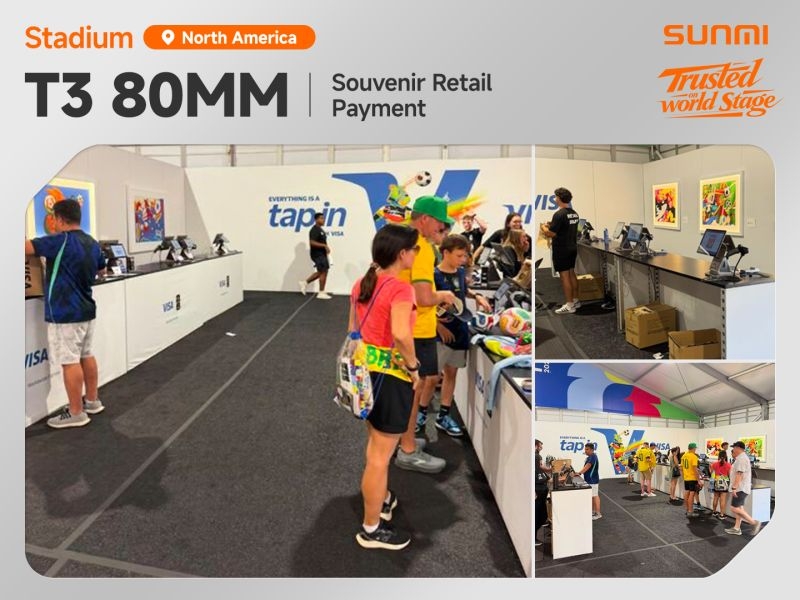
Stadium concession, arena merch checkout, and convention exhibitor floor payment in 2026 push the operational demands on POS hardware in a direction that ordinary retail and QSR terminals were not designed to survive. A 20K-seat arena at halftime, a 50K stadium at the end of the first quarter, or a 25K-attendee trade show at the coffee break each concentrate weeks of transactions into 15 to 30 minutes. This guide covers how the SUNMI T3 80MM counter terminal, the V3 Mix mobile line-buster, and the K2 Mini pop-up self-serve kiosk combine into a peak-traffic checkout stack that clears the intermission window instead of dropping revenue on the floor.
Key takeaways
- For stadium concession, arena merch, and convention peak-traffic checkout in 2026, the SUNMI T3 80MM counter terminal delivers a built-in 80mm thermal printer, a 15.6-inch Android touchscreen, and receipt throughput sized for events that push 60 to 120 transactions per hour per lane.
- Pair the T3 80MM counter workhorse with a V3 Mix mobile line-buster for line-busting on concourses and long lines outside the stand, so guests can pay in the queue before they reach the counter.
- Deploy the K2 Mini for pop-up self-serve zones (branded merch cart, digital menu ordering at the sports bar corner) where fixed cashier staffing is not economical for a 3-hour event window.
- Event ops teams should size hardware by peak transactions per hour, not average daily volume; a 20K-seat arena with a 20-minute intermission window sees peaks that dwarf the daily average of a QSR chain.
- Warranty turnaround matters more for event hardware than for continuous-shift retail; a dead terminal on game day loses the entire event revenue for that stand, which is why in-country stocked replacements with a 2 to 5 business day swap SLA protect the unit economics.
Why stadium and arena POS is a different problem than restaurant POS
Restaurant POS terminals are sized around the sustained shift: 5 to 8 hours of steady transactions with predictable table-turn cadence, a payment authorization pattern that spreads evenly across the shift, and a receipt volume that lets the built-in printer catch its breath between orders. Stadium concession, by contrast, does its entire day of revenue in three peaks: pre-game (60 minutes), the primary intermission window (12 to 20 minutes), and post-game merch (30 to 45 minutes). The counter terminal has to sustain 60 to 120 transactions per hour per lane during those windows with no queue relief, because the fans walk back to their seats when the whistle blows regardless of how long the line took.
This peak pattern reshapes every hardware decision. Receipt printer speed matters more than total daily print volume, because the intermission window prints continuously for 20 minutes without a break. Touchscreen response has to hold under 200 milliseconds because the cashier is running 30 to 40 seconds per ticket, not 90. Payment authorization has to clear inside 3 to 4 seconds because a 10-second latency multiplied across 300 tickets in the peak window is 50 minutes of lost sales. Compute headroom has to absorb the concessionaire menu, promotion engine, loyalty lookup, and printer driver all running under Android without stuttering during the surge. The T3 80MM is the SUNMI counter form factor sized for this profile.
The T3 80MM counter workhorse: 15.6-inch Android 13 with built-in printer
The T3 80MM is the counter-form Android POS terminal SUNMI ships with a 15.6-inch FHD touchscreen, an integrated 80mm thermal receipt printer, Android 13, and Qualcomm octa-core compute. For stadium concession stands and arena F&B counters, this is the workhorse that sits inside the stand under the menu board and clears the intermission surge:
- 15.6-inch FHD touchscreen sized for concession menus with 40 to 80 items visible in one grid, so cashiers can strike items directly without paging through a QSR-style tree menu that costs seconds per ticket.
- Integrated 80mm thermal printer with fast print speed for continuous receipt output during the intermission peak; the built-in form factor eliminates the external printer cable, the second USB port, and the second failure point per lane.
- Android 13 with security patches and long-term OS support, so the venue IT team can standardize on a single OS build across the fleet and manage device configuration through their MDM of choice.
- Qualcomm octa-core compute with enough headroom to run the concessionaire menu, promotion engine, loyalty lookup, integrated payment, and printer driver simultaneously without frame drops.
- Optional 10-inch customer display for tip prompt, order confirmation, and upsell messaging at the counter, without requiring a separate mounted screen and dedicated cable.
For a 20K-seat arena with 40 concession stands, the standardized T3 80MM SKU across all stands means the ops team can pool spares, pre-stage identical device builds, and train the event-week temp staff on one interface. Mixed-vendor fleets double the training overhead and multiply the spare-parts inventory.
V3 Mix as the mobile line-buster: pay in the queue, not at the counter
The V3 Mix is the handheld line-buster that shifts payment out of the counter queue and into the line itself. During the intermission window, a staff member walking the queue with a V3 Mix handheld can capture the order and take payment 30 to 60 feet upstream of the counter, so by the time the guest reaches the register the food is being handed over, not entered. This is the throughput multiplier that lets the same stand clear 30 to 50 percent more tickets in the same 20-minute peak.
- Handheld Android form factor with built-in 80mm thermal printer for guest receipts on the spot, so the line-buster does not have to walk the guest back to the counter for a printed slip.
- Integrated payment support (contactless tap, EMV chip, magnetic stripe) via paired payment terminal or built-in payment module depending on region and processor.
- Battery life sized for a 4-hour event shift without swap, with hot-swap battery options available for double-headers and all-day tournaments.
- Wi-Fi and 4G LTE connectivity so line-busters keep working when the concourse Wi-Fi backhaul saturates during the peak.
The line-buster tactic works only when the venue has a queue long enough to justify the staffing cost of the second cashier. For a 20K-seat arena, the threshold is typically 25 to 30 guests deep at the counter; below that, the counter alone clears the peak and the line-buster is under-utilized. Above that, every line-buster adds another 60 to 120 tickets per hour of throughput at the same stand.
K2 Mini for pop-up self-serve: branded merch cart, sports bar corner, digital menu ordering
The K2 Mini 10.1-inch countertop kiosk covers the pop-up self-serve zones where fixed cashier staffing is not economical for a 3-hour event window: the branded merch cart at section 108, the digital menu ordering point at the sports bar corner, the pop-up beer station at the concourse entrance, the loyalty program signup station. In each of these zones, the K2 Mini runs a self-serve ordering flow, takes the payment on the paired terminal, and prints a claim slip that the guest walks to the pickup window.
The self-serve pattern also opens up hours the venue would otherwise lose to staffing economics. Pre-game merch sales at the arena entrance can start 90 minutes before the first pitch on a K2 Mini kiosk with no dedicated cashier; the same guest who would have walked past a closed stand now picks up a hat and a program. Late-game concessions run past the last-call cutoff for staffed lanes because the kiosk keeps working without labor. For events on tight labor budgets, the K2 Mini extends the revenue window at both ends.
Sizing the fleet: peak transactions per hour, not average daily volume
The most common sizing mistake in stadium and arena POS procurement is to size the fleet against average daily volume. Vendors quoting Y terminals for X thousand daily transactions miss that the venue does not care about the daily average; the venue cares about the 20-minute intermission window where two-thirds of the day’s revenue is at risk. Size the fleet against peak transactions per hour per lane, not against total daily volume.
| Venue size | Peak-hour tx per stand | Recommended stack per main stand |
|---|---|---|
| 5K to 10K seat arena | 150 to 300 tx / hr | 1 T3 80MM counter + optional 1 V3 Mix line-buster during peak |
| 10K to 20K seat arena | 300 to 500 tx / hr | 2 T3 80MM counters + 1 to 2 V3 Mix line-busters + 1 K2 Mini pop-up |
| 20K to 50K seat stadium | 500 to 900 tx / hr | 3 T3 80MM counters + 2 to 4 V3 Mix line-busters + 1 to 2 K2 Mini pop-ups |
| 50K to 100K stadium | 900 to 1500 tx / hr | 4 to 6 T3 80MM counters + 3 to 6 V3 Mix line-busters + 2 to 4 K2 Mini pop-ups |
| Convention center (per exhibitor) | 60 to 200 tx / hr | 1 to 2 T3 80MM counters + 1 K2 Mini self-serve add-on |
The math is straightforward once framed against peak per stand. A 20K-seat arena with 30 stands doing an average 400 peak-hour transactions per stand needs a fleet that clears 12,000 transactions per hour across the venue, not the 2,000 to 3,000 the daily average suggests. Under-sizing against the average is the failure mode that leaves fans standing in line while the whistle blows.
Concessionaire and multi-vendor deployments: standardize the hardware SKU
Large venues typically run concession, merch, box office, and convention F&B through different vendors: an F&B concessionaire (a major stadium operator or a regional foodservice firm), a merch operator, a box office ticketing partner, and often a separate premium suite operator. Each vendor has their own back-of-house software, their own loyalty program, and their own accounting system. What they can share is the hardware SKU.
For venue IT and ops, standardizing on the T3 80MM across every vendor eliminates the multi-SKU spare parts problem, cuts training costs for event-week temp staff, and lets the venue own the MDM baseline and network configuration once. Each vendor’s application still runs its own workflow, but the underlying Android device is the same across the venue. For multi-venue operators (a stadium group operating 8 to 15 venues nationally), the same standardization argument compounds: one hardware fleet, one warranty pipeline, one deployment playbook.
Event-day support: pre-staging, spares at the loading dock, and warranty turnaround
Event hardware failure has a different cost profile than continuous-shift retail failure. A dead terminal on game day loses the entire revenue for that stand for that event, not a fraction of a shift. Rosper supports stadium and arena deployments with pre-configured units shipped to the venue loading dock (MDM enrollment, application install, network provisioning done before the device leaves the warehouse), event-day spares positioned at the venue for in-event swap, and a 2 to 5 business day standard warranty swap SLA across our 8 US and Canadian warehouses.
- City of Industry, CA (main West Coast hub, x2 facilities)
- Ontario, CA (secondary West Coast)
- Tracy, CA (northern California)
- The Colony, TX (South and Central US)
- McLean, VA (mid-Atlantic and East Coast)
- Allentown, PA (Northeast)
- Brampton, ON (Canadian market)
Gen 3 T3 80MM units carry a 3-year manufacturer warranty; Rosper assists with warranty claims, helping you connect with SUNMI faster and coordinating the replacement swap through our in-country stock. For high-profile venues on tight event calendars (playoff hosts, All-Star venues, primary convention halls), we coordinate loading-dock spare positioning ahead of the event week so the on-site team has same-day swap capacity.
Network and connectivity: what breaks on game day
Venue Wi-Fi backhaul is the single most common reason POS terminals stall during peak events, not the terminal itself. When 20,000 phones start hitting the venue Wi-Fi at the gates, the concession Wi-Fi VLAN often saturates alongside them if the venue network was not partitioned. The mitigations that hold up:
- Dedicate a physically separate SSID and VLAN for POS traffic, with QoS priority ahead of guest Wi-Fi. This is a venue network configuration, not a terminal setting, but it is the single highest-leverage change.
- Wire the counter T3 80MM units to Ethernet via the built-in RJ45 port. The counter never moves during the event, so wired backhaul removes the Wi-Fi variable entirely for the primary lanes.
- Provision V3 Mix line-busters with both Wi-Fi and 4G LTE, so when the concourse Wi-Fi saturates the handhelds fail over to cellular without a cashier reboot.
- Test peak-load network capacity at least 60 minutes before doors open, not during the intermission peak. A saturated backhaul is easier to fix at 5 PM than at 9 PM.
Convention center use case: exhibitor booths, badge scanning, and rolling event calendars
Convention center deployments have a different profile than stadium and arena. The venue runs a rolling 3 to 8 event cycle per month, each event brings different exhibitors, and the F&B and merch operators serve the whole hall through 20 to 60 stands that all reset between events. The T3 80MM 15.6-inch touchscreen suits exhibitor booths where the sales agent needs a large screen for product configurator flows, and the built-in 80mm printer handles the receipt without adding a second device to the booth counter that already has a demo laptop and a signage tablet fighting for space.
For convention floor F&B, the K2 Mini self-serve kiosk covers the coffee-and-pastry cart where a full staffed counter is not economical for the 30-minute coffee break, and the V3 Mix line-buster covers the lunch rush across the coffee stands and salad bars. Venue IT can own the MDM baseline (application per event, network per event, receipt template per operator) and reset the fleet between events without physical touch on each device. Rosper handles the event-cycle staging so the venue IT team is not the bottleneck.
Get a stadium and arena POS deployment plan
Rosper is a US and Canadian stocking authorized SUNMI partner handling stadium, arena, and convention center hardware deployments across 8 warehouses. For a peak-traffic sizing model, multi-vendor fleet standardization plan, or event-day support consultation, talk to a Rosper venue specialist.
Related Rosper deployment guides: for lottery retailers and sports betting kiosks with V3H handhelds, see SUNMI handheld POS for lottery and sports betting. For taxi, rideshare, and hotel shuttle fleet EMV payment terminals, see CPad Pay for taxi and rideshare in-vehicle payment.
When SUNMI T3 80MM is not the right call for your venue
Two scenarios where the math does not work in 2026. Very small venues under 3,000 capacity with a single concession stand doing under 50 peak-hour transactions typically get more value from a compact handheld like the V3 Mix used as the counter device, because the counter volume does not justify the 15.6-inch footprint. Full-service premium hospitality suites (executive boxes, chef-driven private dining) usually need a smaller tablet-form terminal because the suite server is working table-side, not at a fixed counter, and the receipt volume does not match the peak-traffic model.
ROI math: event-day revenue capture, not per-terminal cost
Stadium and arena POS procurement is often framed as a cost per terminal, which misses the real driver: event-day revenue capture. A stand that clears 400 peak-hour transactions instead of 260 (a 54 percent lift from adding one V3 Mix line-buster) captures 140 additional tickets at a 12 to 18 USD stadium concession average, or 1,680 to 2,520 USD of incremental revenue per stand per event. Across a 30-stand venue with 15 events per year, that math clears 750K to 1.1M USD of incremental annual revenue, an order of magnitude above the hardware fleet cost.
The framing that matters is not price per terminal; it is revenue per event, per stand. The T3 80MM counter plus V3 Mix line-buster stack was designed against this framing, and it pays back inside the first playoff series for most venues.
Frequently asked questions
What is the best Android POS for stadium and arena concession checkout in 2026?The best Android POS for a stadium or arena concession stand is a counter terminal with a built-in 80mm thermal printer, a large touchscreen (15 inch or larger), and enough compute headroom to run the concessionaire back-of-house software without lag during the halftime rush. The SUNMI T3 80MM covers this baseline: 15.6-inch FHD Android 13 touchscreen, integrated 80mm receipt printer, and Qualcomm octa-core compute for high transaction density. For 20K to 100K capacity venues, pair the T3 80MM counter workhorse with V3 Mix handhelds for line-busting on the concourse.
How many POS terminals does a stadium concession stand need?Working baseline sized by peak transactions per hour, not average daily volume. A single-window concession stand at a 20K-seat arena typically needs 2 to 3 counter terminals to clear the 20-minute intermission window at 60 to 120 transactions per hour per lane. A large stadium main F&B stand (50K to 100K capacity) at halftime often needs 4 to 6 counter terminals plus 2 to 4 V3 Mix line-buster handhelds working the queue. Convention exhibitor booths generally run 1 to 2 counter terminals plus 1 K2 Mini for self-serve add-ons.
Why does the T3 80MM built-in printer matter for events?Event checkout throughput is capped by receipt printing at least as much as by payment authorization, because peak-hour lines print continuously for the intermission window. A built-in 80mm printer on the T3 80MM eliminates the second device (external printer plus USB cable plus separate power) that the concession lane would otherwise need, reducing the failure surface at the lane and cutting the physical footprint at a tight countertop. It also drops the deployment SKU count when standardizing across 40 to 80 stands at a large venue.
Can the T3 80MM handle box office and ticket resale scanning?Yes. The T3 80MM 15.6-inch touchscreen runs Android 13 and supports third-party box office ticketing applications distributed through Google Play or sideloaded via mobile device management (MDM). For ticket barcode scanning at box office windows, pair the T3 80MM with a USB or Bluetooth 2D barcode scanner; the counter terminal handles the ticket lookup, seat assignment, upgrade payment, and printed receipt on the built-in 80mm printer. For rush-window will-call and ticket resale kiosks, this is the counter-form workhorse.
What is the deployment approach for convention centers and multi-hall venues?Convention center deployments typically run 40 to 200 T3 80MM terminals plus mobile line-busters spread across concessionaire stands, exhibitor booths, coffee kiosks, and box office windows, with a rolling 3 to 8 event cycle per month. Standardize on a single hardware SKU across the venue so IT can pre-stage, ship, and pool spares. Rosper handles the pre-configuration (MDM enrollment, application install, network provisioning) before shipping the units to the venue loading dock so the on-site team can rack and go, not spend event week building devices.
What warranty protection do event operators need for peak-day hardware failure?Event hardware failure has a different cost profile than continuous-shift retail failure. A dead terminal on game day loses the entire revenue for that stand for that event, not a fraction of a shift. Rosper stocks SUNMI T3 80MM inventory in 8 US and Canadian warehouses (City of Industry CA times 2, Ontario CA, Tracy CA, The Colony TX, McLean VA, Allentown PA, Brampton ON) with a 2 to 5 business day standard warranty swap SLA. Gen 3 terminals carry a 3-year warranty; Rosper assists with warranty claims, helping you connect with SUNMI faster. For venues with tight event calendars, we also pre-position event-day spares at the loading dock so a bad unit gets swapped inside the event window, not next-day-air a week later.