
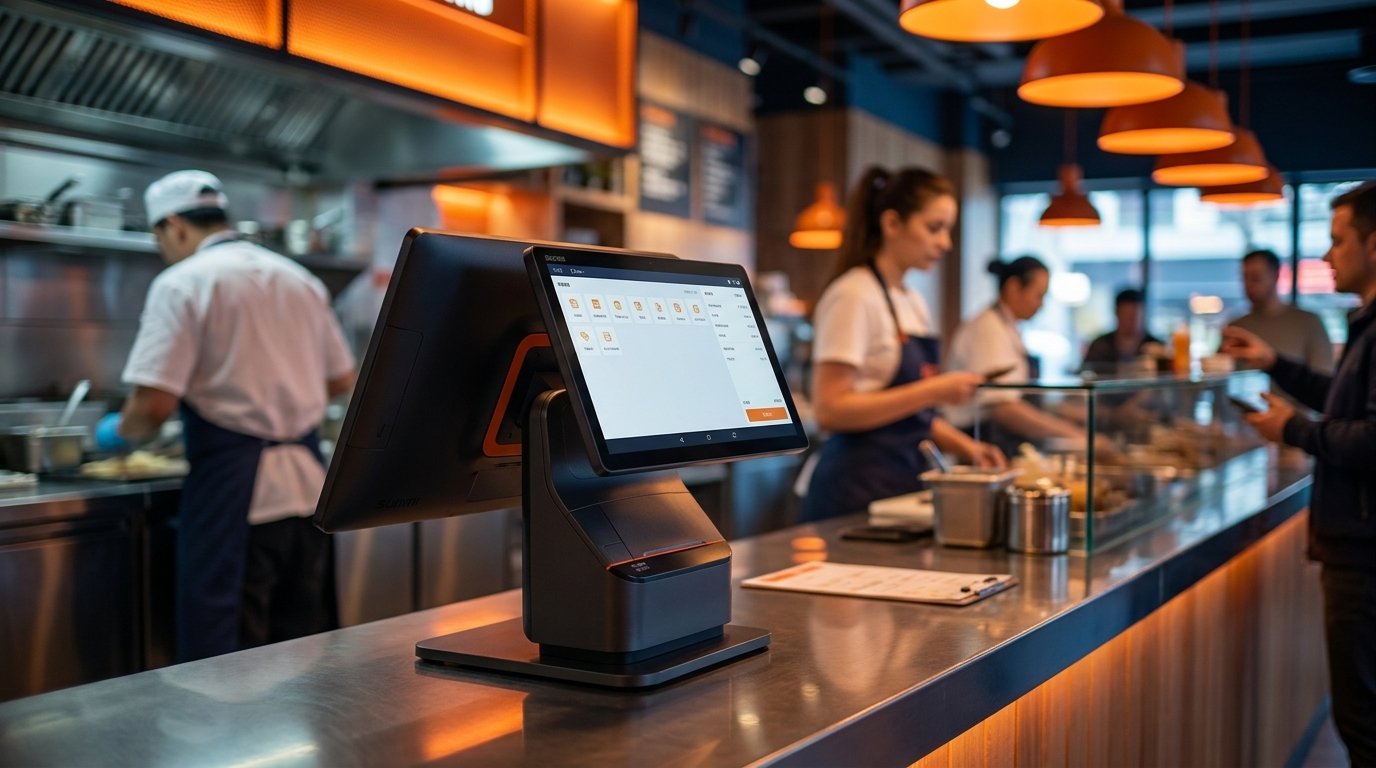
A restaurant chain does not buy POS terminals the way a single restaurant does. A single location can afford to pick the cheapest device that meets today’s needs. A chain that runs 20, 50, or 200 sites has to think about fleet standardization, spare pools, MDM, multi-market shipping, and warranty coordination on top of the unit price.
This POS terminal buying guide is the framework Rosper uses when quoting POS terminals for restaurant chains in the US and Canada. It covers the seven decisions that decide whether a rollout ships on time or slips by a quarter.
How to use this POS terminal buying guide
Read this POS terminal buying guide as a sequence. Each decision below builds on the previous one, from SKU standardization to Android Enterprise fleet management and total cost of ownership, so a chain can specify hardware once and roll it out across every location without surprises.
Decision 1: Standardize on One or Two SKUs
The single highest impact decision in a chain POS refresh is SKU standardization. Most chains end up with a sprawl of hardware across their fleet after years of individual store purchases. That sprawl gets expensive.
Three or four SKUs across the fleet means three or four spare pools, three or four training modules, three or four warranty tracks, and three or four MDM configurations. Consolidating to one primary SKU (and at most one secondary SKU for edge cases) cuts operational overhead dramatically.
Recommended primary SKU: SUNMI T3 Pro GMS
For most restaurant chains, Rosper recommends the SUNMI T3 Pro GMS (P01240007) as the primary counter POS. It runs Android 13 with GMS-EDLA, has a 15.6 inch FHD flippable staff display, Wi-Fi 6E, Bluetooth 5.2, and four USB-A ports plus RJ12 for a cash drawer. The chassis is aluminum alloy and rated for 100,000 plus display flips.
Recommended secondary SKU: SUNMI L2s Pro or CPad 11
For handheld tableside ordering or line busting, the standard secondary SKU is either the SUNMI CPad 11 4G (P10020042 or P10020044 with scanner) or the SUNMI V3 MIX (P06080020) if you need a built-in printer in the handheld itself. Whichever you pick, keep it consistent across every location. Two handheld SKUs across a 40 store chain is one too many.
Decision 2: Fleet Consistency Across Markets
Chains that operate in both the US and Canada need to think about market-specific hardware requirements before they buy. Payment certification, receipt regulations, and shipping duties all diverge across the border.
US and Canadian shipping and duties
Rosper stocks SUNMI hardware at 8 warehouses across the US and 1 warehouse in Brampton, Ontario. Canadian stores get their hardware from Brampton, which avoids cross-border customs delay and duty. US stores ship from the closest warehouse. Typical delivery is 2 to 7 business days for either market.
Certification and receipt regulations
Quebec has specific fiscal receipt requirements that some POS platforms handle through a fiscal printer or a fiscal software module. If your chain includes Quebec locations, confirm your POS platform is Revenu Quebec compliant before you pick hardware. The physical POS terminal is usually agnostic. The compliance work is in the software.
Decision 3: Peripheral Spare Pool
The single biggest cost saver over the life of the fleet is a well-sized peripheral spare pool. Instead of buying spare full terminals, most chains buy spare peripherals (printers, cash drawers, scanners) and let the modular POS chassis stay in service.
Recommended spare ratios
A typical restaurant chain holds 8 to 10 percent spare peripheral inventory relative to the deployed fleet. That covers normal failure rates without tying up excessive capital. Chains with high volume or 24 hour operations should hold 12 to 15 percent.
Where to hold the spare pool
Centralized spare pool at the chain HQ is easiest to manage but slower to reach remote stores. Regional spare pools distributed across 3 to 5 regional depots reach individual stores faster but tie up more capital and require more inventory tracking. Rosper works with chain customers on both models and can hold advance replacement inventory dedicated to specific customer accounts.
Decision 4: MDM and Fleet Management
A restaurant chain running Android POS terminals without a mobile device management platform is running blind. Software updates cannot be pushed centrally. Security policies cannot be enforced. Rogue apps get installed. Devices drift out of compliance.
SUNMI DMP for SUNMI-only fleets
SUNMI DMP (device management platform) is the free MDM that ships with SUNMI Android hardware. It handles OS updates, remote lockdown, kiosk mode, and basic device health monitoring. For chains that run a SUNMI-standardized fleet, DMP is a sensible starting point.
Android Enterprise for mixed fleets
Chains that run a mix of Android POS from multiple vendors, or that already use Android Enterprise for phones and tablets, typically enroll SUNMI POS terminals into Android Enterprise. SUNMI hardware supports Android Enterprise fully management and zero-touch enrollment through a registered reseller.
Decision 5: Warranty and Advance Replacement
In a chain, warranty is not about individual devices. It is about fleet uptime. The math your operations team cares about is how quickly a failed unit gets replaced, not what the warranty document says.
Warranty terms by generation
SUNMI warranty coverage varies by product generation. Gen 1 hardware carries a 1 year warranty. Gen 2 and 3 hardware carries a 3 year warranty. Wear parts (printers, batteries) carry a 1 year warranty. Rosper assists with warranty claims coordination between the chain and SUNMI.
Advance replacement SLA
For chain customers, Rosper offers advance replacement out of our US and Canada warehouses. A failed unit is confirmed, a replacement ships from the closest warehouse the same day or the next business day, and the failed unit is returned to us on its own timeline. Typical replacement arrival is 2 to 5 business days.
Decision 6: Rollout Sequencing
A chain POS refresh works best as a phased rollout, not a big bang. The wave structure that Rosper sees succeed most often is: pilot store first, then 5 to 10 stores per wave with 2 week buffers between waves, then the remainder in larger waves after the process is repeatable.
The pilot store surfaces integration issues, staff training gaps, and hardware quirks. Fix those before the first wave. Then use each wave buffer to catch issues that only appear at scale (network load on a shared VPN, MDM policy conflicts, unexpected menu variations).
Decision 7: Total Cost of Ownership
The number that matters in any POS terminal buying guide is not the sticker price of the terminal. It is the total cost of ownership over the expected life of the fleet. For a typical restaurant chain, that means 5 years.
| Cost line | What it includes | Typical share of 5-year TCO |
|---|---|---|
| Terminal hardware | POS chassis, cash drawer, printer, scanner | 35 to 45 percent |
| Peripheral spares | Printers, cash drawers, scanners, keyboards | 5 to 10 percent |
| Install and staging | Pre-staging, in-store setup, staff training | 10 to 15 percent |
| Warranty and replacement | Advance replacement, RMA logistics | 5 to 8 percent |
| MDM and software | MDM licenses, kiosk mode, remote support | 5 to 12 percent |
| POS software | Per station per month, or per-transaction fees | 25 to 35 percent |
Rosper deployment observation
The single biggest chain TCO lever Rosper sees is pre-staging. Chains that pre-stage POS terminals before shipping to individual stores cut install cost by 40 to 60 percent versus in-store technician deployment. On a 50 store rollout, that is often 30 to 50 thousand dollars saved.
Frequently Asked Questions
How many SKUs should a restaurant chain standardize on for POS?
Most chains do best with one primary counter POS SKU and one secondary handheld SKU. That gives fleet consistency, simplifies MDM, and keeps spare pool costs manageable. Additional SKUs for special cases (kiosks, kitchen displays) are fine as separate categories.
What is the best POS terminal for a US and Canada restaurant chain in 2026?
Rosper recommends the SUNMI T3 Pro GMS (P01240007) as the primary counter POS for most US and Canadian chains. It carries Android 13 with GMS-EDLA, a 15.6 inch flippable display, Wi-Fi 6E, and support for both direct staging and Android Enterprise zero-touch enrollment.
How do I plan a peripheral spare pool for a 40-store restaurant chain?
Hold 8 to 10 percent spare peripheral inventory relative to the deployed fleet. For 40 stores running 3 POS stations each (120 stations total), that means about 10 to 12 spare printers, 8 to 10 spare cash drawers, and 8 to 10 spare scanners.
Do SUNMI POS terminals work with Android Enterprise MDM?
Yes. SUNMI POS terminals support Android Enterprise fully managed mode and zero-touch enrollment when registered through an authorized reseller. Rosper handles the reseller registration for chain customers so devices enroll automatically at first boot.
How fast does Rosper ship POS terminals to individual restaurant locations?
Rosper ships from 8 warehouses across the US and 1 warehouse in Brampton, Ontario. Typical arrival is 2 to 7 business days per location. For phased chain rollouts, we can wave-schedule shipments so stores receive units on the exact date they are ready to install.
What is the SUNMI warranty for POS terminals?
SUNMI Gen 2 and Gen 3 hardware carries a 3 year warranty on the main device. Wear parts such as printers and batteries carry a 1 year warranty. Rosper assists chain customers with warranty claims coordination and can provide advance replacement units from our US and Canada warehouses.
Can Rosper pre-stage POS terminals before shipping to stores?
Yes. For chain rollouts, Rosper pre-stages POS terminals with the chain MDM enrollment, store-specific configuration, and printer or peripheral pairing. Each unit ships to its target store labeled with the store number, ready to plug in and use within 30 minutes.
Specifying POS hardware for a US or Canadian restaurant chain?
Rosper is a SUNMI authorized distributor. We help chains standardize on the right primary and secondary POS SKUs, pre-stage devices before shipping, and coordinate warranty and advance replacement across the fleet.
Send the number of locations, stations per location, and rollout timeline to [email protected]. We will return a configuration, a phased shipping plan, and a fleet-level quote.