
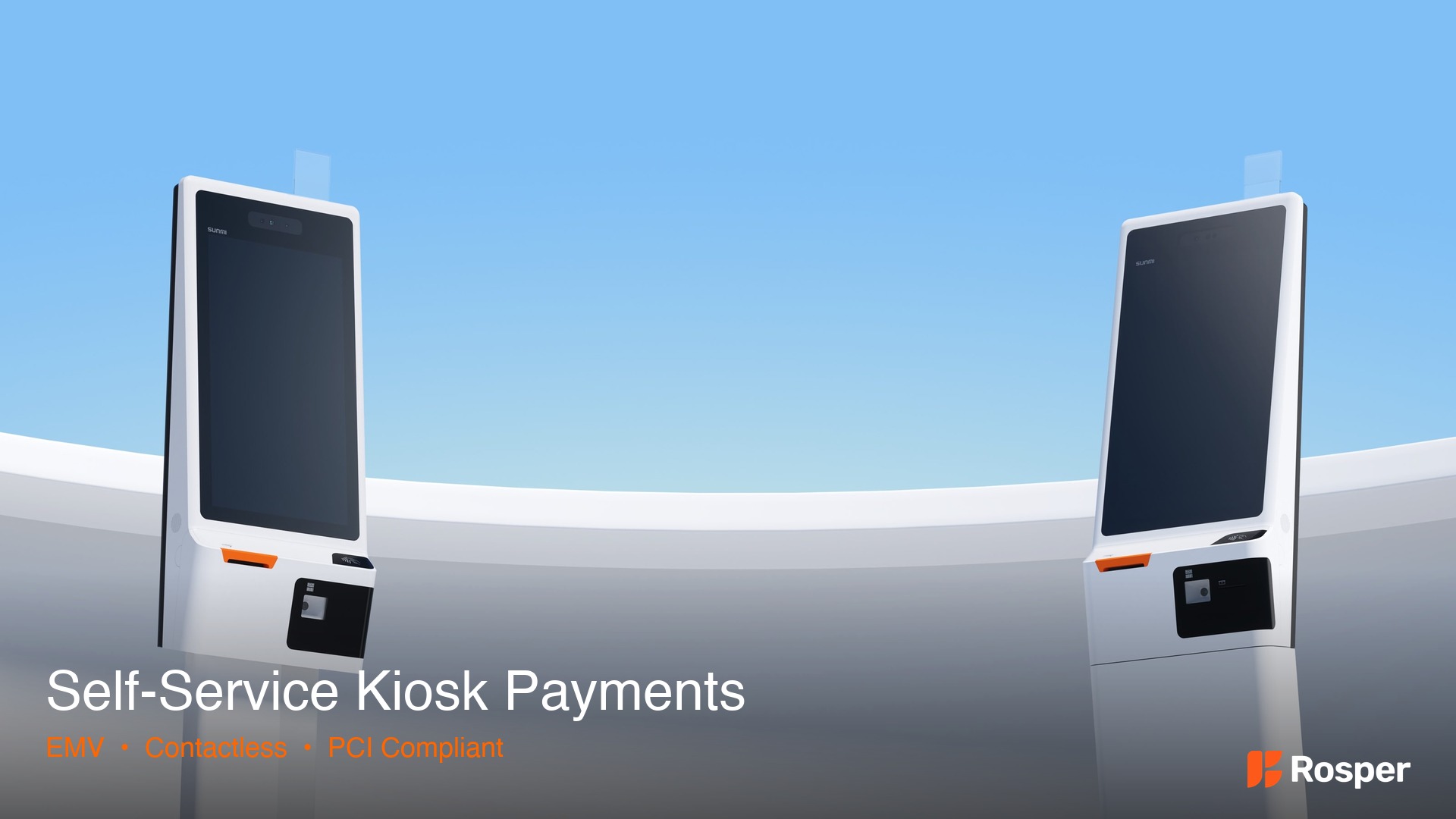
Getting self-service kiosk payment right is the difference between a smooth checkout and an abandoned order. Customers expect to tap, chip, or swipe at the kiosk itself, without a staff handoff. For restaurant and retail operators, that means the payment path has to be built into the hardware and compliant from day one.
This guide covers how self-service kiosks accept payments, integrated versus external readers, EMV chip and contactless support, mobile wallets, and the PCI DSS and P2PE rules that keep card data safe. It also maps how SUNMI kiosks such as the K2 Mini, P3 Mix, and L3 integrate payment, plus the US and Canada differences you need to plan for.
Key Takeaways
- A modern self-service kiosk payment setup should accept EMV chip, contactless tap, and mobile wallets from one built-in reader, not a separate terminal.
- Integrated readers reduce footprint and wiring, while external readers suit sites that must reuse an existing acquirer device.
- PCI DSS applies to every unattended kiosk, and P2PE encryption plus a validated reader shrink your compliance scope.
- In the US you plan for EMV and NFC wallets, in Canada you also plan for Interac chip and contactless.
- SUNMI kiosks like the K2 Mini and P3 Mix ship with NFC and SoftPOS-ready modules, backed by SUNMI’s 3-year warranty on Gen 2-3 hardware with Rosper assisting claims.
How Self-Service Kiosk Payment Works: Integrated vs External Readers
Every self-service kiosk payment flow needs a card-present reader that the customer can reach. You have two paths. The first is an integrated reader built into the kiosk body. The second is an external payment terminal bolted on beside the screen.
An integrated reader keeps the footprint tight and the wiring clean. The NFC and chip hardware sit inside the kiosk, so the customer taps or inserts on the same device that shows the order. This is the preferred setup for new quick-service and retail rollouts.
An external reader makes sense when you must reuse an acquirer-supplied terminal or a specific processor device. It adds a second box, more cabling, and another point of failure, but it can satisfy a bank mandate. Many operators start external and migrate to integrated later.
Bottom line: for most new deployments, an integrated reader that accepts tap, chip, and swipe on the kiosk itself gives the cleanest customer experience and the smallest hardware footprint.
SUNMI kiosks lean toward integration. Models like the K2 Mini and P3 Mix carry a built-in NFC module and support SoftPOS, so contactless acceptance lives inside the kiosk. You can review the full range on the Rosper products page.
EMV Chip, Contactless Tap, and Mobile Wallet Acceptance
A kiosk that only reads magnetic stripe is a liability. The card networks shifted fraud responsibility to the party using the least secure method, which pushed EMV chip acceptance into every serious deployment. Your kiosk reader should handle chip insert as a baseline.
Contactless is now the volume driver. EMVCo contactless and NFC let a customer tap a physical card or hold a phone near the reader. Transactions clear in under a second, which matters when a line is forming behind the kiosk.
Mobile wallets ride the same NFC rails. Apple Pay, Google Pay, and Samsung Pay all present a tokenized card over NFC, so a kiosk with a certified contactless reader accepts them without extra hardware. Tokenization also means the real card number never touches the kiosk.
Here is how the common payment methods line up against what an integrated kiosk reader should support.
| Payment Method | How It Reads | Speed | Should a Modern Kiosk Support It |
|---|---|---|---|
| EMV chip insert | Chip card inserted into slot | Moderate, a few seconds | Yes, baseline requirement |
| Contactless tap (card) | NFC tap of physical card | Under 1 second | Yes, primary volume method |
| Mobile wallet | NFC tap of phone or watch | Under 1 second | Yes, same NFC hardware as tap |
| Magnetic stripe swipe | Stripe swiped through reader | Fast but higher fraud risk | Optional fallback only |
| Interac (Canada) | Chip insert or contactless tap | Under 1 second for tap | Yes for Canadian sites |
The takeaway is simple. Prioritize EMV chip and NFC contactless, keep swipe as a fallback, and confirm the reader is certified by your acquirer for each method before launch.
Need a Payment-Ready Self-Service Kiosk Setup?
Share your payment processor, EMV or contactless requirements, kiosk form factor, and site count, your destination, and target date. Rosper will confirm a compatible kiosk and payment hardware configuration, current warehouse availability, and a quote with a realistic lead time. For a multi-site deployment, include the site count and rollout schedule so we can plan staging and kitting.
PCI DSS and P2PE: Compliance for Unattended Kiosk Payments
Any device that accepts a card is in scope for PCI DSS, the security standard maintained by the PCI Security Standards Council. An unattended self-service kiosk is no exception. In fact, unattended terminals get extra scrutiny because no staff member is watching the reader.
The most effective way to reduce your compliance burden is point-to-point encryption, or P2PE. A validated P2PE solution encrypts card data inside the reader at the moment of tap or insert. The kiosk software never sees raw card data, which shrinks PCI scope.
Tokenization complements P2PE. After authorization, the processor returns a token instead of the card number, so nothing sensitive is stored on the kiosk. Combine P2PE on the way in with tokenization on the way out and the kiosk holds no usable card data.
For unattended kiosks, physical security also matters. Look for tamper-resistant readers, secure boot, and locked device management. You can review the current requirements directly at the PCI Security Standards Council before you finalize any deployment.
What Operators Should Verify Before Launch
Confirm your reader carries a valid PCI PTS listing and that your processor supports P2PE for the kiosk model. Ask whether the reader is on your acquirer’s certified list for both chip and contactless.
Then document the flow. Knowing where encryption starts and where tokens replace card data is what an assessor will ask for. Getting this on paper early saves rework later.
How SUNMI Kiosks Integrate Payment: K2 Mini, P3 Mix, and L3
SUNMI builds Android self-service hardware with payment acceptance in mind. The reader hardware and SoftPOS support vary by model, so match the kiosk to how you want to accept payment.
The SUNMI K2 Mini is a compact freestanding self-order kiosk with a built-in NFC module and SoftPOS support, so it accepts contactless tap and mobile wallets on the device. Pair it with a certified P2PE chip reader where chip insert is required.
The P3 Mix is a small countertop or wall-mount kiosk that also carries a built-in printer and NFC covering Type A and B plus Mifare and FeliCa. That makes it a strong fit for compact self-order points that need both tap-to-pay and a printed receipt.
The L3 is a handheld biometric smart pad with dual NFC, built for mobile check-in and line-busting rather than fixed checkout. Use it where staff take payment on the move and pair it with a shared printer when a receipt is needed. Full specifications are published on SUNMI official.
Because all three run Android on SUNMI OS, one payment and ordering app can move across models as your fleet grows. That consistency lowers integration and certification overhead when you scale from one location to many.
US vs Canada: Interac and Regional Payment Nuances
Payment acceptance is not identical across North America, and Rosper serves US and Canada operators equally. In the US, your kiosk plan centers on EMV chip, NFC contactless, and mobile wallets over Visa, Mastercard, American Express, and Discover rails.
In Canada, you add Interac, the domestic debit network. Canadian customers expect Interac chip and Interac contactless (Interac Flash) at a self-service kiosk, so the reader and processor must be certified for Interac in addition to the global card brands.
Contactless limits and verification behavior can also differ by region, so confirm tap ceilings and PIN prompts with your acquirer for each country. You can check the Canadian debit standard directly at Interac.
The best approach for cross-border operators is a single Android kiosk platform with region-specific processor certification. That lets you run the same K2 Mini or P3 Mix hardware in both countries while meeting local acceptance rules.
Best Self-Service Kiosk Payment Setup by Business Type
Best for high-volume quick-service restaurants: an integrated kiosk with fast NFC contactless and a P2PE chip reader, so lines keep moving during a rush. A larger self-order screen paired with a fast printer completes the flow.
Best for compact cafes and small retail counters: a countertop kiosk with built-in NFC and a printer, so tap-to-pay and receipts happen on one small device. This keeps checkout self-service without surrendering counter space.
Best for mobile and line-busting: a handheld device with dual NFC for tap and mobile wallet acceptance anywhere on the floor. Pair it with a nearby printer or fixed kiosk when a printed receipt is required.
For a deeper look at model sizing, cost, and ROI, see the SUNMI kiosk buyer’s guide, which pairs well with the payment planning in this article.
Getting Payment-Ready Kiosks Shipped and Supported
Choosing the reader is only half the job. The right self-service kiosk payment setup depends on your acquirer, your country, and whether you need chip, tap, or both on each device. Configuration of NFC, chip readers, and printers changes the final build.
Rosper stocks and ships SUNMI kiosk hardware from US and Canada warehouses, and most orders arrive in 2-7 business days. SUNMI provides the official warranty, with Gen 2-3 hardware covered for 3 years, and Rosper assists with any warranty claims.
Planning a payment-ready kiosk rollout? Ask Rosper’s team for pricing, certified reader options, and lead times for the US and Canada.
Rosper is SUNMI’s authorized distributor for the United States and Canada. Our team helps buyers match SUNMI devices, compatible accessories and deployment services to the workflow, confirm exact configurations and current warehouse availability, and coordinate shipping, staging, kitting and warranty support for pilots or multi-location rollouts. Contact our sales team for configuration guidance or to check current stock.
Frequently Asked Questions
Do self-service kiosks have a built-in card reader for tap and chip?
Many do. Modern self-service kiosks such as the SUNMI K2 Mini and P3 Mix include a built-in NFC module for contactless tap and mobile wallets, and support SoftPOS. For EMV chip insert, they pair with a certified P2PE chip reader so the kiosk accepts tap, chip, and swipe from one station.
Are self-service kiosk payments PCI compliant?
They can and must be. Every card-accepting kiosk is in scope for PCI DSS. Using a validated point-to-point encryption (P2PE) reader plus tokenization means the kiosk never handles raw card data, which reduces PCI scope. Always confirm the reader carries a valid PCI PTS listing and acquirer certification before launch.
Do self-service kiosks accept mobile wallets like Apple Pay and Google Pay?
Yes. Mobile wallets present a tokenized card over NFC, the same contactless rail used for tap-to-pay cards. A kiosk with a certified NFC contactless reader accepts Apple Pay, Google Pay, and Samsung Pay without extra hardware, and the real card number never touches the kiosk.
How do self-service kiosk payments differ in Canada versus the US?
In the US you plan for EMV chip, NFC contactless, and mobile wallets over the global card brands. In Canada you also support Interac, the domestic debit network, including Interac chip and Interac Flash contactless. The reader and processor must be certified for Interac in addition to the global brands.
Which SUNMI kiosk is best for accepting payments at a quick-service restaurant?
For most quick-service restaurants, the SUNMI K2 Mini is a strong self-order kiosk because it combines a compact freestanding design with built-in NFC and SoftPOS for fast contactless acceptance. Pair it with a certified chip reader where chip insert is required to cover tap, chip, and swipe.