
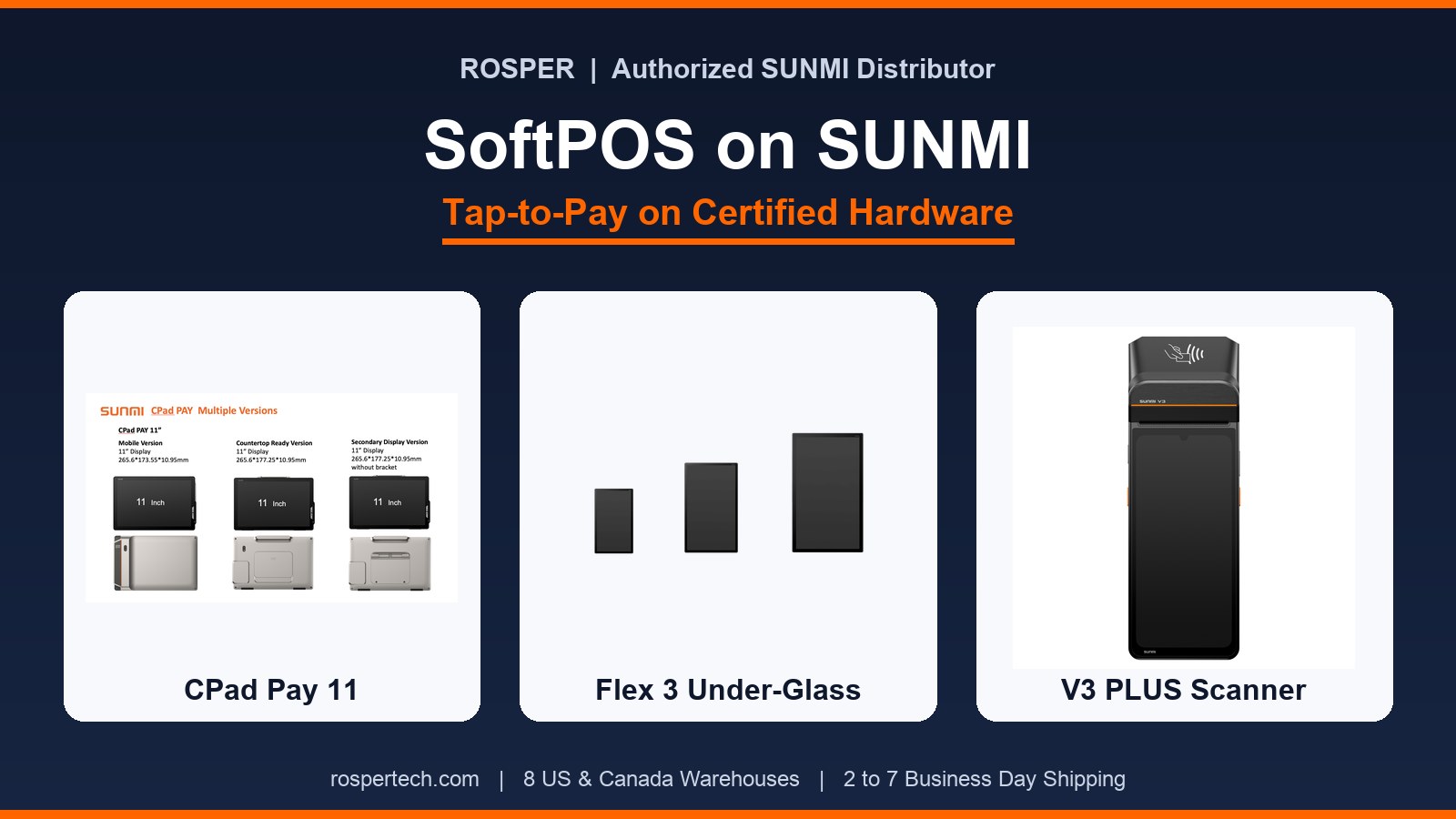
SoftPOS turns a certified smart device into a contactless payment terminal, no separate card reader dongle required. For merchants and independent software vendors it is one of the fastest ways to add tap-to-pay to a checkout without shipping a second peripheral to every station. This guide explains what SoftPOS actually is, what certifications it requires, and which SUNMI devices ship with the NFC hardware and payment kernel to support it in North America.
The short version, SoftPOS is a certified contactless acceptance mode on a device that carries EMVCo PCD Level 1 hardware plus a compliant PIN-on-Glass or Tap-on-Glass software kernel. In the SUNMI lineup that means CPad Pay, the D3 Pro guest-facing display, the Flex 3 interactive surface, V3 PLUS Scanner, and V3 MIX. Rosper stocks these across 8 US and Canada warehouses as the authorized distributor.
Key Takeaways
- SoftPOS is contactless payment acceptance on a certified device, replacing the classic external PIN pad for tap and mobile wallet transactions.
- The two required certifications are EMVCo PCD Level 1 for the NFC hardware and a compliant PIN or Tap-on-Glass kernel for the payment software.
- SUNMI CPad Pay is the flagship SoftPOS tablet with PCI PTS 6.x certification and a semi-integrated payment SDK for ISV apps.
- Flex 3 is the only SUNMI interactive display with under-glass NFC plus EMVCo PCD L1 certification, ideal for self-service SoftPOS.
- Buying SoftPOS-capable hardware through an authorized distributor preserves the certification chain and the payment kernel validity.
What SoftPOS Actually Is
SoftPOS, short for Software Point of Sale, is a payment acceptance mode that runs the contactless payment kernel on a merchant-grade smart device instead of a purpose-built card reader. The device receives the customer tap through its own NFC antenna, hands the transaction to a certified kernel running on the device, and forwards the encrypted result to the acquirer. From the customer view it looks like tapping a card or a phone on the merchant tablet.
The technology has two rails. Tap-on-Glass supports contactless acceptance without PIN entry, and PIN-on-Glass extends acceptance to PIN transactions using a certified software keypad on the merchant device. The EMVCo and PCI SSC specifications define the certification perimeter for both rails.
For an ISV or a POS reseller the appeal is simple. SoftPOS eliminates a peripheral, cuts hardware SKUs per station by one, and lets a checkout tablet do double duty as a payment terminal. For a self-service surface it means the customer taps the same screen they order on, no separate PIN pad in the enclosure.
What Certifications a SoftPOS Device Must Carry
A device is only SoftPOS-capable if its NFC hardware and its payment kernel are both certified. Three certifications appear on every credible SoftPOS spec sheet. First, EMVCo PCD Level 1 for the NFC antenna and RF stack. Second, a compliant payment kernel from the acquirer or the card networks. Third, PCI PTS 6.x for any device that handles PIN entry, since PIN-on-Glass requires a hardened key path and a certified secure display.
Merchants should not assume a phone or generic Android tablet is SoftPOS-capable. The NFC subsystem, the secure element, the OS build, and the software keypad all sit inside the certification perimeter. The PCI Security Standards Council maintains the PTS device listings that acquirers use to validate the payment device on file.
SUNMI devices designed for SoftPOS ship with the certifications baked in. That is a material buying signal, because certifying a generic tablet after purchase is not a merchant-side option. The device either qualifies at ship time or it does not.
SUNMI Devices That Support SoftPOS and Tap-to-Pay
Five current SUNMI lines carry the NFC hardware and payment kernel required for SoftPOS acceptance in North America. Every model runs SUNMI OS 4.0 on Android and is available through Rosper as the authorized distributor.
| Device | Form factor | NFC certification | Payment kernel | Best for |
|---|---|---|---|---|
| CPad Pay 11 (P07180008 / P07180026) | 11″ tablet | EMVCo PCD L1 | PCI PTS 6.x, semi-integrated SDK, Future X RKI on 026 | ISV checkout, assisted retail, salon and spa |
| D3 Pro Guest Display (C20000099) | 10.1″ customer-facing screen | Tap on Glass NFC | SoftPOS on top of D3 Pro terminal | QSR, fast casual, retail counter with customer tap |
| Flex 3 (P11050001 / P11050012) | 18.5″ to 27″ interactive surface | Under-glass NFC, EMVCo PCD L1 | SoftPOS ready | Self-service kiosk, unattended checkout |
| V3 PLUS Scanner (P06120021) | 6.75″ handheld | EMVCo PCD L1, Apple VAS | SoftPOS ready | Delivery, curbside, mobile box office |
| V3 MIX 80mm (P06080020) | 10.1″ mobile all-in-one | NFC Type A/B, Mifera, FeLica | SoftPOS supported | Food truck, drive-thru, mobile vendor |
For an ISV building a semi-integrated payment flow on top of an existing checkout tablet, the CPad Pay is the anchor SKU. The 11 inch screen fits a checkout UI, the SDK supports semi-integrated card and tap acceptance, and the P07180026 variant adds Future X remote key injection for a fully unattended provisioning path. To standardize a fleet on a SoftPOS tablet, request a quote and specify station counts.
Where Under-Glass NFC Matters, and Where It Does Not
The Flex 3 interactive surface is the only SUNMI display with under-glass NFC certified at EMVCo PCD L1. That matters more than most spec sheets admit. In a self-service kiosk the customer taps the same screen they ordered on, so the antenna has to project through 4 to 6 mm of tempered glass. External antennas do not achieve reliable tap in that build.
For a counter tablet the geometry is friendlier. CPad Pay has a top-edge NFC zone that any assisted retail workflow handles cleanly. A guest-facing D3 Pro display similarly hosts NFC on the customer side of the transaction, where reach is short and posture is stable. The Flex 3 under-glass path is the differentiator specifically for unattended surfaces.
ISVs building for both attended and unattended workflows should pick the SoftPOS device by antenna geometry, not by processor family. That single specification often decides whether a rollout ships on time.
Semi-Integrated vs Fully Integrated Payment
SoftPOS deployments split into two integration modes. Semi-integrated payment isolates the card data path from the ISV app. The certified payment kernel handles the card entry, tokenizes the result, and returns a status to the ISV app. That reduces the ISV app PCI scope to a merchant-of-record subset. Fully integrated payment lets the ISV app touch card data directly, which expands PCI scope significantly.
Almost every North American ISV picks semi-integrated. It ships faster, audits smaller, and reuses acquirer-certified kernels. On SUNMI hardware, the semi-integrated path is enabled by the SUNMI Unified Payment SDK plus the certified device kernel. See the ISV partner program for the current SDK and support documentation.
Deployment Checklist for a SoftPOS Rollout
- Confirm EMVCo PCD Level 1 on every device SKU in the bundle, not just the flagship.
- Confirm PCI PTS 6.x if PIN-on-Glass is required by the acquirer.
- Pick semi-integrated payment over fully integrated for a smaller ISV PCI scope.
- Match antenna geometry to workflow, under-glass NFC for kiosk, edge or top NFC for counter and handheld.
- Buy through an authorized distributor to preserve certification and warranty.
- Confirm US and Canada stock before committing rollout dates.
Source SoftPOS Hardware from Rosper
Rosper is the authorized SUNMI distributor for North America. We stock the SUNMI CPad Pay, D3 Pro, Flex 3, V3 PLUS Scanner, and V3 MIX across 8 US warehouses plus a Canadian hub, coordinate the SUNMI warranty and RMA process locally, and support ISVs with the SUNMI Unified Payment SDK and semi-integrated deployment guidance. Most orders arrive in 2 to 7 business days. To scope a SoftPOS fleet, contact us and we will match SUNMI SKUs to your acquirer and rollout plan.
Frequently Asked Questions
What is SoftPOS in simple terms?
SoftPOS is a payment acceptance mode that runs the contactless payment kernel on a merchant smart device instead of an external card reader. The customer taps a card or a phone wallet on the merchant tablet, and a certified software kernel on the device processes the tap. It works only on hardware that carries EMVCo PCD Level 1 NFC and a compliant payment kernel.
Which SUNMI devices support Tap-to-Pay?
The current SUNMI SoftPOS-capable lineup in North America is CPad Pay 11 (P07180008 and P07180026), the D3 Pro guest-facing display with Tap on Glass (C20000099), the Flex 3 interactive surface with under-glass NFC (P11050001 series), the V3 PLUS Scanner handheld (P06120021), and the V3 MIX mobile all-in-one (P06080020). Every one ships with EMVCo PCD Level 1 NFC hardware.
What is the difference between Tap-on-Glass and PIN-on-Glass?
Tap-on-Glass supports contactless acceptance without PIN entry, typically for cards and mobile wallets under the local no-PIN limit. PIN-on-Glass extends acceptance to PIN transactions using a certified software keypad on the merchant device, which requires PCI PTS 6.x certification and a hardened secure display. Both rails run on SUNMI CPad Pay in North America.
Can any Android tablet run SoftPOS?
No. A device is SoftPOS-capable only if its NFC hardware carries EMVCo PCD Level 1 certification and it hosts a compliant payment kernel from an acquirer or card network. Certifying a generic tablet after purchase is not a merchant-side option, so the device must qualify at ship time. SUNMI CPad Pay, Flex 3, V3 PLUS Scanner, V3 MIX, and D3 Pro guest display all qualify at ship.
Where can I buy SoftPOS-ready SUNMI hardware in the US and Canada?
Buy through Rosper as the authorized SUNMI distributor for North America. Rosper stocks the SoftPOS-capable SUNMI lineup across 8 US warehouses plus a Canadian hub, and coordinates the SUNMI warranty and RMA process locally. Buying through the authorized channel preserves the EMVCo, PCI PTS, and SUNMI warranty chain.