
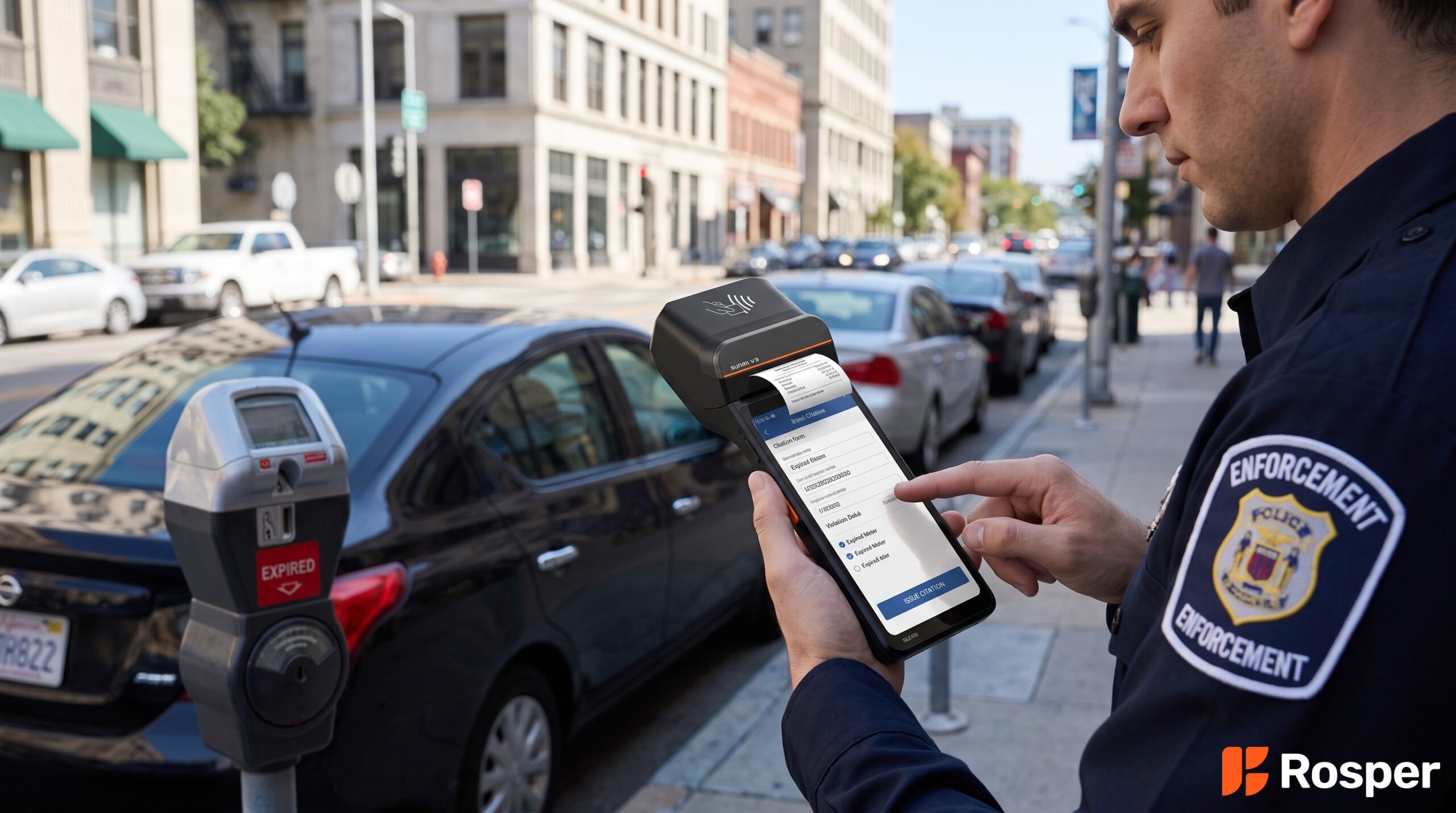
Three SUNMI V3 configurations ship from Rosper US and Canada stock with a barcode scanner and a receipt or label printer built into the same handheld. Two print at 58mm, one switches between 58mm and 80mm. That single fact decides most ecitation hardware shortlists, because a citation workflow is a printing problem before it is a screen problem.
This guide is written for the agencies issuing traffic, parking, and code enforcement citations, and for the software vendors who bundle hardware with their citation platform. It covers what the workflow demands from the device, which configurations match, and what to confirm before committing to a fleet.
Key Takeaways
- A citation device has five jobs in one shift: scan, validate, photograph, geotag, and print a legible ticket.
- The printed citation is the artifact the court clerk processes, so print reliability sits on the revenue path, not the convenience path.
- Two Rosper V3H order codes and one V3 PLUS order code combine a scanner and a printer in one unit, all in US and Canada stock.
- Choose 58mm for a compact walk-around ticket, 58mm and 80mm dual width when the citation form is longer or doubles as a receipt.
- Confirm country of origin and any federal procurement documentation with the manufacturer before an agency bid, not after.
Why eCitation Hardware Is a Printing Problem First
An electronic citation platform earns its budget by removing handwriting and manual data entry from the process. Standardized fields, dropdowns, and automatic court dates cut the errors that get tickets dismissed.
That argument only holds if the ticket actually reaches the citizen and the court in readable form. A jammed printer, a faded thermal slip, or a printer left charging in the vehicle reintroduces the same dismissal risk in a new shape.
This is different from collecting parking revenue at a pay station or booth, which is covered separately in our guide to parking payment hardware. Enforcement issues the citation. Revenue control collects the money. The device requirements diverge quickly.
What the Citation Workflow Demands From the Device
Walk through a single stop and the requirement list writes itself. The officer reads a plate or a permit decal, confirms the record, documents the scene, and hands over a printed notice.
- Scanning: 1D and 2D capture on plates, permit decals, and registration barcodes that are often dirty, curled, or damaged.
- Data validation: an operating system your citation application actually targets, so dropdowns and field rules behave the same on every unit.
- Photo evidence: a rear camera good enough that meter displays, signage, and plate numbers survive review in a contested case.
- Connectivity: cellular data for record lookups and immediate upload, with SIM flexibility across carriers and jurisdictions.
- Printing: an integrated printer, so there is no second device to charge, pair, or lose.
- Fleet control: remote configuration and lockdown across every unit in the agency.
The last item matters more than it looks. A device that officers can browse or reconfigure is a support ticket waiting to happen, which is why Android Enterprise device management belongs in the specification from day one. See Android Enterprise device management for the underlying framework, and our note on managing SUNMI devices at fleet scale for the practical side.
Specifying Hardware for a Citation Rollout?
Send your citation application, print width, scanning targets, carrier, and unit count, along with your destination and target date. Rosper will confirm the exact order codes, current warehouse availability, and a quote with a realistic lead time. For a multi agency rollout, include the site count and schedule so staging and configuration can be planned in advance.
Three eCitation Hardware Configurations From US and Canada Stock
All three sit in the SUNMI V3 family. Specifications below come from the Rosper order code catalogue and the SUNMI product page. Availability is a snapshot and should be confirmed at quote time.
| Configuration | Order code | Scanner | Printer | Rear camera | Best fit |
|---|---|---|---|---|---|
| SUNMI V3H with scanner | P06100013 | SS1104, 1D and 2D | 58mm label | 8MP | Walk-around parking and code enforcement |
| SUNMI V3H, no scanner | P06100004 | Camera capture only | 58mm label | 8MP | Manual entry workflows, lower unit cost |
| SUNMI V3 PLUS with scanner | P06120019 | SS1111, 1D and 2D | 58mm and 80mm receipt and label | 13MP | Longer citation forms, photo-heavy evidence |
Shared across all three: 4GB RAM with 64GB storage, an octa-core processor, a 6.75 inch HD+ display rated at 420 nits by SUNMI, NFC, 4G with NanoSIM, MicroSD, eSIM and dual PSAM slots, GMS-EDLA Android, and a US power adapter.
The V3 PLUS ships with a wrist band, which is the difference that shows up on a walk-around beat rather than on a spec sheet. It also carries the 13MP rear camera, worth specifying when photo evidence is routinely contested.
SUNMI describes the V3 family scanning engine as reading damaged, wrinkled, or stained barcodes, and describes an improved dustproof design for extended printer lifespan. Rosper does not publish an ingress protection rating or a drop specification for these units. If your deployment needs a certified environmental rating, request it in writing before you commit.
One Device or Two: The Tablet Plus Bluetooth Printer Tradeoff
Many citation deployments pair a tablet with a separate 2, 3, or 4 inch Bluetooth printer. That approach is flexible and lets an agency reuse tablets it already owns, which is a real budget argument.
The cost shows up in the field. Two batteries to charge, two devices to inventory, a pairing step before the first ticket of the shift, and a failure mode where the officer has the tablet but not the printer.
An integrated handheld removes that class of problem and gives the software vendor one hardware profile to support instead of a matrix of tablet and printer combinations. For an agency, that shows up as fewer support calls. For a vendor reselling the bundle, it shows up directly in margin.
Fleet Rollout, Warranty, and Procurement Checks
Devices for an agency fleet rarely ship to one address. Rosper stocks the full SUNMI line across eight warehouses, seven in the United States and one in Brampton, Ontario, and most orders arrive in 2 to 7 business days. Details on stock and lead times are in our distributor reference, and Canadian buyers can check V3H availability in Canada.
SUNMI provides a 3-year official warranty on current generation devices, with wear parts covered separately. Rosper assists with warranty claims and helps you reach SUNMI faster. Full terms are on the warranty page.
Confirm these before an agency bid
- Country of origin documentation, and any federal procurement paperwork your end customer requires. Request this from the manufacturer in writing, early.
- Printer supplies: paper width, roll diameter, and a supply source that will still exist in year three.
- Android security update horizon for the specific model, not the family.
- Advance replacement terms, since a unit in repair is a beat not being covered.
- If citizens pay on the spot, payment scope changes the conversation. Our note on payment hardware compliance covers what that adds.
Where to Start
For a pilot, the practical move is a small evaluation batch of one scanner-equipped V3H and one V3 PLUS, tested against your actual citation form and your real print width, before any volume commitment.
Software vendors bundling hardware into their platform can start with the ISV partner program, which covers development units and integration support. Agencies and vendors buying at volume should review bulk ordering for tiered pricing and staging options.
Frequently Asked Questions
Which SUNMI device prints citations without a separate printer?
Three configurations combine printing and the handheld in one unit: the V3H with scanner (P06100013) and the V3H without scanner (P06100004) at 58mm, and the V3 PLUS with scanner (P06120019), which handles both 58mm and 80mm.
What print width should a citation form use?
58mm suits a compact notice handed to a citizen at the vehicle. Choose the 58mm and 80mm dual width configuration when the form carries more fields, appeal instructions, or doubles as a payment receipt. Print your actual form on a sample unit before deciding.
Can these devices scan license plates and permit decals?
The scanner-equipped configurations read 1D and 2D barcodes, which covers permit decals and registration barcodes. SUNMI states the engine reads damaged, wrinkled, and stained codes. Reading plate characters themselves is optical character recognition, a function of your citation application and the camera, not the barcode scanner.
Will these run our existing citation application?
These are GMS-EDLA Android devices, so an Android build has a supported target. Rosper does not certify third party citation applications. Validate your own build on an evaluation unit before a fleet order.
Are these devices available in Canada?
Yes. Rosper ships from eight warehouses, seven in the United States and one in Brampton, Ontario. Most orders arrive in 2 to 7 business days. Confirm the specific order code at quote time, as availability is a snapshot.
What documentation is needed for government procurement?
Agencies commonly require country of origin documentation and federal procurement compliance paperwork. This documentation comes from the manufacturer. Request it in writing at the evaluation stage so it does not stall an award later.