
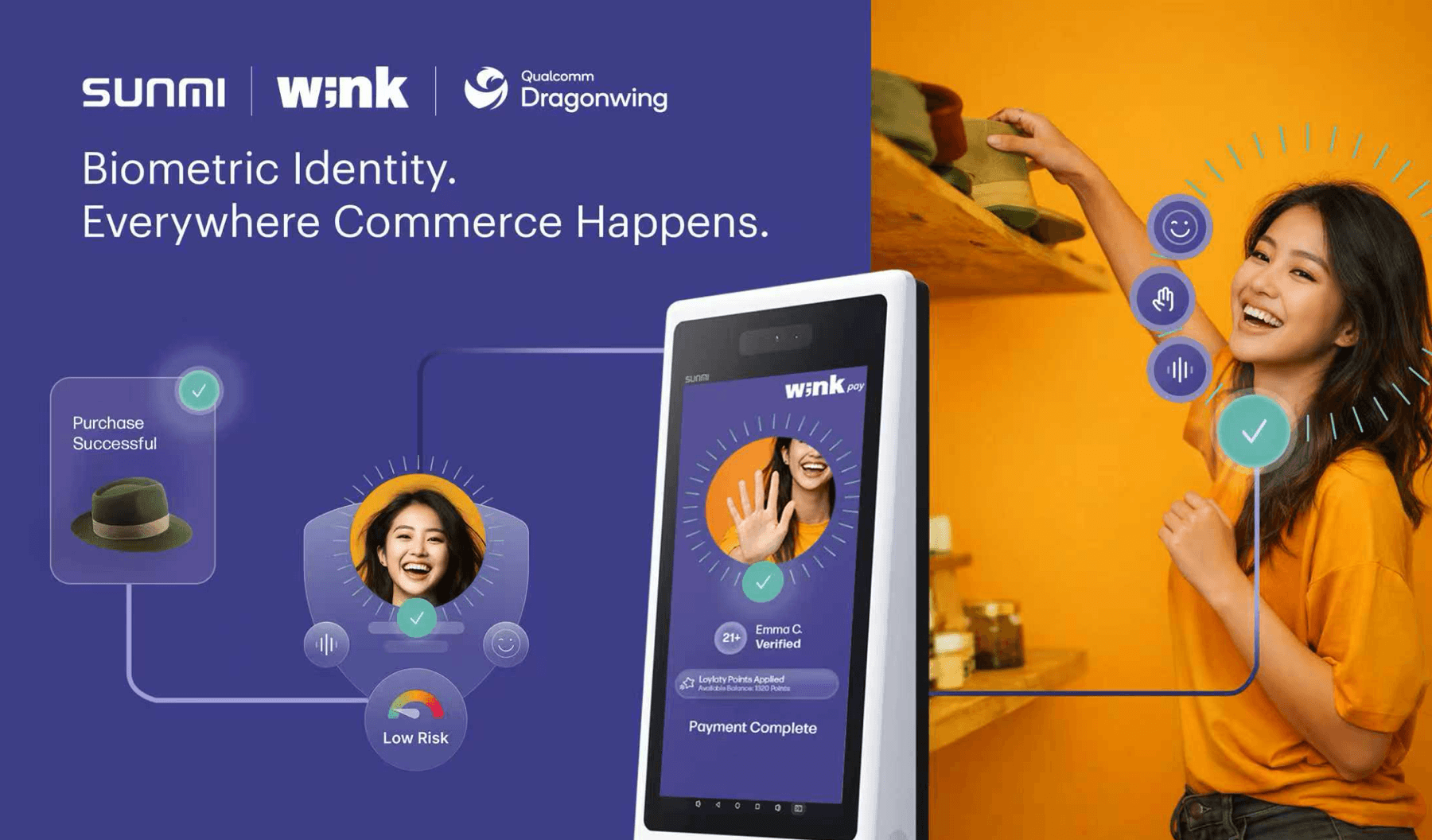
An estimated 1.4 billion people worldwide are expected to use facial biometrics for payments by 2026, according to Market.us. The biometric in-store payment market is projected to reach $34.8 billion by 2032 (S&S Insider), growing at a compound annual growth rate of 24%. North America already accounts for 35.3% of this market.
These are not distant projections. SUNMI, Wink, and Qualcomm Technologies have partnered to bring biometric payment to commercial POS terminals that merchants can deploy today. The collaboration pairs Wink’s multi-modal biometric identity platform with Qualcomm’s edge AI processing, running natively on SUNMI hardware.
As Rosper, the authorized SUNMI distributor for the US and Canada, we have been tracking this partnership closely. This article covers how SUNMI biometric payment works technically, which devices support it, what the regulatory landscape looks like, and where the real limitations are.
What is biometric payment and why is demand accelerating?
Biometric payment uses unique physical characteristics, such as a face scan, palm print, or voice pattern, to verify a customer’s identity and authorize a transaction. Instead of tapping a card, unlocking a phone, or entering a PIN, the customer looks at a camera or places their palm on a reader. The transaction completes.
The appeal is straightforward: speed and zero friction. In high-volume environments like quick-service restaurants, stadiums, and transit hubs, even a two-second reduction per transaction compounds across hundreds of daily checkouts.
Three factors are driving adoption now. First, hardware maturity: the cameras, neural processors, and secure enclaves needed for on-device biometric matching are standard in commercial POS terminals, not experimental add-ons. Second, consumer familiarity: hundreds of millions of people already unlock their phones with face or fingerprint recognition daily. Third, edge AI capabilities: processing biometric data on the device itself has become fast enough and secure enough for payment-grade authentication.
The SUNMI-Wink-Qualcomm partnership sits at the intersection of all three.
How the SUNMI, Wink, and Qualcomm collaboration works
Wink is a multi-modal biometric identity platform that supports face recognition, palm scanning, and voice verification. Unlike single-mode solutions that only handle one biometric type, Wink’s platform can layer multiple modalities for higher security or adapt to different checkout scenarios.
The technical architecture has three layers:
Wink’s identity layer. Wink provides the biometric enrollment, matching, and authentication software. Merchants can integrate through a hosted page (a pre-built biometric checkout flow) or an embedded SDK (for ISVs who want deeper control within their POS application). The platform handles enrollment, template storage, liveness detection, and match scoring.
Qualcomm’s Dragonwing edge AI platform. The Dragonwing platform delivers edge AI acceleration for biometric matching, on-device image processing with security-focused architecture, and the neural processing that enables sub-second authentication. Biometric templates are matched locally on the device processor. Raw biometric data does not leave the terminal.
SUNMI’s device hardware. SUNMI POS terminals provide the cameras, NFC modules, secure chips, and Android platform that Wink’s software runs on. The key detail: no new hardware is required. Merchants using compatible SUNMI devices can activate biometric payment through a software deployment.
As SUNMI stated in the partnership announcement: “Great consumer experiences in payments feel effortless, even as powerful technology works underneath. This collaboration reflects our focus on designing merchant ready payment platforms.”
The practical result is captured in the partnership’s own description: “Sub-second authentication. Zero new hardware. One identity layer across every checkout scenario.”
How a biometric transaction works on SUNMI hardware
A biometric payment on a SUNMI terminal follows four steps:
- Enrollment. The customer registers their biometric data (face, palm, or voice) through Wink’s secure enrollment, linking their biometric template to a payment credential. This is a one-time process.
- Recognition. At checkout, the terminal’s camera or microphone captures biometric input. Wink’s on-device software, accelerated by Qualcomm Dragonwing, matches it against stored templates in sub-second time.
- Authorization. Once verified, the transaction is authorized through the payment processor, following the same rails as any card or NFC transaction.
- Completion. The customer walks away. No card, no phone, no wallet needed.
Unlike consumer-grade face unlock, this is payment-grade authentication with liveness detection (to prevent photo spoofing), encrypted template storage, and audit trails that meet financial-services compliance requirements.
Which SUNMI devices support biometric payment?
The partnership announcement confirms biometric payment support across four SUNMI device categories: mobile, desktop, kiosk, and cPad payment terminals.
Mobile POS devices:
- V3 Family (V3, V3 PLUS, V3 Mix): Handheld terminals with front-facing cameras, NFC, and Qualcomm processors. Well suited for tableside biometric checkout in restaurants, delivery verification, and line-busting at retail.
Desktop terminals:
- D3 Pro: Dual-screen 15.6-inch countertop terminal with a customer-facing camera positioned for face recognition at the checkout counter.
- D3 Mini: Compact countertop terminal for smaller footprint deployments that still require biometric capabilities.
cPad payment terminals:
- CPad: 10-inch commercial tablet with a front-facing camera, designed for face pay at the counter or in mobile checkout scenarios.
Kiosk hardware:
- SUNMI’s self-service kiosk lineup, including models designed for unattended biometric checkout in high-traffic environments like food courts, airports, and corporate cafeterias.
Merchants who purchase any of these devices today get hardware that is biometric-ready out of the box. Activation happens through software, not a hardware swap.
Industry momentum: biometric payment partnerships are scaling
The SUNMI-Wink-Qualcomm partnership is not an isolated development. Across the payment hardware industry, biometric checkout is moving from pilot to production.
In December 2025, Wink also announced a collaboration with PAX Technology to bring biometric authentication to PAX’s payment terminal lineup. This signals that biometric identity is becoming a platform-level capability across major terminal manufacturers, not a feature limited to a single vendor.
Wink CSO Amitaabh Malhotra described the trajectory directly: “Biometric identity is no longer an experiment, it’s becoming the foundation of modern commerce. By combining Sunmi’s global payment device footprint with Qualcomm Technologies’ edge AI leadership, we’re bringing production-ready, identity-native checkout to scale.”
The pattern is clear: biometric payment is moving from concept demos to production integrations with hardware platforms merchants actually use.
Privacy regulations merchants must understand
Biometric data carries unique regulatory weight. Unlike a password or PIN, you cannot change your face or palmprint if the data is compromised. North American privacy laws reflect this sensitivity with specific requirements that merchants and ISVs must follow.
BIPA (Illinois Biometric Information Privacy Act). The strictest biometric privacy law in the US. BIPA requires:
– Written, informed consent (opt-in) before collecting any biometric data
– A publicly available written policy establishing retention schedules
– A data destruction plan specifying when and how biometric data will be permanently deleted
– Private right of action, meaning individual consumers can sue for violations, with statutory damages of $1,000 per negligent violation and $5,000 per intentional violation
CCPA/CPRA (California). California classifies biometric data as “sensitive personal information.” Merchants must:
– Disclose biometric data collection at or before the point of collection
– Provide consumers the right to opt out of the sale or sharing of biometric information
– Honor deletion requests and limit use to disclosed purposes
PIPEDA (Canada). Canada’s federal privacy law applies to commercial biometric collection across all provinces (with additional provincial legislation in Quebec, Alberta, and British Columbia). PIPEDA requires:
– Meaningful consent: the consumer must understand what data is collected, why, and how it will be used
– Purpose limitation: biometric data can only be used for the specific purpose disclosed at collection
– A designated privacy officer responsible for compliance
Additional state laws. Texas, Washington, and several other US states have biometric privacy statutes with varying requirements. Any multi-state deployment needs jurisdiction-by-jurisdiction compliance review.
Wink’s on-device processing architecture addresses several of these requirements by keeping biometric matching at the edge on the Qualcomm processor, so raw data does not transit to cloud servers. However, merchants still bear responsibility for enrollment consent workflows, retention policies, and consumer rights fulfillment.
What biometric payment means for merchants and ISVs
For merchants:
- Faster throughput. Sub-second authentication reduces checkout time. In QSR, coffee shops, and convenience stores, this directly increases transactions per hour during peak periods.
- Wallet-free payment. Customers who forget their card or whose phone battery is dead can still pay. For locations with high repeat-visit rates (corporate cafeterias, gyms, daily coffee shops), this removes a real friction point.
- Loyalty without cards. Biometric identification can automatically recognize returning customers and apply loyalty rewards or stored preferences without requiring a separate loyalty card or app.
- Simplified hardware. If a customer pays with their face using the built-in camera, the need for separate card readers or payment dongles decreases.
For ISVs and payment partners:
- Differentiation. ISVs building on SUNMI hardware can integrate Wink’s biometric SDK to offer face pay, palm pay, or voice pay as a premium feature that legacy platforms cannot match.
- Vertical-specific opportunities. Stadiums, QSR chains, corporate cafeterias, and fitness centers are likely early adopters. ISVs who build for these verticals first capture first-mover advantage.
- Managed enrollment services. The enrollment process itself is a service opportunity for ISOs and ISVs as part of merchant onboarding.
- Remote deployment. SUNMI’s Device Management Platform lets ISVs push biometric payment apps across thousands of terminals remotely.
For ISVs exploring the SUNMI platform, Rosper’s ISV partner program provides technical support, device access, and go-to-market assistance.
Honest limitations and what is not ready yet
We believe in being transparent about what biometric payment can and cannot do today.
Consumer trust is still building. Many North American consumers remain cautious about facial recognition in retail. Winning trust requires transparent enrollment, clear opt-out options, and visible privacy controls.
Payment processor support is incomplete. Not all processors currently support biometric-triggered transactions. The acquirer infrastructure is being built, but universal support is not here yet.
Not every use case fits. Biometric payment delivers the most value in environments with repeat customers and high transaction volume. A tourist shop where every customer is new will see less benefit than a corporate cafeteria serving the same 500 employees daily.
Accuracy in edge cases. Facial recognition performance can vary with lighting, face coverings, glasses, and demographic diversity. Responsible deployments must test across these scenarios and always provide fallback payment methods (card, NFC, QR).
Regulatory complexity. The patchwork of state and federal biometric privacy laws in the US, combined with PIPEDA in Canada, means compliance is not one-size-fits-all. Multi-jurisdiction deployments need legal review before going live.
Why buying SUNMI now is a future-ready decision
The practical approach to POS hardware purchasing is buying equipment that handles today’s needs while being ready for what comes next. SUNMI’s current generation delivers on both.
Today:
– Certified Android POS terminals with NFC for contactless payments
– Google AER Gold Partner status with regular security patches and GMS compliance
– Full ecosystem of POS applications through the Google Play Store
– SUNMI Care 3-year standard warranty on every device
Tomorrow:
– Biometric payment capability through the Wink integration, activated via software update
– No hardware replacement needed. The cameras, Qualcomm processors, and security chips are already built in
– Access to face, palm, and voice payment modalities as they become available in your market
Rosper stocks SUNMI devices across 8 warehouses in the US and Canada, with 2 to 7 business day delivery. Whether you are deploying 5 terminals for a single restaurant or 5,000 across a franchise network, the hardware is available now.
Request a quote to discuss SUNMI biometric payment-ready devices for your business.
Frequently asked questions
What is SUNMI biometric payment?
SUNMI biometric payment is the ability to accept face, palm, or voice-based payment authentication on SUNMI POS terminals. It is powered by Wink’s multi-modal biometric identity platform and Qualcomm’s Dragonwing edge AI processing. Biometric matching happens on-device, not in the cloud.
Do I need new hardware for biometric payment on SUNMI devices?
No. SUNMI mobile, desktop, kiosk, and cPad payment terminals already include the cameras, Qualcomm processors, and secure chips needed for biometric payment. Wink’s biometric software is deployed as a software update, with no hardware swap required.
Is SUNMI biometric payment available in Canada?
The SUNMI hardware is available now through Rosper, with warehouses in both the US and Canada. Biometric payment software deployment in Canada will need to comply with PIPEDA requirements for meaningful consent and purpose limitation. Rosper supports Canadian merchants with local warehousing and knowledge of the Canadian regulatory landscape.
How does Wink protect biometric data on SUNMI devices?
Wink processes biometric templates on-device using Qualcomm’s Dragonwing edge AI platform. Raw biometric data does not leave the terminal for cloud-based matching. Templates are encrypted and stored locally. This on-device architecture reduces data-exposure risk and simplifies compliance with biometric privacy regulations like BIPA and PIPEDA.
Can customers still pay with cards if they do not want to use biometric payment?
Yes. Biometric payment is an additional checkout option, not a replacement. All SUNMI terminals continue to support NFC contactless, chip, magnetic stripe, and QR code payments. Biometric enrollment is always voluntary and opt-in.
What biometric privacy laws apply to merchants in North America?
The main frameworks are BIPA (Illinois), which requires opt-in consent and a written data destruction plan; CCPA/CPRA (California), which requires disclosure and opt-out rights; PIPEDA (Canada), which requires meaningful consent and purpose limitation; plus additional state-level laws in Texas, Washington, and other jurisdictions. Merchants should consult legal counsel for jurisdiction-specific compliance.
Rosper is the authorized SUNMI distributor in North America. We stock SUNMI POS terminals across 8 warehouses in the US and Canada, with 2 to 7 business day delivery and 3-year warranty coverage. Visit rospertech.com to learn more about SUNMI biometric payment-ready devices.