

Tablets for Business Use in modern commercial operations
Tablets are now essential tools in modern commercial operations. Restaurants use them for ordering and payment. Retail stores rely on them for checkout, inventory, and customer engagement. Warehouses depend on them for scanning and data accuracy.
Because of this change, choosing the right tablets for business use is very important. It is no longer just about buying hardware. The tablet is no longer just a screen—it is part of the business system.
Many companies still default to iPad or Samsung devices. They are familiar, widely available, and easy to deploy at first. However, once businesses start using consumer tablets, they quickly see the limitations.
This is where SUNMI CPAD delivers a clear advantage.
SUNMI CPAD,iPad and Samsung
which one is Better Tablets for Business Use
Tablets for business use are selected based on how well they support daily operations, system control, and hardware integration. Businesses usually evaluate whether a device is built for commercial environments or adapted from consumer use.
iPad and Samsung Consumer Tablets
iPad and Samsung devices are commonly adopted as tablets for business use because they offer strong usability and mature software ecosystems. However, these consumer tablets are primarily designed for general productivity rather than specialized commercial workflows.Specifically, it mainly includes:
- Designed mainly for personal and office productivity
- Limited enterprise-level device control and customization
- Often require external accessories for payment, scanning, or POS integration
- Long-term maintenance costs may increase due to additional hardware dependencies
SUNMI CPAD
SUNMI CPAD is developed specifically as a tablet for business use, focusing on operational stability and built-in commercial functionality. As one of the best Android tablets for business, it is engineered to reduce hardware complexity while supporting scalable deployments.Specifically, it mainly includes:
- Purpose-built for long-hour commercial operations
- Integrated payment, scanning, and business peripherals
- Supports unified enterprise deployment and centralized device management
- Designed to scale across multi-location business environments
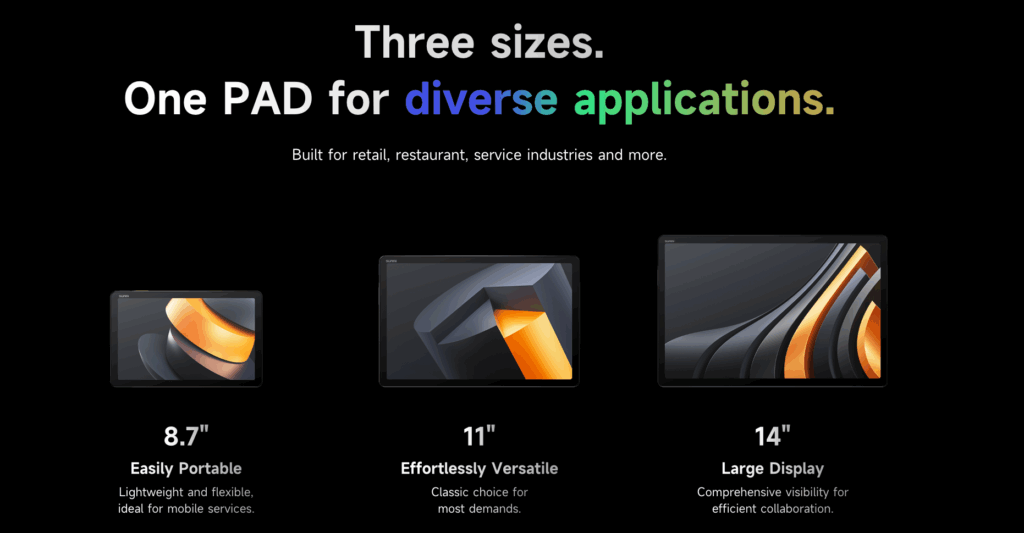
This comparison helps explain why many businesses evaluate SUNMI CPAD when upgrading from consumer tablets to commercial-grade deployment solutions.
Consumer Tablets vs commercial Tablets: A Fundamental Difference
At first glance, iPad, Samsung tablets, and SUNMI CPAD may appear similar. All of them offer touchscreens, modern operating systems, and app support.
The difference lies in how they are designed to be used.
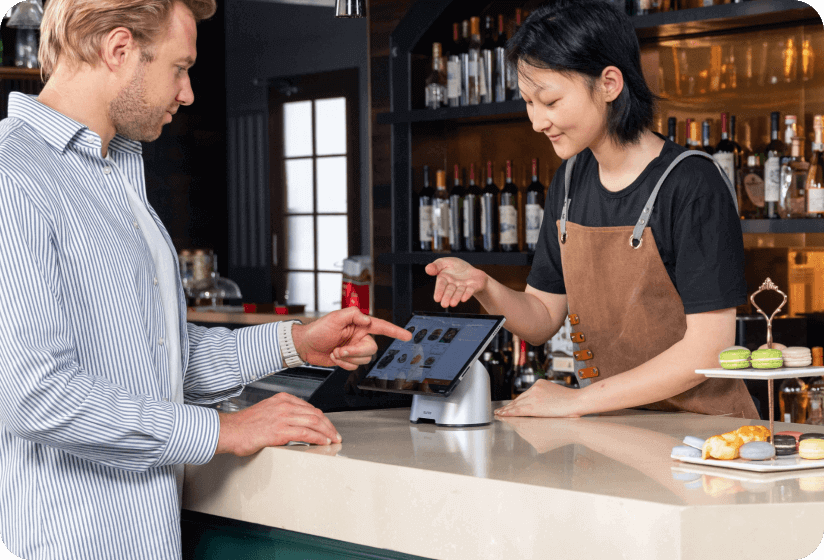
Consumer tablets are built for individuals. They prioritize entertainment, design, and short usage sessions. A tablet for business use, by contrast, is designed to operate as part of a workflow. Stability, durability, and system integration matter more than appearance.
This difference is very important in restaurants, retail stores, and warehouses. In these environments, devices run all day and are shared by many employees.
Why iPad and Samsung Tablets Struggle in Commercial Environments
iPad and Samsung tablets perform well in controlled environments such as homes or offices. Commercial settings are very different.
Devices must operate for long hours, connect to multiple peripherals, and remain stable under pressure. In these conditions, consumer tablets often face overheating, unstable connections, and limited system control.
Over time, businesses experience higher replacement rates and increased maintenance costs. What initially seems like a premium choice often turns into a long-term operational burden.
SUNMI CPAD: Built from the Ground Up as a Tablet for Business Use
SUNMI CPAD is not a consumer tablet adapted for work. It is tablets for business use designed specifically for commercial operations.
SUNMI focuses on enterprise hardware for retail, hospitality, and logistics. This experience is reflected in CPAD’s design. Rather than chasing consumer features, SUNMI CPAD prioritizes reliability, integration, and scalability.
It belongs to a category often described as a commercial pad or commercial android tablet.

How SUNMI CPAD Approaches Business Hardware Differently
SUNMI CPAD follows a commercial-grade hardware philosophy that directly supports daily operations.
- Designed for continuous operation, CPAD supports long, uninterrupted working hours. It is ideal for restaurants and service counters that operate all day.
- Durability for shared environments Business devices are handled by many users. CPAD machines are built to handle this reality better than consumer tablets.
- Lower long-term ownership cost Fewer failures and replacements reduce total cost over time.
This is the foundation of true tablets for business use.
Tablets for Business Use in Restaurants: Reliability Under Pressure
Restaurants place intense demands on hardware. Speed, accuracy, and uptime all directly affect customer experience.
SUNMI CPAD is built specifically for business use. As a tablet for retail environments, it enables retailers to standardize how tablets are deployed, mounted, and used across all stores.
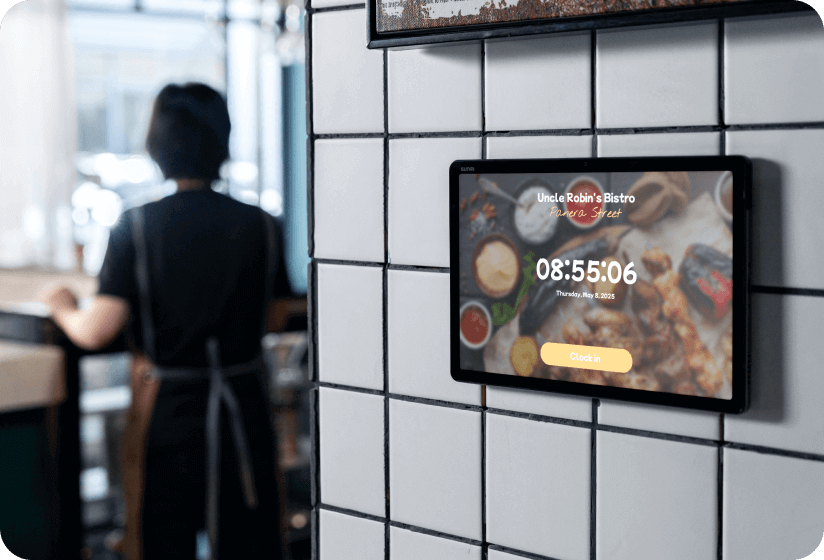
That consistency matters throughout the entire customer journey. From wall-mounted check-in screens at the entrance, to table-side and mobile ordering inside the store, CPAD delivers a familiar experience for both customers and staff.
Employees can use the same device for table assignment, customer service, and checkout without switching hardware or learning new interfaces.
Many restaurants use iPad or Samsung devices as a tablet POS for restaurants. At low volume, this can work. However, during peak hours, consumer tablets often struggle with performance and peripheral reliability.
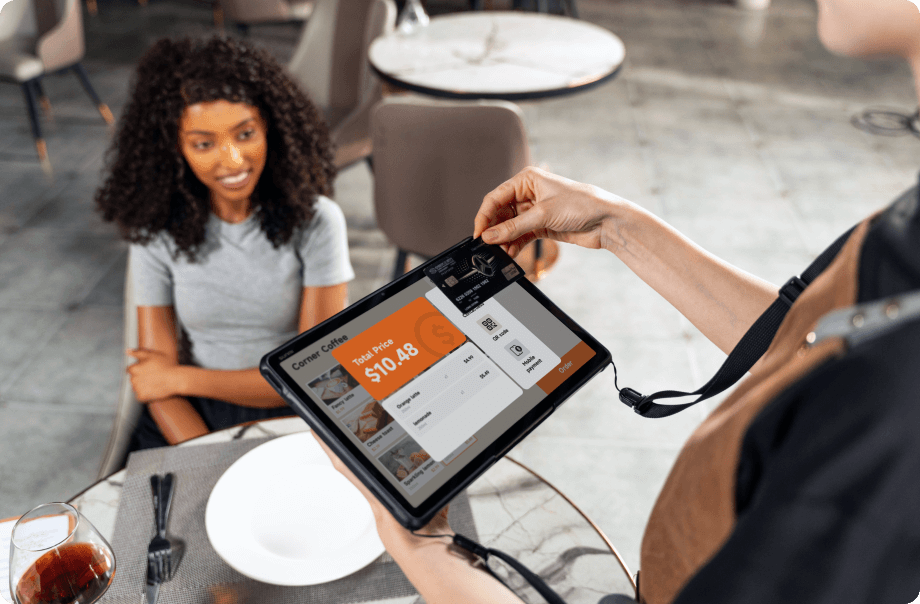
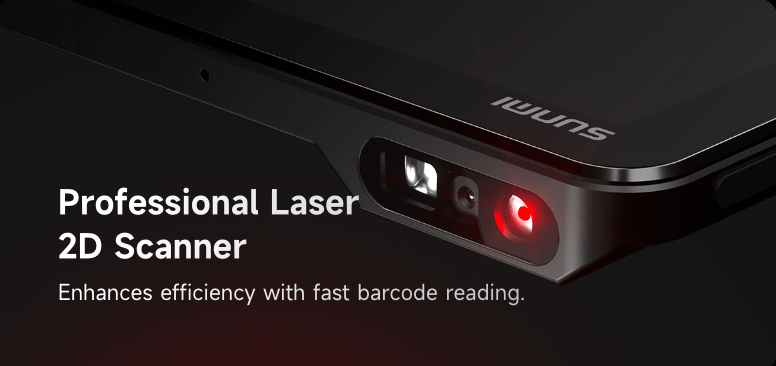
SUNMI CPAD is designed to support restaurant workflows more directly. CPAD has NFC and scanning built in, so you don’t need other devices. It also works smoothly, even when it gets busy.
FAQ: Why do consumer tablets fail in restaurant POS scenarios?
Consumer cellular tablets are not designed for high-frequency commercial use. They rely on external accessories for payment and scanning, increasing failure points. In contrast, SUNMI CPAD integrates these functions into one device, reducing complexity and improving reliability.
Tablets for Business Use in Retail Stores : Consistency Across Locations
Retail operations depend on consistency. Whether operating one store or many, systems must behave the same way everywhere.
iPad and Samsung tablets are commonly used, but managing consumer devices across multiple locations is difficult. System updates, accessory compatibility, and device variation increase IT workload.
In daily store operations, tablets are also expected to support fast, practical tasks on the sales floor. Staff need to quickly check product prices, look up item availability, or locate where a product is placed in the store or stockroom. When devices or systems vary by location, these simple actions become slower and more error-prone.
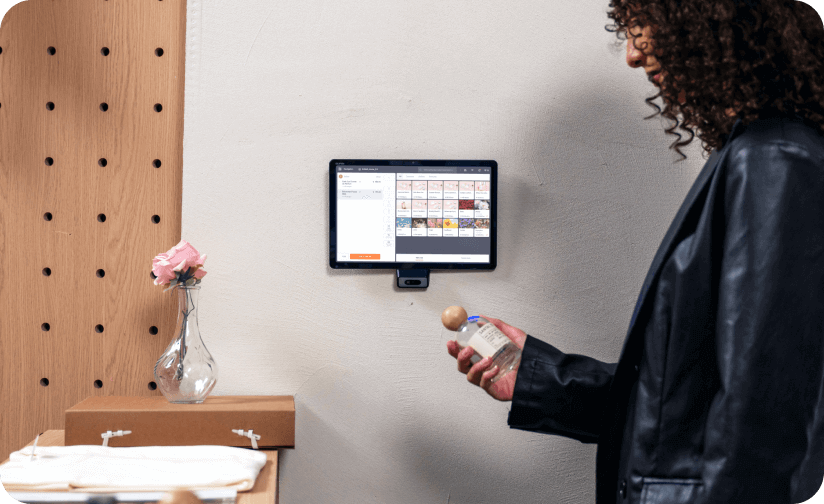
With a standardized business tablet, these workflows can be handled the same way in every store. Store associates can use one device to search products, verify pricing, and access inventory or location information in real time, without switching tools or learning different setups across locations.
SUNMI CPAD is built to scale. As tablets for business use, it is easy to set up across different stores. It also works the same way every time, so it is easier to manage.
Many retailers see it as the best tablet for retail business. It can be used for checkout, mobile customer service, and inventory tasks, all within one device family.
FAQ: Why is consistency so important in retail tablet deployment?
Inconsistent devices slow down training and increase errors. SUNMI CPAD helps retailers standardize hardware and workflows, reducing operational friction and improving staff efficiency.
Tablet for Business Use in Warehouses: Built for Real Work
Warehouses demand durability and accuracy. Devices must withstand movement, long shifts, and frequent scanning.
Consumer android tablets are fragile and heavily dependent on external scanners. SUNMI CPAD integrates industrial-grade scanning directly into the device.
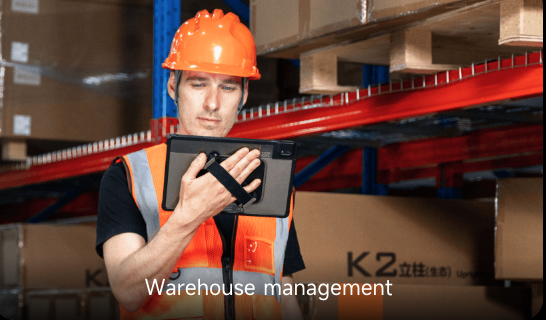
As a reliable tablet for warehouse operations, CPAD supports real-time data capture and stable connectivity, reducing errors and improving productivity.
FAQ: Can a tablet really replace dedicated warehouse scanners?
In many workflows, yes. SUNMI CPAD has built-in scanning. Workers can check inventory and pick items without using another device. This helps them work faster and make fewer mistakes.
Beyond Hardware: Why Deployment Strategy Matters
Choosing the right device is only part of the decision. Deployment, configuration, and long-term support are equally important.
Without the right partner, even strong hardware can fail to deliver value. This is where the role of a professional distributor becomes essential.
Why Rosper Adds Real Value as a SUNMI Distributor
If you are evaluating a high-value tablet for business use, working with an experienced distributor can significantly reduce deployment risks. As an authorized SUNMI distributor in America and Canada, Rosper provides professional consultation across the entire SUNMI product ecosystem, helping businesses choose the right devices based on real operational workflows.
Rosper operates four warehouses in Los Angeles, Tracy, New Jersey, and Maryland, providing full coverage across the U.S. and Canada. With stable local inventory, most orders ship within 1–2 business days, helping businesses avoid delays and shorten deployment cycles.

Rosper maintains ready inventory for popular SUNMI models such as Flex 3,CPAD and D3 PRO, allowing partners to quickly test and deploy devices. Beyond tablets, Rosper supports a full range of SUNMI devices for business, including mobile payment terminals, kiosk solutions, desktop POS systems, and integrated payment hardware designed for commercial scalability.
Rosper maintains ready inventory for popular SUNMI models such as Flex 3 and D3 PRO, allowing partners to quickly test and deploy devices. Beyond tablets, Rosper supports a full range of SUNMI devices for business, including mobile payment terminals, kiosk solutions, desktop POS systems, and integrated payment hardware designed for commercial scalability.
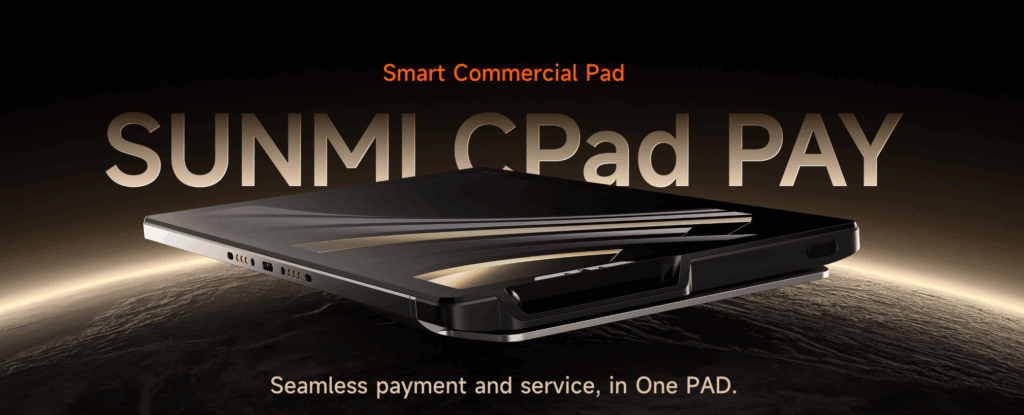
In addition to CPAD, SUNMI also offers CPAD Pay, a tablet designed for business use. CPAD and CPAD Pay serve different operational priorities. SUNMI CPAD is designed as a flexible tablet for business use, focusing on workflow management, system integration, and multi-device connectivity across POS, inventory, and service applications.
CPAD Pay builds on CPAD by adding integrated payment acceptance, including NFC, QR, and card transactions, turning the device into an all-in-one payment and POS terminal. Businesses typically choose CPAD for operational flexibility, while CPAD Pay is ideal for merchants that want checkout and payment built directly into one device.
Rosper supports multiple delivery options, including FedEx, UPS, LTL freight, drop shipping, and warehouse pickup. If a model is temporarily unavailable in North America, Rosper can arrange direct China shipment within 1–2 weeks to keep projects moving.
Beyond logistics, Rosper delivers strong pre-sales and post-sales support. With deep SUNMI product experience and direct communication with SUNMI teams, Rosper provides device testing, technical consultation, and deployment guidance to reduce risk and improve long-term ROI.
Conclusion: Choosing the Right Tablets for Business Use
SUNMI CPAD is not competing with iPad or Samsung in the consumer market. It replaces them where they fall short—professional environments.
As true tablets for business use, SUNMI CPAD delivers stability, integration, and scalability. It supports restaurants, retail, and warehouses. Choosing the right hardware also means choosing the right partner. With Rosper as a trusted SUNMI distributor, businesses gain fast deployment, reliable supply, and expert support that helps ensure long-term operational success.