
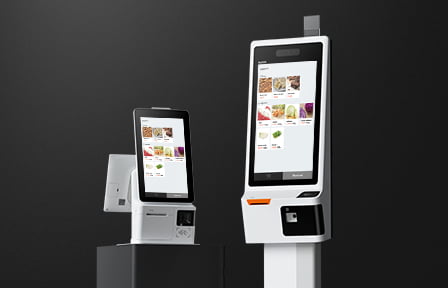
Self-order kiosks have moved from a “nice tech demo” to a labor strategy. With US restaurant wages at 16 to 22 USD per hour and labor shortages still pricing in across QSR and fast-casual, a 4-lane K2 fleet does more than reduce headcount: it lifts average ticket 15 to 30 percent through upsell prompts the cashier line consistently skips. This guide walks the 2026 SUNMI kiosk lineup, the procurement decisions that actually move ROI, and the deployment pattern that ships 4 units in under 8 weeks instead of 16.
Key takeaways
- Self-order kiosks lift average ticket by 15 to 30 percent for QSR concepts, per published industry studies, by exposing modifiers and combo prompts the cashier line skips.
- The K2 (21.5 inch floor or wall mount) and K2 Mini (15.6 inch countertop) cover 95 percent of restaurant kiosk use cases without custom hardware.
- A 4-kiosk deployment for a 200 ticket per day fast-casual concept typically pays back in 9 to 14 months at current labor rates of 16 to 22 USD per hour.
- ADA Section 508 compliance for federally funded or public sector deployments requires reach range, screen-reader audio jack, and tactile cues built into the hardware, not bolted on.
- Procurement timeline from RFP to deployed-and-live is 4 to 8 weeks with a US-stocking authorized distributor, versus 10 to 16 weeks with cross-border direct order.
The 2026 restaurant kiosk landscape
Two structural pressures have pushed kiosks from optional to operational. First, US restaurant labor costs continue to climb: the Bureau of Labor Statistics May 2024 occupational data put median food service hourly wages at 14.96 USD, with effective fully-loaded labor running 18 to 23 USD per hour in metro markets once payroll taxes, benefits, and turnover replacement cost are included. Second, customer ticket-size data published by multiple national QSR chains shows a 15 to 30 percent lift when the order interface presents combo prompts and modifier upsells consistently, which humans under shift pressure do not do reliably. The math has tilted: the kiosk is no longer discretionary capex for chains over 5 locations doing 150-plus tickets per shift.
Best SUNMI kiosk for your restaurant: K2 vs K2 Mini decision matrix
The current SUNMI restaurant kiosk lineup covers two form factors that solve the 95 percent case for restaurant self-order: the K2 (21.5 inch floor or wall mount) and the K2 Mini (15.6 inch countertop). Picking between them is a function of throughput, floor plan, and brand presentation, not feature checklists.
| Use case | Recommended SKU | Why |
|---|---|---|
| QSR drive-thru indoor lane, 200-plus tickets per day | K2 (floor mount) | 21.5 inch screen reads from 6 feet, payment terminal pedestal mounts cleanly, queues handle 4-deep lines without crowding the order rail. |
| Fast-casual order ahead pickup, 100 to 200 tickets per day | K2 (wall mount) | Wall mount saves floor footprint, separates order from pickup flow, ADA reach range easy to hit at the specified mount point. |
| Cafe, juice bar, dessert shop, under 100 tickets per day | K2 Mini (countertop) | Sits on existing counter, customer line of sight matches cashier interaction, lower hardware spend with same Android stack so software portfolios across the chain. |
| Stadium concession, cinema lobby, transit hub | K2 (floor mount) | Built for crowd traffic and standing-eye-level reads, hardened glass and steel housing survive 12-hour event days. |
| ADA-mandated public sector or federal contractor deployment | K2 (wall mount) | Wall mount controls the reach range and viewing height variables that ADA Section 508 procurement specs require. |
Both kiosks run Android and use the same SUNMI device management agent, so a chain that mixes K2 floor units in flagship stores and K2 Mini on smaller pickup counters can run one application build and one MDM policy across the entire fleet. That matters at the 10-plus location threshold where managing two device profiles becomes a real operational tax.
Kiosk cost, total cost of ownership, and the payback math
Three lines drive the kiosk business case: hardware, install, and ongoing software. Hardware is a one-time purchase, with the countertop K2 Mini priced below the full-size K2 and volume tiers at 5, 10, and 25 units unlocking additional savings through an authorized US distributor; request a quote for current figures. Install (mounting, network drop, payment terminal pairing, application load, staff training) lands between 500 and 1,500 USD per unit depending on whether existing electrical and data already serve the kiosk location. Ongoing software is the kiosk application subscription plus the payment terminal acquiring fees, which are a function of card mix and ticket profile, not the kiosk choice.
On the revenue side, two effects compound. The upsell effect adds 15 to 30 percent to average ticket value, because the kiosk presents the combo and modifier sequence every single transaction without staff variability. The labor effect reallocates 0.5 to 1.0 cashier full-time equivalent per location to expo, prep, or table-touch, which is where guest satisfaction (and tip income for the team) gets earned in 2026. A 4-kiosk rollout in a 200-ticket-per-day fast-casual at an 11 USD average ticket and 18 USD blended labor cost pays the hardware back in 9 to 14 months, then compounds gross profit for the remaining 4 to 5 years of hardware life.
ADA Section 508 compliance for public sector and franchise procurement
Procurement teams running RFPs for federal, state, or large franchise systems hit ADA Section 508 as a gating requirement, not a nice-to-have. The relevant chapters: reach range (which mandates where touch targets can live on the screen based on mount height), tactile cue placement (a raised cue locating the headphone jack and home/help controls), and an audio output path for screen-reader navigation. The K2 hardware platform supports all three with the correct mount kit. Full compliance is always hardware-plus-software, so a kiosk application running on the K2 must also pass WCAG 2.1 AA color contrast, focus order, and operability checks. For procurement officers writing the spec, the safest pattern is to specify the K2 wall-mount configuration with the audio jack populated, then require the software vendor to demonstrate Section 508 conformance against the running application, not the hardware alone. The Section 508 laws and policies overview and the US Access Board ICT accessibility standards are the authoritative references the procurement team will cite back.
Procurement and deployment timeline: 4 to 8 weeks vs 16 weeks
The single biggest cost lever no one talks about is the procurement path. Buying SUNMI kiosks direct overseas, with no US stocking and no local install partner, typically runs 10 to 16 weeks from PO to live and exposes the deployment to FCC and customs holds that surface at exactly the wrong moment. Buying through an authorized US distributor stocking the units in-country compresses the same deployment to 4 to 8 weeks and pre-clears the import paperwork.
Realistic 4-unit deployment timeline through an authorized distributor:
- Week 1: PO issued, hardware reserved from US stock, payment terminal model finalized.
- Week 2: Hardware shipped to the integration partner or store, bench configured with the kiosk application and MDM enrollment.
- Week 3: Site survey, network drop confirmed, electrical reviewed, mount kit installed.
- Week 4: Kiosks installed on site, payment terminal paired and tested, staff trained on assisted-checkout fallback.
- Week 5 to 8: Soft launch, ticket-lift measurement, second wave of menu and upsell prompt tuning based on first-week data.
For chains rolling out 25 or more units across multiple sites in one quarter, the difference between the 4 to 8 week path and the 16 week path is one full season of incremental revenue and labor savings. Procurement leaders running multi-location chains typically anchor the RFP on the distributor’s in-country stock position, warranty turnaround SLA, and ability to run a coordinated install schedule across multiple time zones rather than the unit price alone.
When a SUNMI kiosk is not the right call
Three scenarios where the kiosk math does not work in 2026. Concepts under 80 tickets per shift with a single cashier rarely save enough labor to clear the install hurdle inside 18 months. Full-service casual dining where the experience is the table-side interaction often sees flat to negative guest satisfaction when the entrance flow gets replaced by a kiosk; consider SUNMI handheld POS for table-side order capture instead. Drive-thru-only QSR with no indoor seating and an existing drive-thru menu board can often get most of the ticket-lift benefit from the menu board upsell logic without adding kiosk hardware capex, which makes the kiosk a strategic add for second-stage growth, not a first deploy.
Frequently asked questions
What drives the cost of a SUNMI K2 kiosk in 2026?
Kiosk hardware is a one-time purchase, with volume discounts available at 5, 10, and 25 unit tiers through an authorized US distributor and the K2 Mini countertop version positioned below the full-size K2. For current figures, request a quote through an authorized US distributor. Total cost of ownership over 5 years should also include payment terminal integration, mounting hardware, install labor, and software subscriptions, which often add 30 to 60 percent to the hardware line.
What is the payback period for a restaurant self-order kiosk?
For a quick-service or fast-casual concept doing 150 to 250 tickets per shift, a kiosk fleet typically pays back in 9 to 14 months. Two drivers do most of the work: 15 to 30 percent average-ticket lift from upsell prompts that cashiers skip under pressure, and 0.5 to 1.0 cashier full-time equivalent labor reallocation per location. A 4-kiosk lane at 18 USD per hour blended labor recovers roughly 33,000 to 38,000 USD per year in labor.
Is the SUNMI K2 ADA Section 508 compliant?
The K2 hardware platform supports the physical requirements needed for ADA Section 508 procurement: an audio jack for screen reader output, tactile cue placement, and a screen height range that meets reach requirements when wall-mounted at the specified mount point. Full compliance is always a function of both hardware and the kiosk application software, so deployments for public sector, university, hospital, and federal contractors should validate the running software against WCAG 2.1 AA and Section 508 chapters before procurement sign-off.
Does the SUNMI kiosk integrate with my payment processor?
The K2 and K2 Mini run Android and accept payment over standard semi-integrated payment device protocols. The most common deployment pattern in 2026 is to pair the kiosk with a separate PCI-listed payment terminal mounted on the kiosk pedestal, communicating over the local network or USB. The kiosk application calls the payment terminal for tender, and the terminal returns an approval token. This pattern preserves PCI scope on the certified terminal and keeps the Android kiosk out of PCI cardholder data environment.
What is the lead time to deploy 4 kiosks?
A typical 4-unit deployment with a US-stocking authorized distributor runs 4 to 8 weeks from PO to live: 1 to 2 weeks for hardware ship and bench config, 1 to 2 weeks for site survey, mounting, and network drop, 1 to 2 weeks for kiosk application install and payment terminal pairing, and a final week for staff training and soft launch. Cross-border or direct-from-overseas orders typically add 4 to 8 weeks of additional ship and customs time.
What is the difference between SUNMI K2 and K2 Mini?
The K2 is a 21.5 inch full-size floor-stand or wall-mount kiosk targeted at high-traffic QSR, cinema, and stadium concession lanes. The K2 Mini is a 15.6 inch countertop kiosk for cafes, juice bars, and small footprint restaurants that need self-order without giving up counter real estate. Both run the same Android OS and integrate with the same payment terminal options, so software written for one can run on the other with a layout tweak.
Can I manage 20 kiosks remotely?
Yes. SUNMI hardware ships with a remote device management agent that lets a single operator push application updates, lock screens, monitor health, and recover devices across a multi-location fleet from one console. For chains running 10 or more units across multiple sites, this is the difference between dispatching a tech for every config change and pushing it from headquarters in an afternoon.
Talk to a US-stocking authorized SUNMI distributor
Rosper Technology is a US-stocking authorized SUNMI distributor handling K2 and K2 Mini deployments across QSR, fast-casual, stadium, cinema, transit, and public sector procurement. For a 4 to 25 unit deployment quote, ADA Section 508 documentation packet, or a 30-minute consult on whether kiosks are the right call for your concept, contact Rosper for a deployment plan and unit pricing.