
In 2026, the ISOs winning new merchant deals are the ones bundling SUNMI payment terminal ISO partner hardware into the merchant agreement, not the ones quoting interchange-plus over the phone and hoping the merchant brings their own terminal. The math is straightforward: hardware margin captures the first purchase, the ISO logo on the device in the merchant’s hand protects the relationship at renewal, and 36 to 60 months of processing residuals on the same merchant build the recurring revenue base. This guide walks the SUNMI payment hardware lineup positioned for ISO and MSP partners, the semi-integrated payment architecture that keeps PCI scope tight, the ISO-branded hardware program, and the partner onboarding path for ISOs ready to ship hardware in 2026.
Key takeaways
- For ISOs bundling hardware with merchant accounts in 2026, SUNMI ships two PCI-compliant payment platforms: the P2 handheld payment terminal and the CPad Pay tablet payment device, both certified to the PCI PTS standard.
- The semi-integrated payment pattern (kiosk or POS calls a separate PCI-certified payment device) keeps the merchant Android device out of the cardholder data environment and dramatically simplifies PCI DSS scope.
- White-label and ISO partner programs through SUNMI authorized distributors let ISOs ship hardware branded for the ISO instead of the manufacturer, which protects merchant relationships at renewal.
- ISO bundling math: hardware margin plus 36 to 60 months of processing residuals on the same merchant is the structural reason every serious ISO ships hardware in 2026.
- For ISO partner onboarding, Rosper ISO partner program provides US-stocking, FCC and PCI documentation, MDM enrollment, and semi-integrated SDK support.
The 2026 SUNMI payment terminal ISO playbook: why hardware bundling matters
Two structural shifts have reshaped the ISO market over the last 24 months. First, merchant churn at renewal has risen sharply as a wave of payment processor pricing pressure and bundled software-plus-payments competitors has trained merchants to expect a hardware refresh at every renewal cycle. Second, the EMV and PCI PTS device generation in service at most US merchants is aging into mandatory replacement windows, which creates a structural reason for every merchant to take a hardware call in 2026 and 2027. ISOs who ship hardware capture both the replacement cycle revenue and the renewed merchant relationship; ISOs who refer the merchant to a hardware vendor lose the touch point at exactly the moment competitors are calling.
The SUNMI payment hardware lineup for ISO deployments
Two devices anchor the SUNMI payment-class hardware portfolio currently positioned for ISO and MSP partner programs in the US market:
- SUNMI P2: handheld payment terminal with EMV chip, magnetic stripe, contactless tap, and PCI PTS certification. Form factor positioned for restaurants, mobile services, in-home delivery payment, and any merchant where the payment device travels to the customer rather than the customer to the counter.
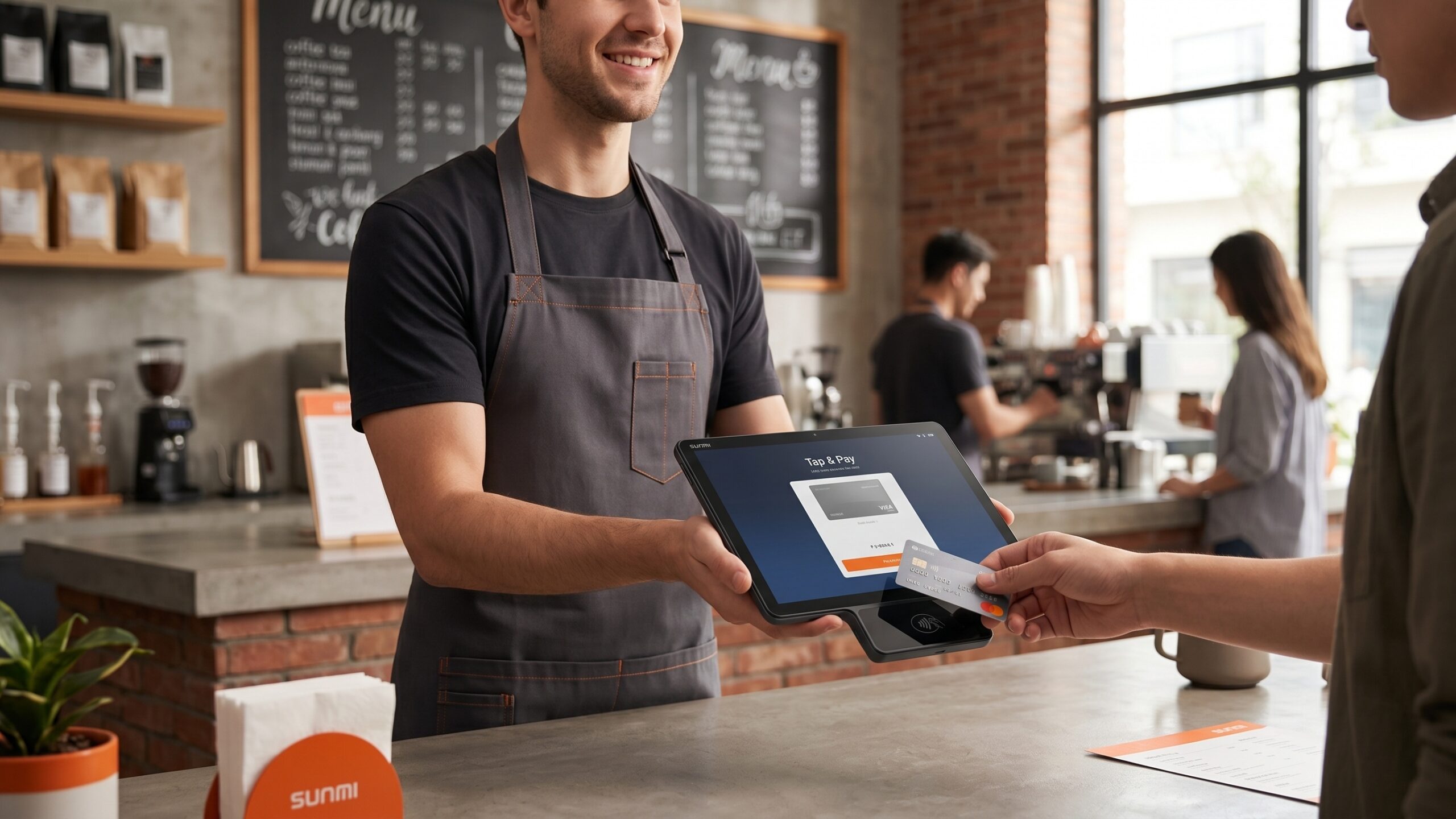
- SUNMI CPad Pay: tablet-form payment device with built-in PCI-certified payment surface. Form factor positioned for salon and spa checkout, table-side casual dining, retail checkout where a tablet UX matters, and any merchant scenario where a full-size Android tablet UX combines with PCI hardware payments on the same device.
Beyond the payment-class devices, the broader SUNMI Android lineup (V3 family handheld, T3 Pro family counter, K2 kiosk) integrates with the P2 or CPad Pay using the standard semi-integrated payment pattern, which lets the ISO ship a full POS-plus-payment bundle from one platform.
Semi-integrated payment architecture: keep PCI scope tight
The semi-integrated payment pattern is the default architecture for new ISO-led merchant deployments in 2026 because it dramatically narrows the merchant’s PCI DSS audit footprint. The flow:
- The merchant’s POS or kiosk application (running on T3 Pro, K2, or a similar device) calculates the order total and calls the payment device with the amount to charge.
- The payment device (P2 or CPad Pay) prompts the cardholder, captures the card (EMV chip, contactless tap, or magnetic stripe), runs the authorization through the processor over its own network connection, and returns an approval token to the calling application.
- The POS or kiosk application records the approval token against the order and prints the receipt. No card number ever touches the POS application or its environment.
- PCI DSS audit scope at the merchant covers the payment device and the network segment that carries payment traffic, but does not extend into the POS application, the merchant’s general-purpose Wi-Fi, or the kiosk Android OS environment.
For ISOs supporting merchant PCI compliance, this architecture is the difference between an annual self-assessment questionnaire that covers two devices and a network segment, versus a full PCI DSS audit covering every device in the merchant’s store. Merchants notice this when the renewal QSA conversation starts; ISOs who lead with the semi-integrated architecture as a default win the procurement decision.
White-label and ISO-branded hardware: protect merchant relationships at renewal
The renewable-merchant economics of the ISO model break down when the merchant develops loyalty to a hardware vendor instead of the ISO. A merchant looking at a payment terminal stamped with a manufacturer logo at year 3 of the relationship sees a hardware vendor first and the ISO second, which is the wrong frame at renewal time. ISO-branded hardware inverts that: the merchant sees the ISO’s logo every day the terminal is on the counter, and the renewal conversation starts from a position of installed-base loyalty rather than a competitive bid.
The SUNMI partner program supports three branding tiers through the authorized distributor:
- Tier 1 (low MOQ, fastest turnaround): MDM-managed boot logo, lock screen, and home screen branding applied at bench config. No hardware MOQ beyond the standard volume tier.
- Tier 2 (medium MOQ, multi-week turnaround): Custom boot animation, ISO-branded accessory pack (USB cable color, ISO-branded box insert, ISO welcome card). MOQ in the 50 to 200 unit range.
- Tier 3 (higher MOQ, longer turnaround): Physical device housing branding (laser engraving or color application), custom retail packaging. MOQ in the 100 to 500 unit range depending on housing branding depth.
For ISOs starting an ISO-branded hardware program, the proven path is to start at Tier 1 with a 50 to 100 unit initial program, validate merchant pull-through and ISO sales motion, then commit to Tier 2 or Tier 3 at the next volume tier once the operational pattern is proven.
ISO partner onboarding: documentation, certification, and stocking
A typical ISO partner onboarding through Rosper ISO partner program covers the documentation, certification, and stocking workflows that let the ISO ship to merchants within 30 to 60 days of contract signing:
- Hardware certification documentation: PCI PTS device listings, FCC ID filings, EMV kernel certifications, contactless network certifications (Visa, Mastercard, Amex, Discover plus regional networks).
- Semi-integrated payment SDK: integration guide and reference implementation for the ISO’s payment vendor SDK on the P2 and CPad Pay hardware platform.
- MDM environment setup: dedicated MDM tenant for the ISO, ISO-branded device profiles, application allowlist, OS update policy aligned to the ISO’s release cadence.
- US-stocking and ship: hardware physically in-country at the contract date, with ship-to-merchant addressing handled either by the ISO or the distributor depending on the ISO’s preferred fulfillment model.
- Warranty and swap pipeline: claim handling at the ISO level (one ticket queue for all ISO merchants), with stocked replacement units and a 2 to 5 business day swap SLA.
- Coordinated branding application: Tier 1 to Tier 3 branding workflows pre-set for the ISO, so each new wave of devices ships ready for merchant deployment without per-unit setup.
ISO bundling economics: hardware margin plus residuals math
The structural ISO economic case for shipping hardware in 2026, expressed as a working example. An ISO bundling a P2 handheld payment terminal plus an interchange-plus processing relationship with a typical mid-market restaurant or services merchant:
- Hardware: a one-time margin captured at deal close, sized by volume tier and configuration.
- Processing residuals: 30 to 80 basis points of merchant card volume, paid monthly for the 36 to 60 month life of the merchant relationship. On a mid-market merchant doing 500,000 USD per year in card volume, residuals run 1,500 to 4,000 USD per year per merchant.
- Renewal anchoring: ISO-branded hardware in the merchant’s hand at year 3 reduces churn by an estimated 20 to 40 percent versus un-branded or competitor-branded hardware (effect varies by vertical and ISO sales motion).
- Compounding base: every merchant signed in year N contributes residuals through year N+3 to N+5, so the ISO’s monthly run-rate compounds with every new merchant added to the book.
The ISO who ships hardware captures both the first-purchase economics and the recurring stream on the same merchant. The ISO who refers the merchant out to a hardware vendor captures only the processing residuals, and loses the merchant at renewal when a competitor calls with a fresh hardware quote and a sharper processing rate.
External certifications and references
For ISO compliance and legal teams writing merchant agreements that reference SUNMI payment hardware, the authoritative external certification references:
- PCI Security Standards Council device directory for current PCI PTS listings.
- FCC ID database for radio and wireless certification on the device platform.
- EMVCo for the EMV chip and contactless kernel specifications referenced in merchant agreements.
Frequently asked questions
What SUNMI payment terminals are PCI PTS certified in 2026?
SUNMI ships two payment-class devices currently positioned for ISO and merchant deployment: the P2 handheld payment terminal and the CPad Pay tablet payment device. Both are certified to the PCI PTS standard (the PIN Transaction Security framework that governs payment hardware), with current listings on the PCI Security Standards Council device directory. For ISOs writing merchant agreements, the relevant certifications to specify in the contract are PCI PTS for the device, EMV Level 1 and Level 2 for the contact and contactless kernel, and the regional contactless certifications (Visa, Mastercard, Amex, Discover, plus regional networks where applicable).
Can I white-label SUNMI hardware for my ISO brand?
Yes, white-label and ISO-branded hardware is supported through the SUNMI partner program operated by authorized distributors. The typical pattern: the ISO works with the distributor on minimum order quantity, branding artwork (boot logo, device skin, accessory packaging), and per-unit branding cost. Branded devices ship from the distributor with the ISO logo on the device housing, ISO welcome materials in the box, and the ISO MDM enrollment pre-applied. For ISOs protecting merchant relationships at renewal, putting your brand on the hardware in the merchant’s hand is a structural advantage that no software stack alone provides.
What is semi-integrated payment and why does it matter for ISO deployments?
Semi-integrated payment is the pattern where the POS or kiosk application does not handle card data directly. Instead, the application calls a separate PCI-certified payment device (the P2 handheld or CPad Pay tablet in SUNMI deployments) which prompts the cardholder, captures and tokenizes the card, completes the EMV authorization, and returns an approval token to the calling application. The application never touches the card number. The PCI DSS audit scope is then constrained to the certified payment device and the network segment connecting it, not the entire POS environment. This pattern is the default architecture for new merchant deployments in 2026 because it dramatically reduces PCI DSS audit burden for the merchant and for the ISO supporting them.
What is the typical ISO bundling economics for hardware plus processing?
The structural reason every serious payment ISO ships hardware in 2026: hardware margin captures the first-purchase economics, and 36 to 60 months of merchant processing residuals on the same merchant captures the recurring stream. A bundled deal that captures hardware margin at deal close plus an interchange-plus processing relationship that yields 30 to 80 basis points of residual margin on the merchant’s volume creates an annual residual that compounds while the hardware sits depreciated on the merchant’s counter. ISOs who ship third-party hardware capture only the processing residual, and lose the merchant when a competitor calls with a fresh hardware quote 24 months in.
How does SUNMI payment hardware integrate with my payment processor or gateway?
SUNMI P2 and CPad Pay support the standard semi-integrated payment SDK pattern with multiple US payment vendors. The integration model: the ISO’s payment vendor (or the ISO’s own gateway) provides a payment SDK for Android that runs on the device, handles the EMV and contactless flows, communicates with the processor, and returns approval tokens to the application. SUNMI provides the hardware certifications (PCI PTS), the Android OS environment, and the device management agent. The processor or gateway vendor provides the payment SDK, processor connectivity, and tokenization. For ISOs running a closed-loop integration, the SUNMI partner program supports SDK certification on the device platform.
What is the minimum order quantity for branded SUNMI hardware?
MOQ for branded hardware varies by the branding scope: pure software MDM and boot-logo branding has effectively no hardware MOQ beyond the standard 5 or 10 unit volume tiers. Physical device housing branding, custom boot animation, custom accessory packaging, and ISO-branded inserts typically require 100 to 500 unit MOQ depending on the branding depth and the ship region. For ISOs piloting an ISO-branded hardware program, the staged path is: start with MDM and boot-logo branding at low MOQ, prove merchant pull-through, then commit to physical-housing branding at the next volume tier.
Does SUNMI hardware support contactless and tap-to-pay?
Yes. The P2 and CPad Pay payment terminals support EMV chip-and-PIN, magnetic stripe (where regulators still require), and contactless tap including phone-based tokenized payments (Apple Pay, Google Pay, Samsung Pay, plus regional wallets). The contactless kernel certifications cover the major US networks and regional schemes. For ISOs deploying into specialty merchant verticals where regional payment schemes matter (transit, government, healthcare), the SUNMI partner program supports additional kernel certifications on a case-by-case basis through the authorized distributor.
Apply to the Rosper ISO partner program
Rosper Technology runs the US-stocking authorized SUNMI distribution channel for ISOs, MSPs, and payment processors bundling SUNMI payment hardware into merchant agreements. For ISO partner program onboarding, hardware certification documentation, semi-integrated payment SDK integration support, or a 30-minute call on bundling economics for your merchant book, apply to the Rosper ISO partner program or contact Rosper for an ISO bundling plan.