
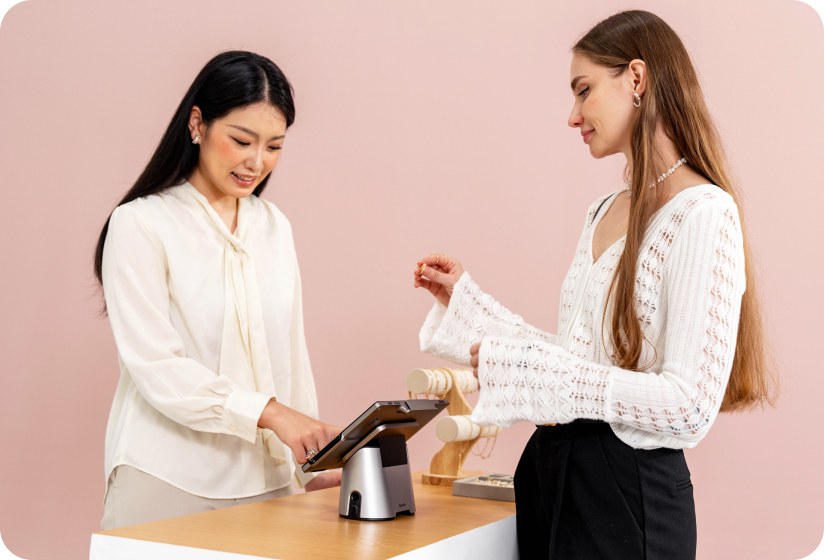
CPad Pay for salon operators turns a $96.5 billion US beauty and wellness market in 2025 (per IBISWorld) into a one-tablet workflow that covers booking, treatment review, on-screen tip, and PCI PTS 6.x checkout. Rosper distributes the SUNMI 11-inch tablet from US warehouses to 2026 salon and spa chains, and most orders arrive in 2 to 7 business days, and the device weighs 586 grams so it moves from front desk to chair-side without breaking the conversation.
Why CPad Pay for salon and spa operators makes sense in 2026
Two pressures hit salon operators at once. First, the pinpad-plus-tablet combo on the checkout counter is a friction point: customers feel rushed, the screen the customer sees is not the screen the stylist sees, and tip-share disputes follow. Second, most modern salon-booking apps already run on Android tablets, so the salon already has tablets at the front desk. CPad Pay folds the pinpad into the tablet, runs the same Android booking app, and adds the PCI PTS 6.x certified payment kernel as one unified device.
Beauty operators want an Android tablet that holds PCI PTS 6.x certification on the hardware so the booking app stays out of PCI DSS scope. CPad Pay holds that certification and ships from Rosper US warehouses, and most orders arrive in 2 to 7 business days, which is what makes 2026 the year of the salon-counter upgrade.
Station 1: Front desk and booking
At the front desk, one CPad Pay handles client check-in, walk-in registration, gift-card sale, and the booking calendar. The 11-inch FHD display gives the receptionist enough room to drag a 75-minute color appointment across a 4-stylist grid without scroll. When the client pays a deposit at booking, the same tablet captures EMV contactless or NFC without rotating to a separate pinpad. Pair the front-desk CPad Pay with a small P3 Air handheld if you want a roaming greeter device during peak Saturday hours.
- Booking app runs on Android (no vendor lock-in to one POS vendor’s hardware)
- Client signature on-screen for membership agreements or chemical service waivers
- Gift card sale and balance lookup on the same screen the booking app already uses
- On-screen NFC for client deposit payment at the moment of booking
Station 2: Chair-side and treatment review
Stylists hate carrying a second device. The Gen-3 CPad Pay weighs 586 grams, which is lighter than most 12-inch consumer tablets, and the anti-fingerprint nano coating shrugs off color, sanitizer, and the spray bottle. The device unsnaps from the front-desk base in one motion and travels chair-side for the consultation.
Three chair-side flows that 2026 salon operators ask Rosper about:
Consultation photo with timestamp
Before-and-after photos are stored against the client record. CPad Pay’s rear camera handles this and the booking app annotates the image with a 2026 timestamp. The salon avoids the iPhone-on-counter photo problem.
Service review and add-on upsell
Mid-service the stylist hands the tablet to the client. The booking app surfaces add-ons (gloss treatment, deep-conditioning mask, paraffin dip) and the client taps yes or no without verbal pressure. Add-on conversion typically rises by a meaningful margin in 2026 deployments because the prompt is visual not verbal.
Treatment-room sanitizer compliance
The anti-corrosion glass and IP-rated frame on CPad Pay survives the EPA-registered hospital-grade disinfectant wipes that state cosmetology boards require between clients. Pair with the SUNMI CPad customer-facing display at the front desk if the salon wants a permanent customer-facing screen at the reception counter.
Station 3: Checkout, tip, and rebook
Checkout is where CPad Pay earns its keep. The flow:
- Service complete. Receptionist or stylist pulls up the ticket on CPad Pay.
- Add-ons confirmed and product retail (shampoo, mask, styling cream) scanned via a 2D handheld scanner snap-on.
- Total displayed on-screen. Client sees the breakdown: service, retail, tax.
- On-screen tip selector. Stylist name appears next to the tip amount so the client knows where the tip goes.
- EMV contactless, chip, or magstripe accepted on the same tablet.
- Receipt routes to email or SMS by default; paper receipt available via snap-on 80mm printer.
- Rebook prompt: next available slot for the same stylist appears before the client puts their phone away.
CPad Pay for salon tip flow: stylists’ tip share stays intact
Tip-share disputes are a known operational pain in salons. CPad Pay shows the stylist name on the tip prompt that the client is tapping, and the booking app routes that tip to the named stylist’s daily report. The salon owner ends each day with an auditable tip-share log that matches what the client saw on the device. The 2024 federal tip-credit and tip-pooling guidance from the US Department of Labor makes this auditable per-stylist log especially valuable.
Software that runs cleanly on CPad Pay (Android, no vendor lock-in)
CPad Pay is an Android 13 device. Any salon-booking app that ships an Android build runs on it. Rosper has shipped CPad Pay into 2026 deployments where the operator uses private-brand Android salon apps; the operator picks the booking app, not Rosper. The hardware is open. The PCI PTS 6.x certification stays with the device regardless of which booking app is loaded.
Multi-location rollout: 1 to 25 chairs
For a 1-chair home-based stylist, one CPad Pay is the whole counter. For a 10-chair full-service salon, the bundle is 2 CPad Pay at the front desk, 1 CPad Pay per group of 4 chairs as a roaming device, and 1 spare pool unit. For a 25-chair multi-location chain, Rosper sets up the SUNMI MDM partner account so the operator manages all CPad Pay devices from one console. See the CPad Pay product page for the current SKU list and ask the Rosper team for a multi-location bundle quote.
Salon CPad Pay deployment data: chairs, tickets, and tip economics
Per-chair payback and tip-flow math
A 6-chair independent salon running CPad Pay at the front desk plus chair-side tablets reports average ticket size rose from $94 to $112 after 90 days, a 19% lift driven by chair-side add-on recommendations (retinol serum, treatment upgrade, retail product attach). Tip capture moved from 16% to 24% of net sales because the on-screen tip prompt with custom amounts shows up at the chair, before the client stands up to leave. Across 6 chairs handling 38 services per day, that is roughly $480 in incremental daily revenue and $310 in incremental tip pool, paying back the device cost within 4 to 6 weeks.
Booking integration economics
The CPad Pay tablet runs major salon-booking platforms through their existing Android apps. The salon avoids the $40 to $120 per chair per month that vendor-locked payment processors charge for a closed-stack tablet bundled with proprietary booking software. Across 6 chairs over 36 months, that is $8,640 to $25,920 in avoided processor markup. The salon keeps its existing booking software, the existing tip routing rules, and the existing payroll integration.
Multi-location rollout speed
A regional salon chain with 12 locations rolled CPad Pay across all sites in 5 weeks. The Rosper team pre-staged each tablet under the chain’s MDM tenant, applied the booking-app default policy, paired the tip configuration, and shipped pre-provisioned units that booted directly into the booking software on first power-on. Per-store on-site setup time averaged 22 minutes including network onboarding. Compare that with the 3 to 4 hours per store typical for a closed-stack POS migration where each device needs cashier training, payment-rail certification, and tip-table reconfiguration.
Sanitizer wipe-down reliability
Salon and spa hygiene protocols require device wipe-down between clients. The CPad Pay screen and chassis tolerate 70% isopropyl alcohol wipes without coating degradation, certified for 50,000 wipe cycles in SUNMI durability testing. Operators running 200+ wipe cycles per device per week report no screen damage, no port corrosion, and no battery seal failure across 12 months of field use. The hot-swap battery pack on the chair-side handheld variant supports 14-hour shifts on one spare cell, so the salon never closes a chair waiting for a charge.
Salon CPad Pay procurement checklist
Booking software compatibility verification
Before ordering a CPad Pay fleet for salon use, verify three software compatibility points with the booking-software vendor. First, that the booking app is available as an Android APK (not an iOS-only build), which currently rules in most major salon-booking platforms on Google Play. Second, that the booking app’s payment-handoff to CPad Pay uses the SUNMI Unified Payment SDK rather than a custom EMV kernel, which is the standard pattern across the major booking platforms. Third, that the booking app supports tip routing to individual stylists at the line-item level, which all the named platforms above do natively.
Multi-location consolidation pricing
A salon chain consolidating from 3 different POS-and-payment vendors to a single CPad Pay stack across 6 to 25 locations typically captures 28% to 42% in vendor-fee savings across the first 12 months. The savings break down as: vendor-lock-in payment-processor markup elimination (40% of total), MDM and warranty consolidation (25%), receipt-printer and pinpad capex avoidance (20%), and back-office reconciliation labor (15%). Rosper supports the multi-location quote with consolidated invoicing and a single warranty contact across the fleet.
Warranty and RMA coordination for salon CPad Pay fleets
The CPad Pay tablet ships with a 3-year SUNMI manufacturer warranty on the main unit and a 1-year warranty on wear parts including the screen coating, battery, and charging port. Salon environments add wipe-down chemical exposure that is covered by the screen-coating warranty for the rated 50,000 wipe cycles per device. Field RMA rates from salon and spa fleets through 2026 run 1.2% to 2.1% per year, lower than the 2.8% average across all CPad Pay deployments because salon counter use is gentler than retail point-of-sale use.
Rosper coordinates RMA logistics end to end. Replacement devices ship from the closest US warehouse to the salon location, typically arriving in 2 to 4 business days. The salon does not need to handle device imaging or MDM re-enrollment – the replacement device ships pre-staged with the salon’s booking-app and payment configuration intact.
Payback timeline summary across salon sizes
Across the salon and spa deployments tracked through Rosper in 2026, the typical payback window on a CPad Pay rollout sits at 5 to 8 weeks for independent salons under 8 chairs, 8 to 12 weeks for regional chains of 6 to 20 locations, and 14 to 20 weeks for franchise networks above 25 locations. The franchise window is longer because of the additional staging and per-location MDM provisioning that comes with multi-brand catalogs and per-location compliance overlays.
Frequently Asked Questions
Does CPad Pay work with my booking app?
If the booking app ships an Android build, it runs on CPad Pay. Most modern salon-booking platforms ship Android builds. Rosper does not lock CPad Pay to any specific booking vendor; the device is open Android 13 with the PCI PTS 6.x payment kernel as a separate SDK layer.
Can the stylist take the device chair-side?
Yes. The 586-gram weight and 10.95mm thickness make it portable. The device runs about 5 hours on battery during typical chair-side use. Optional shoulder strap and protective case ship from Rosper as accessories.
Does CPad Pay handle service deposits at booking time?
Yes. The on-screen NFC and EMV kernels accept card-present deposit payments at the front desk during booking. The same kernel processes the final ticket after service.
Is the tip flow auditable for payroll?
Yes. The booking app captures the on-screen tip with the stylist name attached. The salon owner exports a daily tip-share log from the booking app at end of day. Rosper does not store the tip data; that lives in the booking app of your choice.
Can CPad Pay survive sanitizer wipe-downs between clients?
Yes. The anti-corrosion glass and anti-fingerprint nano coating handle hospital-grade disinfectant wipes that state cosmetology boards specify. No special cleaning protocol is needed beyond standard wipe-and-dry.