
Key Takeaways
- CPad Pay 11 includes an on-device PCI-certified payment module; the standard CPad 11 does not.
- Both share the same 11-inch FHD touchscreen, Wi-Fi 6E, BT 5.3, and under-screen NFC on supported variants.
- Standard CPad 11 spans 3 GB to 8 GB RAM and 32 GB to 128 GB ROM across SKUs; CPad Pay is fixed at 4 GB + 64 GB.
- CPad Pay bundles a D3 Pro holder or T3 holder; standard CPad 11 is a stand-alone tablet with no bundled mount.
- Future X SKU adds Remote Key Injection (RKI) for processors that require RKI provisioning for card acceptance.
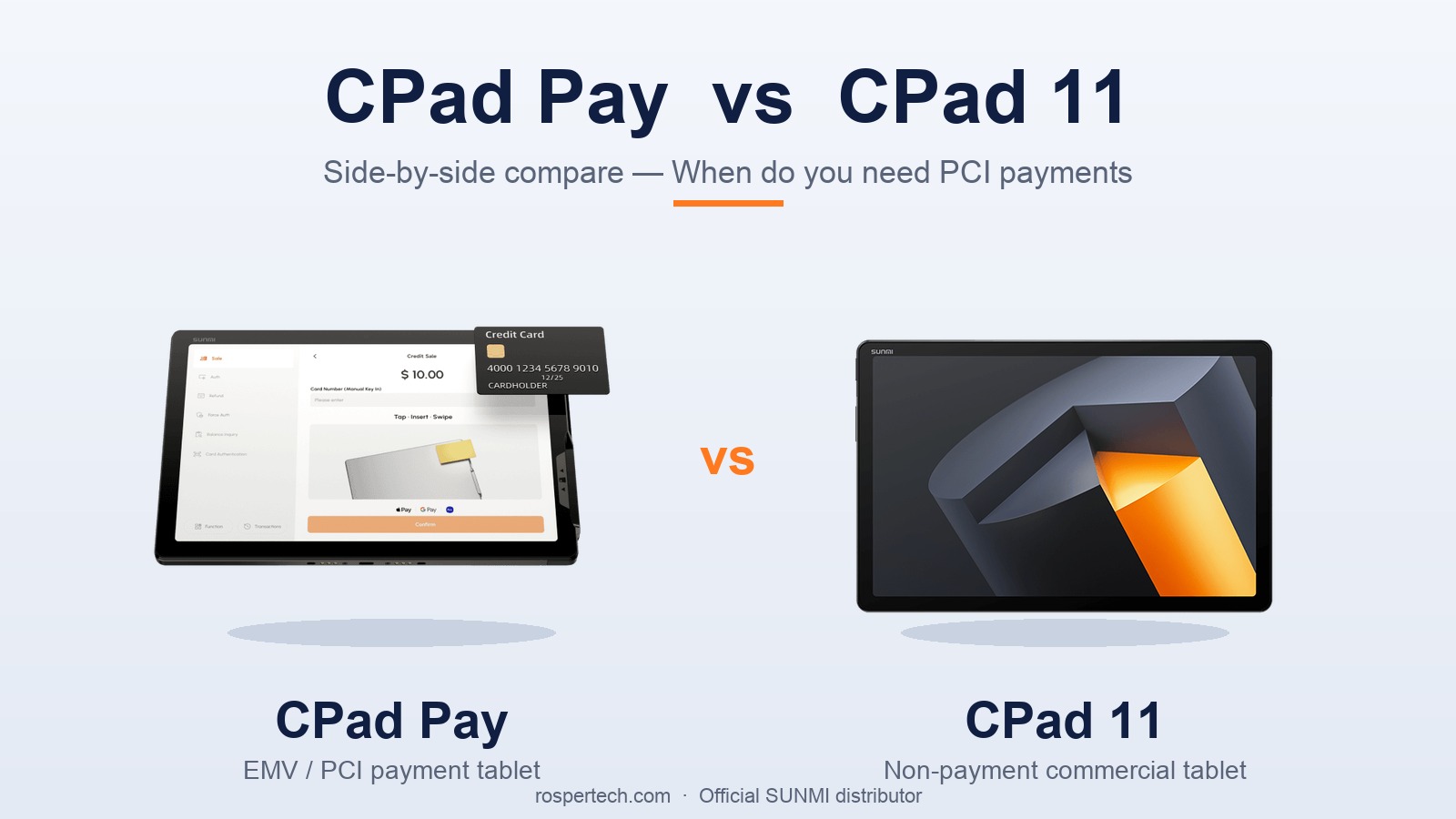
If you are scoping an 11-inch SUNMI tablet for the front counter, the cpad pay vs cpad 11 question is essentially a payment question. Both share the same 11-inch chassis, both run SUNMI’s commercial Android stack, and both can drive POS, inventory, and tableside workflows. The split is the on-device payment module: standard CPad 11 is a commercial tablet, and CPad Pay 11 adds a PCI-certified payment module that lets the tablet accept card payments directly without a separate card reader.
This guide walks through every cpad pay vs cpad 11 difference at the SKU level, the PCI and RKI details that decide which variant you need, the D3 Pro Display bundle, and the scenarios where the standard CPad 11 is the right pick. Rosper is the SUNMI distributor for North America and stocks every CPad and CPad Pay configuration from 8 warehouses across the US and Canada.
CPad Pay vs CPad 11 at a Glance
The CPad Pay 11 and the standard CPad 11 share the same 11-inch FHD touchscreen, Wi-Fi 6E radio, BT 5.3, under-screen NFC on supported variants, and the broader CPad accessory ecosystem. The split between them is the PCI-certified payment module, the RKI option, and the bundled D3 Pro or T3 holder.
| Spec | CPad Pay 11 | Standard CPad 11 |
|---|---|---|
| PCI-certified payment module | Yes, on device | No |
| Remote Key Injection (RKI) | Optional with Future X SKU | Not applicable |
| Bundled holder | D3 Pro holder or T3 holder | None, stand-alone tablet |
| Memory | 4 GB RAM + 64 GB ROM | 3 GB to 8 GB RAM, 32 GB to 128 GB ROM (varies by SKU) |
| Display | 11-inch multi-touch | 11-inch multi-touch |
| Under-screen NFC | Yes | Yes on 4G and Hyper WiFi variants, no on the 3G WiFi-only base SKU |
| Fingerprint reader | Yes | Yes on 8 GB 4G variants, no on the lower-memory variants |
| Wi-Fi | Wi-Fi 6E (2.4 / 5 / 6 GHz) | Same on most SKUs |
| Bluetooth | BT 5.3 | BT 5.3 |
| Built-in 2D scanner | No | Yes on P10020044, no on the others |
| Cellular | Wi-Fi, holder-tethered | 4G + eSIM on the 8 GB variants, Wi-Fi only on the others |
If the counter needs to take card payments on the device itself, CPad Pay is the only option. If the tablet is for ordering, inventory, line-busting, or as a customer-facing screen and a separate payment device handles the card, the standard CPad 11 covers that workload at a leaner spec point.
The PCI Payment Module Is the Headline Difference
The PCI-certified payment module on CPad Pay is the reason this SKU exists. It is the secure element required to accept chip, swipe, and contactless card payments on the device itself without an external card reader.
Standard CPad 11 has under-screen NFC on the 4G and Hyper WiFi variants, which is useful for reading membership cards, NFC tags, and HCE workflows. However, NFC alone does not make a tablet a payment terminal. A payment terminal needs a PCI-certified secure module, processor partnership, and EMVCo certification on top of the radio. CPad Pay packages all of that into the 11-inch chassis.
If your processor or payment partner requires Remote Key Injection (RKI), the Future X RKI variant of CPad Pay (P07180026) supports that workflow. Standard CPad 11 has no RKI path because it has no PCI payment module to inject keys into.
CPad Pay vs CPad 11: SKU Map
Rosper stocks four CPad Pay SKUs and five standard CPad 11 SKUs. Use the table below to map your floor plan to the right variant.
CPad Pay 11 SKUs
| SKU | Configuration | Holder | RKI |
|---|---|---|---|
| P07180008 | CPad Pay 11 plus D3 Pro display holder | D3 Pro | Standard |
| P07180026 | CPad Pay 11 plus D3 Pro display holder with Future X RKI | D3 Pro | Future X RKI |
| P07180007 | CPad Pay 11 plus T3 display holder | T3 | Standard |
| P07180027 | CPad Pay 11 plus T3 display holder | T3 | Standard |
Standard CPad 11 SKUs
| SKU | RAM / ROM | Network | NFC | Fingerprint | 2D Scanner |
|---|---|---|---|---|---|
| P10020092 | 3 GB + 32 GB | Wi-Fi | No | No | No |
| P10020037 | 4 GB + 64 GB | Hyper Wi-Fi | Yes | No | No |
| P10020096 | 4 GB + 64 GB | Wi-Fi | Yes | No | No |
| P10020042 | 8 GB + 128 GB | GL 4G + eSIM | Yes | Yes | No |
| P10020044 | 8 GB + 128 GB | GL 4G + eSIM | Yes | Yes | SS1111 2D |
The standard CPad 11 family lets you tune memory, cellular, and scanner to the workflow. CPad Pay sits on top of the 4 GB + 64 GB chassis with the PCI payment module and the holder bundle as the differentiators.
When CPad 11 Is the Right Choice
If the tablet does not need to accept card payments on the device, the standard CPad 11 is the leaner pick at a lower spec cost.
Tableside ordering and order-up workflows
Servers carry the tablet to the table, take the order, and fire it to the kitchen. Payment happens at the counter on a separate payment terminal or at the table on a dedicated payment device. Standard CPad 11 covers this with the 4 GB + 64 GB Wi-Fi or Hyper Wi-Fi SKU.
Inventory, receiving, and stock checks
Warehouse and back-of-store staff scan barcodes, update counts, and look up SKUs on the move. The CPad 11 with the SS1111 2D scanner (P10020044) handles this in one device, no payment module required.
Line-busting and queue-busting
During peak hours, staff with tablets help customers start orders before they reach the counter. Card capture still happens at the fixed terminal. Standard CPad 11 fits this role with the 8 GB 4G variant for outdoor or curbside coverage.
Self-service kiosks and customer-facing displays
The 11-inch screen is large enough for customer-facing menu boards, loyalty enrollment, and order confirmation. No PCI requirement when payment is taken on the host terminal.
Multi-location chains rolling out an MDM-driven fleet
If you are standardizing on the CPad 11 chassis across many locations, the standard CPad 11 lets you scale at the lower spec point while reserving CPad Pay for the counters that actually need payment certification.
When You Must Choose CPad Pay
There are five scenarios where standard CPad 11 will not do the job and CPad Pay is the right SKU.
You need card payment acceptance directly on the tablet
The counter has space for one device, not three. CPad Pay collapses the card reader, the POS app, and the receipt or signature flow into one 11-inch tablet docked in the D3 Pro or T3 holder. Standard CPad 11 cannot do this because it has no PCI payment module.
Your processor requires Future X RKI
Some processors and payment partners require Remote Key Injection (RKI) to provision the device with payment keys. P07180026 is the Future X RKI variant of CPad Pay built for that workflow.
You are using the D3 Pro Display bundle
The D3 Pro Display holder is part of CPad Pay bundles P07180008 and P07180026. The cashier sees the 11-inch tablet, the guest sees the 15.6-inch D3 Pro screen, and the tablet handles NFC tap, chip insert, and signature. Standard CPad 11 does not bundle into this holder pairing.
Beauty, spa, and boutique retail with a clean counter
Front-of-house aesthetics matter. CPad Pay replaces the visual clutter of a separate card reader, stand, and POS tablet with one docked device. Standard CPad 11 still needs a card reader next to it for card acceptance.
Multi-location operators standardizing the payment path
If you are deploying across 10, 20, or 50 locations and want one device family that handles both the POS workflow and the payment workflow, CPad Pay is the consolidated SKU. Standard CPad 11 fleets typically need a paired card reader at each station.
Connecting CPad Pay to the D3 Pro Display
CPad Pay 11 plus the D3 Pro Display bundle (P07180008, P07180026) is one of the more common counter configurations Rosper ships. The 11-inch CPad Pay docks into a holder mounted to the D3 Pro chassis, and the cashier and the guest each see their own screen. The 11-inch CPad Pay is the cashier interface and payment device. The 15.6-inch D3 Pro display is the guest-facing screen for the order review, tip prompt, and digital receipt confirmation. Payment happens on the CPad Pay through the PCI module and under-screen NFC. The guest taps a card, inserts a chip, or signs on the D3 Pro side.
This configuration suits restaurants, quick service, beauty, and boutique retail where the counter needs a real guest-facing screen and a real payment device, not two separate devices stitched together.
How to Choose Between CPad Pay and CPad 11
| Your Situation | Recommended SKU |
|---|---|
| Counter that needs to accept card payments on the tablet itself | P07180008 (CPad Pay plus D3 Pro holder) |
| Counter where your processor requires Future X RKI | P07180026 (CPad Pay plus D3 Pro holder with RKI) |
| Counter that already runs a T3 Pro desktop terminal as the primary POS | P07180007 or P07180027 (CPad Pay plus T3 holder) |
| Tableside ordering or line-busting with payment taken at the counter | P10020037 or P10020096 (standard CPad 11 Wi-Fi + NFC) |
| Inventory, receiving, and stock checks with barcode scanning | P10020044 (standard CPad 11 8 GB + 4G + scanner) |
| Outdoor or curbside coverage where Wi-Fi is unreliable | P10020042 (standard CPad 11 8 GB + 4G + eSIM) |
| Customer-facing display or self-service kiosk only | P10020037 (standard CPad 11 4 GB Hyper Wi-Fi + NFC) |
| Low-cost back-office tablet with no NFC or payment need | P10020092 (standard CPad 11 3 GB Wi-Fi) |
If you are unsure which variant fits your workflow, share your floor plan and processor with the Rosper team. The common pattern is CPad Pay at the payment counter, standard CPad 11 everywhere else.
Where to Buy CPad Pay and CPad 11 in the US and Canada
Rosper is the SUNMI distributor for North America and stocks every CPad Pay and CPad 11 SKU in 8 warehouses across the US and Canada. Most orders arrive in 2-7 business days from the nearest warehouse. Every Gen 3 SUNMI hardware unit sold through Rosper carries a 3-year warranty, and Rosper assists with warranty claims, helping you connect with SUNMI faster than buying direct from overseas.
Browse the CPad Pay product page on rospertech.com for the payment-certified variants, the CPad product page for the standard CPad 11 family, or request a quote with your unit count, processor, and whether you need RKI. The Rosper team will confirm SKU, lead time, and recommended accessories. Contact Rosper for availability and pricing.
CPad Pay vs CPad 11 FAQ
What is the difference between CPad Pay and CPad 11?
CPad Pay 11 is built on the same 11-inch chassis as the standard CPad 11, with the addition of a PCI-certified payment module that lets the device accept chip, swipe, and contactless card payments directly. CPad Pay bundles with a D3 Pro or T3 holder. Standard CPad 11 has no PCI payment module and is sold as a stand-alone commercial tablet for ordering, inventory, line-busting, and customer-facing display use.
Is CPad Pay PCI certified?
Yes. CPad Pay includes the on-device security module required for PCI-certified card acceptance. That module is the core reason to choose CPad Pay over the standard CPad 11. The Future X RKI variant (P07180026) also supports Remote Key Injection for processors that require RKI workflows.
Can CPad Pay connect to a D3 Pro Display?
Yes. CPad Pay bundles P07180008 and P07180026 ship with a D3 Pro Display holder. The 11-inch CPad Pay docks into a holder mounted to the D3 Pro chassis. The cashier sees the 11-inch tablet, the guest sees the 15.6-inch D3 Pro screen, and payment happens on the CPad Pay through the PCI module and under-screen NFC.
Does CPad 11 have NFC?
Most CPad 11 SKUs have under-screen NFC. The 4G variants (P10020042, P10020044) and the 4 GB Hyper Wi-Fi variant (P10020037) include NXP7220 under-screen NFC. The Wi-Fi 4 GB base variant (P10020096) also includes NFC. The 3 GB Wi-Fi base SKU (P10020092) does not include NFC.
Where can I buy CPad Pay and CPad 11 in the US?
Rosper is the SUNMI distributor for North America and stocks every CPad Pay and CPad 11 SKU in 8 warehouses across the US and Canada. Most orders arrive in 2-7 business days. Contact Rosper for availability and pricing.