
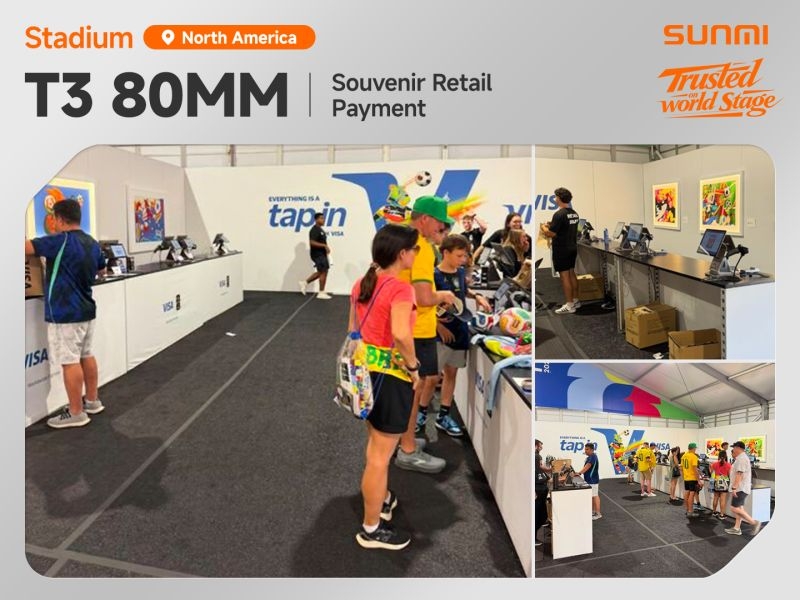
Stadium team stores, arena souvenir kiosks, and concourse merchandise carts run one of the most demanding retail peak profiles in North American commerce. The team store at a 20K-seat arena does the majority of its event-day revenue in a 45-minute post-game window when 3,000 to 6,000 fans push through the checkout line at the same moment. Ordinary retail POS terminals were not sized for this pattern. This guide covers how the SUNMI T3 80MM counter workhorse, the SUNMI V3 Mix mobile line-buster, and the K2 Mini pop-up self-serve kiosk combine into a stadium team merch POS stack sized against the pre-game, in-game, and post-game peak windows that make up the event-day revenue curve.
Key takeaways
- For stadium team stores, arena souvenir kiosks, concourse merch carts, and theme park character shops in 2026, the SUNMI T3 80MM counter workhorse plus the SUNMI V3 Mix mobile line-buster clear the pre-game and post-game peak windows that overwhelm ordinary retail POS terminals.
- A 20K-seat arena team store typically needs 2 to 3 T3 80MM counter terminals plus 2 to 4 V3 Mix handhelds for line-busting during the 45-minute post-game merch rush.
- For pop-up merch carts on the concourse, at gate entrances, and at parking-lot tailgates, the K2 Mini self-serve kiosk covers no-labor merch sales during the pre-game hours when staffing a full cashier does not pencil.
- Peak-window ticket velocity at a stadium team store dwarfs typical retail: 400 to 900 transactions per hour compressed into 45 minutes post-game, with average ticket sizes 30 to 80 USD for hats, jerseys, and program purchases.
- Standardizing the hardware SKU across team store, souvenir kiosks, and concourse merch carts lets the venue and the team merchandise operator pool spares, cut training overhead for event-week staff, and coordinate warranty pipeline through one Rosper account across 8 US and Canadian warehouses.
The stadium team merch revenue curve: pre-game, in-game, post-game peaks
Event-day merch revenue at a team store or concourse souvenir kiosk splits across three distinct windows with very different volume and ticket-size profiles. Pre-game (90 minutes before first pitch through the anthem) captures fans coming through the gates who want a program, a cap, or a game-day jersey; ticket sizes tend to be smaller (10 to 40 USD) and volume is steady rather than surging. In-game (across the game itself) captures impulse purchases from fans on concessions runs; volume is moderate and steady, ticket sizes small.
Post-game is the peak. In the 45 minutes after the final whistle, fans stream past the team store either to buy a game-day commemorative item (championship shirt, series patch, commemorative jersey for a milestone game) or a family gift on the way out. Volume surges to 400 to 900 transactions per hour at a 20K-seat arena and higher at larger stadiums. Ticket sizes are larger (30 to 80 USD average) because impulse purchases at the exit trend toward hats, jerseys, and gift items rather than programs. Post-game is where the year’s revenue capture happens, and it is where the POS stack either delivers or drops thousands of dollars of missed sales per event.
The T3 80MM counter workhorse for the team store checkout row
The T3 80MM is the counter-form Android POS terminal that sits at the main checkout row of the team store: 15.6-inch FHD touchscreen, integrated 80mm thermal receipt printer, Android 13, and Qualcomm octa-core compute. For the stadium team merch POS counter, the relevant hardware profile:
- 15.6-inch touchscreen sized for the team store product grid: dozens of jersey variants, hat colorways, program editions, and player-specific items in a scrollable grid the cashier can strike directly without paging through a tree menu.
- Integrated 80mm thermal printer for continuous receipt output during the post-game rush; the built-in form factor eliminates the external printer cable, the second USB port, and the second failure point per lane.
- Android 13 as the platform for the team merchandise operator application (the software the team merch operator uses across the venue and often across multiple team stores in a franchise or league group).
- Qualcomm octa-core compute with enough headroom to run the merchandise inventory lookup, integrated payment, jersey personalization workflow, and printer driver simultaneously without frame drops during the peak.
- Optional 10-inch customer display for the tip prompt where applicable, order confirmation, or brand messaging at the counter.
For a 20K-seat arena team store with a 6-lane checkout row, standardizing on the T3 80MM across every lane means the team merch operator can pool spares, pre-stage identical device builds for game-week install, and train event-week temp staff on one interface. Mixed-vendor fleets double the training overhead and multiply the spare-parts inventory.
V3 Mix mobile line-buster: pay in the queue, not at the counter
The V3 Mix is the handheld Android POS that shifts checkout out of the counter queue and into the line itself. During the post-game rush at a stadium team store, a staff member walking the queue with a V3 Mix can capture items and take a tap to pay EMV contactless payment 30 to 60 feet upstream of the counter, so by the time the customer reaches the register, the transaction is complete. This is the throughput multiplier that lets the same team store clear 30 to 50 percent more tickets in the same 45-minute post-game window.
- Handheld Android form factor with built-in 80mm thermal printer for on-the-spot receipts, so the line-buster does not have to walk the customer back to the counter for a printed slip.
- Integrated contactless tap, EMV chip, and magnetic stripe payment on the same handheld.
- Barcode scanning for the item tag or jersey UPC, enabling fast lookup against the merchandise inventory.
- Battery life sized for a 4-hour event shift without swap, with hot-swap battery options for double-headers, tournaments, and playoff runs.
- Wi-Fi and 4G LTE connectivity so line-busters keep working when the concourse Wi-Fi backhaul saturates during the peak.
The line-buster tactic works only when the queue is long enough to justify the staffing cost of the second cashier. For a 20K-seat arena team store, the threshold is typically 20 to 30 customers deep at the counter; below that, the counter alone clears the peak and the line-buster is under-utilized. Above that, every line-buster adds another 60 to 120 tickets per hour of throughput at the same team store.
K2 Mini for pop-up merch zones: gate entrance, concourse cart, tailgate tent
The K2 Mini 10.1-inch countertop kiosk covers the pop-up merch zones where fixed cashier staffing is not economical for a 2 to 4 hour event window. Examples that pay back:
- Gate-entrance pop-up selling programs and game-day hats for the 90 minutes before doors open, when a staffed counter is not economical but the fan foot traffic justifies a self-serve kiosk.
- Concourse merch cart at section 108 or the top-deck concourse where the volume does not justify a full staffed team store but the location captures impulse sales during in-game.
- Parking-lot tailgate merch tent at outdoor stadiums, where the tailgate crowd stops for a hat or a game-day shirt on the way in.
- Character shop pop-up at theme parks, where a specific character meet-and-greet zone attracts fans buying themed merchandise.
- Post-game commemorative kiosk at the stadium exits, letting fans grab a commemorative shirt without the team-store line.
The self-serve pattern also opens up hours the venue would otherwise lose to staffing economics. Pre-game merch sales at the arena entrance can start 90 minutes before doors open on a K2 Mini kiosk with no dedicated cashier; the same fan who would have walked past a closed pop-up now picks up a program on the way to the seat. Late-game commemorative merch continues past the last-call cutoff for staffed lanes because the kiosk keeps working without labor.
Sizing the stadium team merch POS fleet: peak-hour tickets, not average daily volume
The most common sizing mistake in stadium team merch POS procurement is to size against average daily volume. The team store does not care about the daily average; it cares about the 45-minute post-game window where the year’s revenue capture happens. Size the fleet against post-game peak-hour tickets per merch location, not against total daily or annual volume.
| Venue size | Post-game peak tx per store | Recommended stack for main team store |
|---|---|---|
| 5K to 10K seat arena | 200 to 350 tx / hr | 1 to 2 T3 80MM counters + optional 1 V3 Mix line-buster + 1 K2 Mini pop-up |
| 10K to 20K seat arena | 350 to 600 tx / hr | 2 to 3 T3 80MM counters + 2 V3 Mix line-busters + 1 to 2 K2 Mini pop-ups |
| 20K to 50K seat stadium | 600 to 1000 tx / hr | 3 to 5 T3 80MM counters + 3 to 4 V3 Mix line-busters + 2 to 3 K2 Mini pop-ups |
| 50K to 100K stadium | 1000 to 1800 tx / hr | 5 to 8 T3 80MM counters + 4 to 6 V3 Mix line-busters + 3 to 5 K2 Mini pop-ups |
| Theme park character shop | 80 to 250 tx / hr peaks | 1 to 2 T3 80MM counters + 1 K2 Mini pop-up |
The math is straightforward once framed against peak per location. A 20K-seat arena with one main team store plus 4 concourse merch carts doing a combined 2,000 post-game peak-hour transactions needs a fleet sized to clear 2,000 transactions per hour across the venue, not the 400 to 600 the daily average suggests. Under-sizing against the average is the failure mode that leaves fans queuing while their families are already in the parking lot.
Team merch operator standardization: one hardware SKU across the venue
Large stadium and arena team merch operations typically span three or four locations across the venue: the main team store, the pro shop at the executive-club level, one or two concourse merch carts per level, and pop-up kiosks at the gates. Some venues also run a satellite team store off-site (mall or downtown pop-up) that operates on the same operator system. What all of these locations can share is the hardware SKU.
For team merch operators (national merchandise supply chains, team-owned merch operations, arena merch group operators), standardizing on the T3 80MM across every location eliminates the multi-SKU spare parts problem, cuts training costs for event-week temp staff, and lets the operator own the MDM baseline and merchandise application configuration once across the venue. For multi-venue operators (a merch group operating stores at 8 to 15 venues nationally), the same standardization argument compounds: one hardware fleet, one warranty pipeline, one deployment playbook.
Championship and commemorative-game surge: capacity above the baseline
The revenue capture problem gets an order-of-magnitude harder for championship games, playoff series, retirement nights, milestone games, and other events where fans arrive specifically to buy a commemorative item. Post-game merch volume at these events routinely runs 3 to 5 times the regular-season peak, and the ticket size averages materially higher because fans pay for the commemorative jersey and the framed program together.
The operational pattern that captures this surge: position pre-staged additional units for the event, position dedicated commemorative-item pop-up kiosks near the exits, position additional V3 Mix line-busters in the concourse to clear the checkout queue at the main team store, and coordinate the merch operator app to unlock the commemorative SKUs at the game-ending moment (not before, to protect against pre-sale). Rosper positions event-day spare units at the venue for high-profile championship weeks so the operator can turn a bad device without shipping delay.
Jersey personalization workflow: at the counter or at the kiosk
Jersey personalization (custom name and number heat-press on a blank jersey) is one of the highest-margin merch categories at stadium team stores. The workflow typically runs at a dedicated counter with the T3 80MM handling the item entry, personalization payment, and the paired heat-press machine handling the physical print. For high-volume team stores with dedicated personalization stations, the T3 80MM 15.6-inch touchscreen covers the personalization workflow (name entry, number entry, font style, color, size confirmation) while also handling the payment.
For team stores at smaller arenas where personalization is offered from the main counter row rather than a dedicated station, the same T3 80MM handles both workflows depending on what the customer is buying. Personalization tickets tend to be larger (100 to 200 USD range) and warrant the extra counter time; standard merch throughput happens on the same device between personalization jobs.
Event-day support: pre-staging, spares at the loading dock, warranty turnaround
Event hardware failure at a stadium team store has a different cost profile than continuous-shift retail. A dead counter terminal on game day loses the post-game rush revenue for that location for that event, which for a championship game or playoff series can be tens of thousands of dollars per stand. Rosper supports stadium and arena team merch deployments with pre-configured units shipped to the venue loading dock (MDM enrollment, application install, network provisioning done before the device leaves the warehouse), event-day spares positioned at the venue for in-event swap, and a 2 to 5 business day standard warranty swap SLA across our 8 US and Canadian warehouses.
- City of Industry, CA (main West Coast hub, x2 facilities)
- Ontario, CA (secondary West Coast)
- Tracy, CA (northern California)
- The Colony, TX (South and Central US)
- McLean, VA (mid-Atlantic and East Coast)
- Allentown, PA (Northeast)
- Brampton, ON (Canadian market)
Gen 3 units carry a 3-year manufacturer warranty; Rosper assists with warranty claims, helping you connect with SUNMI faster and coordinating the replacement swap through our in-country stock. For high-profile venues on tight event calendars (playoff hosts, All-Star venues, championship game hosts), we coordinate loading-dock spare positioning ahead of the event week so the on-site team has same-day swap capacity.
Theme park character shops and adjacent retail
Theme park character shops (the branded retail at large flagship theme parks, regional theme parks, or independent theme park character meet-and-greet zones) run a peak profile similar to stadium concourse merch: steady throughout the day with pronounced peaks around parade times, character appearance schedules, and closing hours when families make final purchases on the way out. The T3 80MM plus K2 Mini stack covers the same operational pattern: T3 80MM at the main counter with the built-in printer clearing the peak, K2 Mini pop-up at the queue entry for impulse purchases before customers hit the counter row.
For theme park operators standardizing across dozens of character shops, adjacent food concessions, and park-wide retail, the same standardization argument applies. One hardware SKU across the park lets the operator IT team pool spares, run one training program for seasonal staff, and coordinate warranty pipeline through a single Rosper account.
When SUNMI POS is not the right call for your team merch operation
Two scenarios where the math does not work in 2026. Very small college or amateur team merch counters at venues under 3,000 capacity doing under 100 game-day tickets typically get more value from a compact tablet-form POS because the counter volume does not justify the 15.6-inch footprint. Full couture-style team retail (limited-run luxury team apparel sold at exclusive boutique locations, often independent of the arena team store operation) usually needs a smaller-form terminal with a boutique retail feel; the T3 80MM is sized for the peak-throughput stadium team store, not the low-volume high-touch boutique.
ROI math: event-day revenue capture per merch location
Stadium team merch POS procurement often gets framed as a cost per terminal, which misses the real driver: event-day revenue capture per merch location. A team store that clears 650 post-game peak-hour transactions instead of 400 (a 62 percent lift from adding two V3 Mix line-busters plus one additional T3 80MM counter) captures 250 additional tickets at a 45 to 65 USD stadium team store average, or 11K to 16K USD of incremental revenue per event. Across a 41-home-game NBA season plus playoff runs, that math clears 500K to 700K USD of incremental annual revenue at the main team store alone, an order of magnitude above the fleet cost.
The framing that matters is not price per terminal; it is revenue per event, per merch location. The T3 80MM plus V3 Mix line-buster plus K2 Mini pop-up stack was designed against this framing, and it pays back inside the first playoff series for most stadium and arena team merch operations.
Frequently asked questions
What is the best POS terminal for a stadium team merch store in 2026?The best POS terminal for a stadium team store is a counter Android device with a large touchscreen for the product grid, a built-in 80mm receipt printer for peak-hour throughput, integrated payment, and Android as the platform for the merchandise operator application. The SUNMI T3 80MM covers this baseline: 15.6-inch FHD touchscreen, integrated 80mm printer, Android 13, and Qualcomm octa-core compute for high transaction density. For 20K-seat arenas and larger venues, pair 2 to 3 T3 80MM counter terminals with V3 Mix mobile line-busters to clear the post-game rush.
How does V3 Mix line-busting work in a stadium team store?A V3 Mix mobile line-buster is a staff member walking the checkout queue with a handheld Android device that has a built-in 80mm receipt printer. The staff member scans items already in the customer’s hands, takes payment on the same device via contactless tap or chip, prints the receipt, and hands the customer their purchase. By the time the customer reaches the counter, the transaction is complete. This shifts throughput out of the counter queue and into the line itself, typically clearing 30 to 50 percent more tickets in the same peak window. Line-busting is the operational tactic that turns a stadium team store from a bottleneck into a revenue capture engine.
When does a K2 Mini self-serve kiosk make sense for stadium merch?A K2 Mini self-serve kiosk makes sense for pop-up merch zones where fixed cashier staffing is not economical for a 2 to 4 hour event window: concourse carts at a specific section, gate-entrance pop-ups selling programs and hats before the event, parking-lot tailgate merch tents, character meet-and-greet shops at theme parks. The kiosk runs the merchandise operator app on a 10.1-inch touchscreen, the customer scans the tag or selects the item, pays on the paired terminal, and picks up the merch from the attendant. For events on tight labor budgets, this extends the sales window on both ends of the event.
How does the T3 80MM built-in printer help stadium team store throughput?A built-in 80mm receipt printer on the T3 80MM eliminates the second device (external printer plus USB cable plus separate power) that the counter would otherwise need, reducing the failure surface at the lane and cutting the physical footprint at a tight counter. During a post-game rush at a 20K-seat arena team store, the counter prints continuously for 45 minutes without a break, and the built-in printer keeps up with the pace better than a paired external printer where cable or driver issues can drop the print. It also drops the deployment SKU count when standardizing across 20 to 50 merch locations at a venue.
How many devices does a stadium team merch store need for a 20K-seat arena?Working baseline sized against post-game peak throughput. A 20K-seat arena team store typically clears 400 to 700 transactions per hour during the 45-minute post-game rush, plus a smaller pre-game window and steady in-game sales. A working stack: 2 to 3 T3 80MM counter terminals on the main checkout row, 2 to 4 V3 Mix handhelds as line-busters walking the queue during the post-game peak, and 1 to 2 K2 Mini kiosks at gate entrances or concourse pop-ups for pre-game merch sales. Concourse souvenir kiosks and pop-up carts add another 1 to 2 T3 80MM counter terminals each.
What warranty and support does Rosper offer for stadium merch fleet deployments?Rosper stocks SUNMI T3 80MM, V3 Mix, and K2 Mini units in 8 US and Canadian warehouses (City of Industry CA times 2, Ontario CA, Tracy CA, The Colony TX, McLean VA, Allentown PA, Brampton ON) with a 2 to 5 business day standard warranty swap SLA. For stadium team stores where a dead terminal on game day loses the entire event revenue for that stand, we coordinate loading-dock spare positioning ahead of high-profile event weeks. Gen 3 units carry a 3-year manufacturer warranty; Rosper assists with warranty claims, helping you connect with SUNMI faster.
Get a stadium team merch fleet deployment plan
Rosper is a US and Canadian stocking authorized SUNMI partner handling stadium team store, arena souvenir kiosk, concourse merch cart, and theme park character shop deployments across 8 warehouses. For a peak-window sizing model, jersey personalization workflow consultation, or championship-game surge planning, talk to a Rosper venue specialist.