
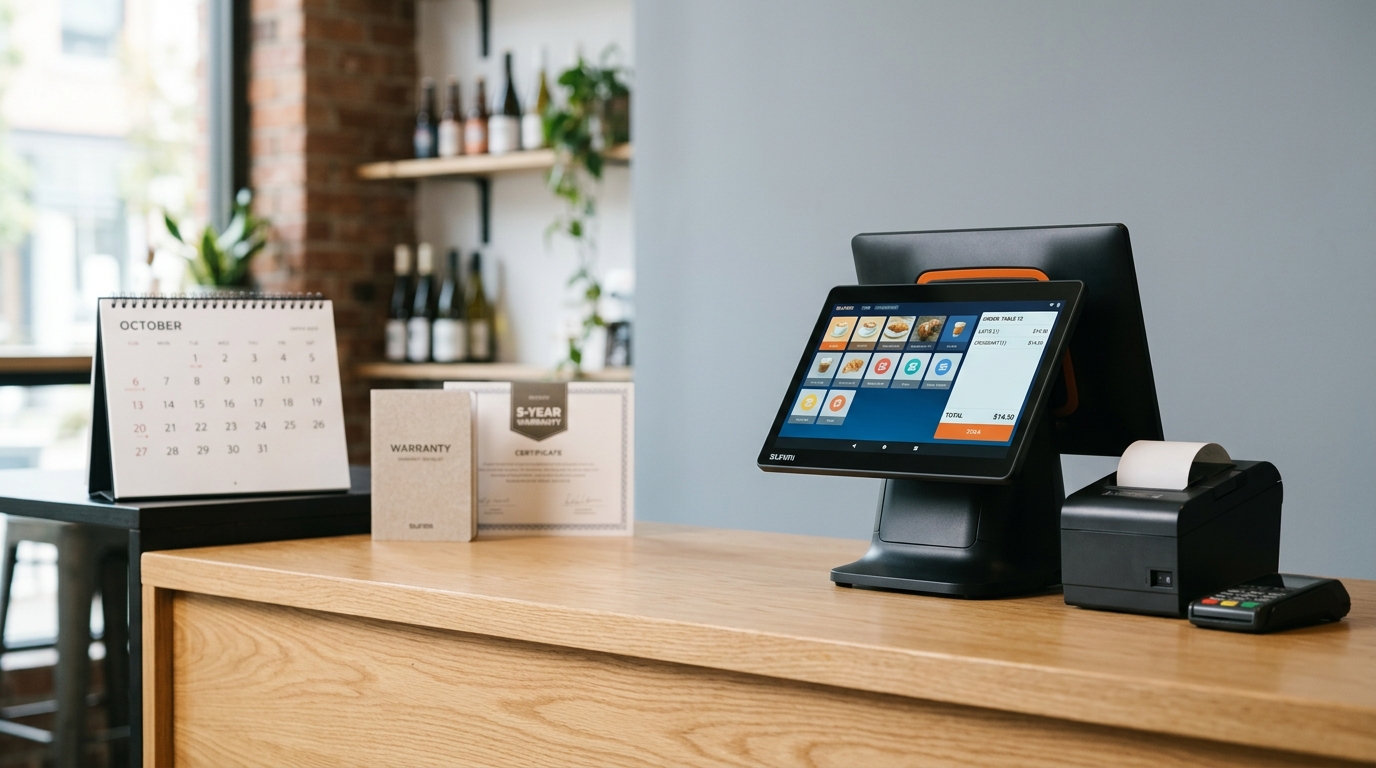
How long do SUNMI POS terminals last is one of the first questions a CFO, IT director, or franchise operator asks before signing off on a new POS refresh. The answer matters. Payment terminals are a multi-year capital investment, and the replacement cycle has real implications for budgeting, depreciation schedules, payment certification stability, and the total cost of ownership per transaction.
This 2026 guide breaks down how long SUNMI POS terminals actually last in US and Canadian deployments, what the official 3-year warranty covers, how real-world failure rates compare with other Android POS brands, and how to plan a sensible replacement cycle for your fleet. For any buyer evaluating SUNMI hardware through Rosper as the authorized North American distributor, this is the expected-lifespan baseline to plan around.
The Short Answer: How Long Do SUNMI POS Terminals Last?
In active daily use across US and Canadian restaurants, retailers, and payment deployments, most SUNMI POS terminals reliably operate 5 to 7 years on the original hardware. High-use environments (quick-service restaurants, busy kiosks, food trucks) typically see 4 to 6 years. Lower-use, fixed-counter retail deployments frequently cross the 7-year mark on the same device.
SUNMI publishes a 3-year official warranty under the SUNMI Care Standard program on nearly every current-generation device sold through Rosper. The 3-year window covers manufacturing defects, battery degradation beyond published thresholds, and printer/display/port failures that occur in ordinary business use. The practical working life of the hardware extends well beyond the warranty period, but the 3-year mark is the planning horizon most finance teams use for depreciation and planned refresh budgeting.
For a typical US or Canadian restaurant running a SUNMI V3 PLUS, P3, or T3 Pro eight to twelve hours per day, seven days a week, the real-world lifespan math looks like this:
- Year 1 to 3: Warranty-covered. Component-level failures are rare, and Rosper handles any RMA or replacement under warranty.
- Year 4 to 5: Post-warranty. Batteries and thermal printer heads are the two components most likely to need service.
- Year 6 to 7: Most devices still work. Software support and security patches from SUNMI typically cover this window, especially on Android 11 and newer devices.
- Year 7 and beyond: The device still functions for many use cases. Payment terminals face their own separate clock tied to PCI PTS expiration, which we cover below.
What Determines How Long a SUNMI POS Terminal Lasts?
Several factors decide whether a specific SUNMI POS terminal hits the 5-year or the 7-year end of the range. Understanding them lets you plan, specify, and protect the hardware.
Usage Intensity and Daily Transaction Volume
The single biggest variable is how many transactions and how many screen-on hours the device sees every day. A SUNMI V3 PLUS at a 24-hour convenience store handling 800 tickets daily puts noticeably more wear on the battery, printer, and touchscreen than the same device on a retail counter handling 150 tickets daily.
Common Rosper-observed lifespans by usage class:
- Quick-service restaurant (QSR), food truck, busy bar: 4 to 5.5 years on the original hardware before a recommended refresh. Printer head and battery are usually the first components to need service.
- Full-service restaurant, specialty retail, salon: 5 to 6.5 years before a recommended refresh.
- Low-volume counter (boutique, service desk, reception): 6 to 8 years. The device often outlasts the software or payment cert window.
Environment and Physical Handling
IP ratings and drop specs exist for a reason. A SUNMI V3 PLUS rated IP65 and 1.5m drop-tested will tolerate kitchen grease, patio rain, and occasional drops that a non-rugged terminal would not survive. The SUNMI L2s Pro, P2 SE, and P3 are engineered for mobile and wet environments and hold up significantly better outdoors.
The devices that age fastest are not necessarily the most used. They are the ones put into environments they were not specified for. An 80 mm-printer SUNMI V3 Mix rated IP54 does not belong in a wet bar. A non-rugged desktop POS does not belong on a patio. Matching the device rating to the environment adds years to the realistic lifespan.
Battery Care and Charging Cycles
Lithium-ion battery life is the most predictable decay curve in any handheld POS or mobile terminal. SUNMI handheld devices (P3, P2, L2s Pro) use high-density cells rated for roughly 500 to 800 full charge cycles before noticeable capacity loss. In practice:
- Year 1 to 2: Battery holds essentially original capacity.
- Year 3 to 4: Expect 10 to 20 percent capacity reduction under constant daily use.
- Year 5+: Capacity may drop below 70 percent of original. This is when many businesses swap the battery rather than the full device.
Under the SUNMI Care Standard 3-year warranty, Rosper handles battery replacement for devices whose battery health drops meaningfully below published thresholds within the warranty period. Outside the warranty window, battery swaps are inexpensive relative to a full unit replacement and are a standard part of extending the fleet lifespan past year 5.
Software and Security Support
SUNMI’s OS support timeline directly affects the functional lifespan. Modern SUNMI POS devices shipping in 2025 and 2026 run Android 11, Android 13, or Android 14 under the SUNMI OS overlay. Google provides Android security updates on a tiered schedule, and SUNMI typically releases security patches through the SUNMI OS channel for 4 to 6 years from device launch.
For payment terminals in particular, software support is tied less to generic Android patching and more to PCI PTS certification validity, which operates on its own timeline. We cover this in the dedicated section below.
Printer Head, Scanner, and Port Wear
Integrated components that touch physical materials wear out predictably:
- Thermal printer heads: SUNMI integrated printers (V3 PLUS, L2s Pro, P2, V3) are rated for approximately 50 to 100 kilometers of paper. For a medium-volume restaurant, that is 4 to 6 years of receipts. Rosper stocks replacement printer heads and can quote a swap at a fraction of a full device replacement.
- Barcode scanners: On scanner-equipped SUNMI devices (L2s Pro, D3 Pro, P2 SE), the scanner window is the component most likely to scuff. Replacement is straightforward under SUNMI Care.
- USB-C and pogo pin ports: These tolerate tens of thousands of connection cycles. In practice they outlast the rest of the device unless the port is physically abused.
The SUNMI Care Standard 3-Year Warranty: What Is and Is Not Covered
Every current-generation SUNMI POS terminal sold through Rosper in the US and Canada ships with the SUNMI Care Standard 3-year warranty. This is a structured warranty program, not a simple “contact the manufacturer” policy.
What SUNMI Care Standard covers:
- Manufacturing defects reported within the 3-year window
- Display failures not caused by drop, burn, or water damage beyond the device’s IP rating
- Battery degradation below published thresholds for handheld/mobile devices
- Integrated printer mechanism failures in ordinary use
- Touchscreen digitizer failures
- Port and connector defects
- Motherboard and processor failures
What SUNMI Care Standard does not cover:
- Physical damage beyond the device’s drop and IP rating (for example, dropping a V3 Mix rated for 1.2m onto concrete from 3m)
- Water damage on non-IP65 devices
- Damage from unauthorized repair attempts
- Damage from third-party non-SUNMI accessories (non-OEM chargers, non-OEM docks)
- Cosmetic wear and tear
For full RMA workflow under Rosper, see the complete Rosper-managed SUNMI RMA process guide. The short version is that Rosper processes US and Canadian RMA requests directly, ships replacements from North American warehouses, and you never deal with SUNMI global support or overseas returns.
PCI PTS Certification Lifespan: The Other Clock on Payment Terminals
For SUNMI payment terminals specifically (P2, P2 SE, P3, P3 AIR, P3 Lite, CPad Pay), device lifespan has a second clock that is often more important than hardware durability: PCI PTS certification.
PCI PTS (Payment Card Industry PIN Transaction Security) certifications are issued for a fixed period by the PCI Security Standards Council. Current SUNMI payment devices certified under PCI PTS 6.x have certifications that remain valid well into the late 2020s. When a PCI PTS version expires, payment processors generally stop authorizing transactions from devices whose certifications have lapsed, regardless of whether the hardware itself still functions.
Practical implications:
- A SUNMI P3 purchased in 2026 with PCI PTS 6.x certification has useful payment life through at least 2028 to 2029, depending on the exact sub-revision. Physical hardware may last longer, but the device may need to be replaced for compliance reasons rather than hardware failure.
- Non-payment SUNMI devices (V3 series desktop POS, L2s Pro handheld, D3 Pro, T3 Pro) are not tied to PCI PTS and are free to operate as long as the hardware holds up and the OS receives patches.
For a full explanation of what PCI PTS 6.x covers on SUNMI devices and what processor-level certification you still need on top of it, see the PCI PTS 6.x on SUNMI Pay devices explainer.
How SUNMI POS Lifespan Compares with Other Android POS Brands
Across North American deployments, SUNMI sits in the same 5 to 7 year useful-life band as other reputable Android POS vendors. Comparing against common alternatives:
- SUNMI vs Clover: Clover Station and Flex hardware typically last 4 to 6 years in busy restaurants. Component-level repair options are more limited because the ecosystem is bundled.
- SUNMI vs PAX: PAX Android terminals (A920 series) run 5 to 7 years in typical deployments. Hardware durability is comparable, with SUNMI having a longer standard warranty at 3 years vs PAX’s typical 1-year manufacturer warranty.
- SUNMI vs Ingenico: Ingenico AXIUM Android terminals are engineered for banking-grade life spans of 7+ years on counter-only deployments. Handhelds land in a similar band to SUNMI.
- SUNMI vs Toast: Toast hardware is engineered for the closed Toast ecosystem. Typical replacement window in QSR is 4 to 5 years, driven partly by software refresh cycles rather than hardware end-of-life.
SUNMI’s combination of the 3-year warranty included standard, rugged IP-rated models, and an open Android platform means most businesses get a flexible 5 to 7 year useful life at a competitive total cost of ownership.
Planning Your SUNMI POS Replacement Cycle
Most North American operators we work with at Rosper settle on one of two replacement frameworks:
5-year refresh (QSR, food trucks, mobile, busy bars): Refresh flagship hardware at year 5 to stay ahead of battery degradation, printer-head replacement costs, and potential PCI PTS timing for payment terminals. Roll the old units into lower-volume spare pool use.
7-year stretch (full-service, specialty retail, B2B counter): Keep devices deployed through year 7 with battery swap at year 4 to 5 and printer-head service at year 5 to 6 under standard SUNMI Care or post-warranty service. Refresh when either PCI PTS expires (for payment terminals) or Android security support sunsets.
A realistic annual TCO on a flagship SUNMI V3 PLUS spread over a 6-year useful life, including one mid-life battery or printer-head service through Rosper, lands at roughly one-third to one-half of a comparable Clover or Toast deployment spread over the same window. The long warranty, modular component service, and open Android platform are the reasons SUNMI has become the fastest-growing Android POS brand in North America.
How Rosper Supports SUNMI POS Lifespan in the US and Canada
Rosper is an authorized SUNMI distributor for the United States and Canada. For the entire lifespan of your fleet, Rosper provides:
- Stock in US warehouses for next-day or 2-7 day delivery on replacement units.
- Direct Canadian shipping with duties and brokerage handled up front.
- SUNMI Care Standard 3-year warranty managed end-to-end by Rosper (no overseas returns).
- Battery and printer-head replacement service through the warranty window and beyond.
- Fleet staging and MDM pre-configuration so new units arrive pre-loaded to your baseline.
- Pre-deployment consultation on device model selection to match the expected lifespan to your environment.
FAQ
How long do SUNMI POS terminals last in daily use?
SUNMI POS terminals typically run 5 to 7 years on the original hardware in active US and Canadian deployments. Quick-service restaurants and mobile field crews using the V3 MIX or L2s Pro handhelds average 4 to 6 years before a battery swap restores another 2 years of life. Fixed counter retail running the SUNMI D3 Pro or V3 PLUS often exceeds 7 years thanks to lower thermal stress and steady AC power. Self-ordering kiosks built around the T3 Pro fall in the middle at roughly 5 to 6 years, driven mostly by touchscreen wear. All current models ship with the SUNMI Care Standard 3-year warranty, managed end-to-end by Rosper from North American warehouses.
What does the SUNMI Care Standard 3-year warranty cover?
The SUNMI Care Standard 3-year warranty included with every Rosper-shipped V3 PLUS, D3 Pro, T3 Pro, V3 MIX, L2s Pro, and P3 series device covers manufacturing defects across the major hardware subsystems: display panel and backlight, motherboard, integrated thermal printer mechanism, touchscreen digitizer, USB and serial ports, and battery degradation that exceeds SUNMI’s published thresholds on handheld models. It does not cover physical damage beyond each model’s published drop and IP rating (1.5 m drop and IP65 on the V3 PLUS, lower ratings for non-rugged units), water damage on non-IP65 devices, or damage caused by unauthorized repair or third-party batteries and chargers. Rosper handles all RMA logistics inside the US and Canada.
How long does a SUNMI handheld POS battery last before it needs replacement?
Plan on a battery swap around year 4 to 5 for the SUNMI V3 MIX, L2s Pro, and other handheld POS terminals. Cells inside SUNMI handhelds are rated for 500 to 800 full charge cycles before measurable capacity loss begins. In typical daily restaurant or retail use a unit holds full original capacity through year 1 and 2, drops 10 to 20 percent by year 3 to 4, and falls below 70 percent of original capacity by year 5. Battery replacement during the 3-year SUNMI Care Standard window is covered for SUNMI-defined degradation thresholds, and out-of-warranty swaps are inexpensive and shipped from Rosper’s US and Canada warehouses with same-week turnaround.
Does PCI PTS certification affect how long a SUNMI payment terminal lasts?
Yes. For SUNMI payment terminals such as the P2, P3, P3 AIR, P3 Lite, and CPad Pay, PCI PTS certification sets a firm second clock on top of hardware longevity. Each PCI PTS approval has a fixed expiration date set by the PCI Security Standards Council, after which acquiring banks and payment processors stop authorizing transactions on that hardware. Current SUNMI payment devices certified under PCI PTS 6.x remain valid well into the late 2020s, but plan a refresh by year 5 to 7 regardless of physical condition. Non-payment SUNMI models (V3 PLUS, D3 Pro, T3 Pro, V3 MIX, L2s Pro) are not tied to PCI PTS and run as long as the hardware and Android OS support continues, often beyond 7 years.
When should I replace my SUNMI POS terminals?
Most operators follow either a 5-year or a 7-year refresh framework. Plan a 5-year cycle on high-use deployments such as QSR counters, food trucks, and busy bar shifts using the SUNMI V3 PLUS or T3 Pro to stay ahead of battery and printer-head wear. Stretch to 7 years on lower-volume environments, full-service restaurants, specialty retail, and counter-only setups, with a mid-life battery swap and printer-head service at year 4 to 5. Payment terminals (P3, CPad Pay) should be refreshed against the PCI PTS expiration window rather than hardware health. Email [email protected] for a model-specific replacement plan based on your transaction volume and PCI requirements.
How does SUNMI POS lifespan compare with Clover, PAX, and Toast?
SUNMI POS terminals sit in the 5 to 7 year useful-life band, comparable to PAX Android payment terminals and longer than typical Clover and Toast hardware refresh cycles, which run 4 to 6 years before merchants are pushed to upgrade. Two factors drive the difference. First, the 3-year SUNMI Care Standard warranty is meaningfully longer than the 1-year manufacturer warranty common on PAX hardware and the lease-tied refresh cycles built into Clover and Toast contracts. Second, SUNMI runs an open Android platform that lets operators extend useful life with their own MDM and software, instead of being forced into a closed-ecosystem refresh.
Does Rosper handle SUNMI warranty and repair services in the US and Canada?
Yes. Rosper is an authorized SUNMI distributor for the US and Canada and manages the SUNMI Care Standard 3-year warranty end-to-end. That includes RMA case opening, return shipping labels, replacement units shipped from US and Canadian warehouses (no overseas RMA), in-warranty battery and printer-head service, and out-of-warranty component repair on the V3 PLUS, D3 Pro, T3 Pro, V3 MIX, L2s Pro, and P3 series. Customers never need to ship units overseas or contact SUNMI global support directly. Email [email protected] to open an RMA, request a service quote, or set up a master service agreement for a multi-location fleet.
I’m planning a 10-location deployment, should I budget for replacement in year 3 or year 5?
Budget for a year 5 refresh on a 10-location SUNMI POS deployment, not year 3. SUNMI Care Standard’s 3-year warranty is the financial-protection window, not the end of useful life. Most multi-location operators we work with at Rosper run flagship hardware (SUNMI V3 PLUS, D3 Pro, T3 Pro) into year 5 or 6 with an inexpensive battery swap and printer-head service in years 4 to 5, then refresh ahead of any PCI PTS sunset for the payment units. For a 10-location budget, plan roughly 17 to 20 percent of original hardware spend for mid-life service across years 4 to 5, then a full refresh in year 5 to 6. Email [email protected] for a multi-location refresh-budget worksheet.
Which SUNMI terminal lasts longest for a high-volume restaurant?
For a high-volume restaurant, the longest-lasting SUNMI counter terminal is the SUNMI V3 PLUS, IP65-rated and 1.5 m drop-tested with a thermal printer rated for 50 to 100 km of paper, which translates to roughly 5 to 6 years of receipts in a busy QSR. If your floor model needs the larger 15.6-inch operator screen, the SUNMI D3 Pro covers high-volume counters with the same multi-year duty cycle. For tableside service, the V3 MIX handheld lasts 4 to 5.5 years before a battery swap restores another 2 years of life. All three ship with the SUNMI Care Standard 3-year warranty managed end-to-end by Rosper from US and Canadian warehouses. Email [email protected] to spec the right rugged terminal for your restaurant volume.
Is it worth extending a SUNMI POS fleet past the 3-year warranty?
Yes, extending a SUNMI POS fleet past the 3-year warranty is worth it for most US and Canadian operators. The hardware reliably runs 5 to 7 years on the original chassis, and the cost of a Rosper-handled battery swap plus printer-head service in year 4 to 5 is a small fraction of buying new units. The exception is SUNMI payment terminals (P2, P3, CPad Pay), which face a separate PCI PTS expiration clock that can force replacement around year 5 to 7 regardless of hardware health. For non-payment devices like the V3 PLUS, D3 Pro, T3 Pro, and L2s Pro, a year 4 to 5 service pass typically buys you another 2 to 3 productive years. Email [email protected] for an extension-vs-refresh quote on your fleet.
What replacement cycle do you recommend for SUNMI kiosks in QSR?
Plan a 5-year refresh cycle for SUNMI T3 Pro self-ordering kiosks in QSR environments. QSR kiosks see 12-hour duty cycles, near-continuous touchscreen wear, and on payment-enabled kiosks the same PCI PTS clock as countertop payment terminals. Rosper recommends a year 4 mid-life check for touchscreen calibration, a printer-head service if the kiosk has an integrated receipt printer, and a full hardware refresh by year 5 to 6. Non-payment kiosks (menu-and-order-only setups paired with a separate counter terminal for payment) can stretch to year 6 to 7 with a touchscreen and printer-head service. Email [email protected] for a QSR kiosk refresh plan and rollout staging.
Ready to Plan Your SUNMI POS Fleet for 5 to 7 Years?
If you are evaluating SUNMI POS hardware for a new deployment or planning a refresh of an existing fleet, how long the terminals last is the frame that makes every other number (unit cost, warranty, service, TCO) make sense. For US and Canadian businesses, the straight answer is 5 to 7 years of reliable useful life on current-generation SUNMI hardware, backed by the SUNMI Care Standard 3-year warranty and Rosper’s end-to-end warranty and service coverage across North America.
Contact the Rosper team for a model-specific lifespan expectation, volume pricing, and a fleet refresh plan that matches your deployment environment.