
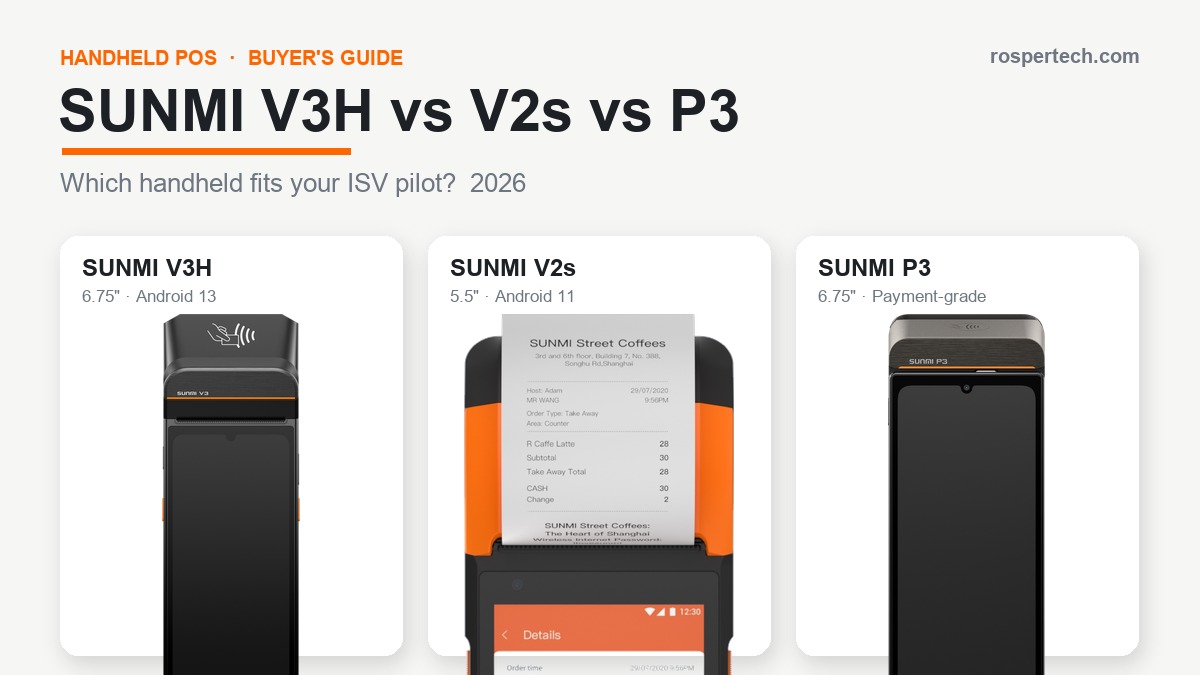
Choosing between the SUNMI V3H vs V2s vs P3 comes down to matching one handheld to your pilot workflow, not chasing a spec sheet. The V3H is the current-generation flagship for order-heavy, screen-forward apps; the V2s is a proven compact ticketing and inventory workhorse; and the P3 is an entry-level Android Go payment terminal for tap-to-pay checkouts. This guide gives ISV and software teams the real numbers, a side-by-side table, and a decision framework so a pilot standardizes cleanly across a fleet. Read on for the full SUNMI V3H vs V2s vs P3 breakdown.
Key takeaways for an ISV pilot
- V3H is the current-generation pick. A 6.75-inch HD+ display, octa-core CPU up to 2.4 GHz, up to 4GB RAM plus 64GB UFS storage, and SUNMI OS on Android 13 make it the longest-runway device for a multi-year rollout.
- V2s is the compact ticketing and inventory choice. Its 5.5-inch screen, dual receipt-plus-label printing, and detachable 3500mAh battery suit one-handed scan-and-print work.
- P3 base is an entry Android Go payment terminal. A 6.75-inch screen and a full EMV, magstripe, and NFC SoftPOS payment stack with PCI PTS 6.x, but only 2GB RAM on Android 11 Go, so plan for light apps.
- Standardize on one device per workflow. Fewer SKUs across locations means simpler MDM, fewer firmware branches, and a lower total cost of ownership.
- All three ship from US and Canada stock, and most orders arrive in 2 to 7 business days.
SUNMI V3H vs V2s vs P3: which handheld fits your pilot?
Pick the V3H for order-taking, tableside, and delivery apps that need a big bright screen and headroom for a multi-year deployment. Pick the V2s when the job is fast one-handed scanning and label or receipt printing in retail, events, and logistics. Pick the P3 when the primary task is taking a card payment and the software footprint is light. Below, each device is broken out by real spec so you can match hardware to workflow.
SUNMI V3H: the current-generation flagship
The SUNMI V3H is the newest of the three and the safest bet for a long pilot. It runs SUNMI OS on Android 13 with an octa-core CPU up to 2.4 GHz, delivering a roughly 200 percent performance boost over its predecessor. Memory scales up to 4GB RAM plus 64GB of fast UFS ROM, with a 3GB plus 32GB option for lighter builds.
The 6.75-inch HD+ display runs 720×1600 at 420 nits, bright enough for indoor and shaded outdoor use. It adds dual printing with a 58mm thermal head at about 80mm/s and a 50mm roll, a laser 2D barcode scanner that reads damaged or wrinkled labels, NFC SoftPOS that is EMVCo PCD L1 certified, and a removable 7.7V roughly 3100mAh battery. At 419g and 238 by 81.8 by 16.8mm, it operates from -10C to 50C, with fingerprint login and an optional US GMS build.
SUNMI V2s: the compact ticketing and inventory workhorse
The SUNMI V2s is a compact 5.5-inch handheld built for one-handed scan-and-print work. It runs SUNMI OS on Android 11 with a quad-core 2.0 GHz CPU, 2GB RAM plus 16GB ROM as standard, and a 3GB plus 32GB configuration for customization. That is enough for focused ticketing, inventory, and delivery apps rather than heavy multitasking.
Its built-in thermal printer handles both receipts and labels with an auto-detection algorithm for accurate label positioning. A professional 2D scan engine reads scratched, folded, or stained codes; built-in NFC is available on the Label and NFC and Label and Scanner versions. The detachable 3500mAh 7.7V battery supports full-shift use, and 1.2m drop resistance plus sealed ports handle field conditions. It is the smallest and most pocketable of the three.
SUNMI P3: the entry Android Go payment terminal
The base SUNMI P3 is a payment-first device, and it is honest to call it entry-level. It runs SUNMI OS based on Android 11 Go on a quad-core A53 at 2.0 GHz with 2GB RAM plus 32GB ROM. The Android Go base and 2GB of memory mean it is tuned for lightweight payment and ordering apps, not resource-heavy software; if you need more headroom, the P3H variant steps up to 4GB plus 64GB.
Where the P3 shines is payments. The 6.75-inch HD+ screen fronts a full stack: EMV chip, magstripe, on-screen NFC SoftPOS tap-to-pay, and QR scanning, backed by PCI PTS 6.x, EMV, and major network certifications. It adds a 70mm/s thermal printer with a 58mm and 40mm roll, an optional 1D/2D scanner, IP65 sealing, 1.5m drop resistance, a removable 7.7V 2630mAh battery, and a 400g body at 201.4 by 80 by 17mm. For pure tap-to-pay checkouts it is capable; for order-heavy software it is the weakest of the three.
Spec comparison table: V3H vs V2s vs P3
| Spec | SUNMI V3H | SUNMI V2s | SUNMI P3 (base) |
|---|---|---|---|
| Generation | Current (3rd-gen V3) | Proven compact | Entry payment terminal |
| Display | 6.75″ HD+ 720×1600, 420 nits | 5.5″ HD IPS | 6.75″ HD+ 720×1600 IPS |
| CPU | Octa-core up to 2.4 GHz | Quad-core 2.0 GHz | Quad-core A53 2.0 GHz |
| RAM / ROM | Up to 4GB + 64GB (UFS); 3GB+32GB option | 2GB + 16GB; 3GB+32GB option | 2GB + 32GB |
| OS | SUNMI OS (Android 13) | SUNMI OS (Android 11) | SUNMI OS (Android 11 Go) |
| Printer | Dual receipt+label, 58mm, ~80mm/s, 50mm roll | Dual receipt+label thermal, auto-detect | Thermal 70mm/s, 58mm/40mm roll |
| Scanner | Laser 2D (reads damaged labels) | Professional 2D scan engine | 1D/2D scanner (optional) |
| NFC / payment | NFC SoftPOS, EMVCo PCD L1 | NFC (version dependent) | EMV, magstripe, NFC SoftPOS, PCI PTS 6.x |
| Battery | Removable 7.7V ~3100mAh | Detachable 7.7V 3500mAh | Removable 7.7V 2630mAh |
| Weight / size | 419g; 238×81.8×16.8mm | Compact 5.5″ body | 400g; 201.4x80x17mm |
| Ruggedness | -10C to 50C operating | 1.2m drop, sealed ports | IP65, 1.5m drop |
| Best for | Order-heavy, big-screen, multi-year rollout | Ticketing, inventory, one-handed print | Tap-to-pay checkout, light apps |
How should an ISV pick the right handheld?
The SUNMI V3H vs V2s vs P3 decision starts with the primary workflow, then checks three constraints: app weight, screen size, and deployment lifespan. If your software is a full ordering or field app that will grow over a two to three year contract, the V3H is the standardization anchor because its Android 13 base and UFS storage give the most runway. Under-provisioning a fleet is the most expensive mistake in a pilot.
If the pilot is scan-heavy with frequent label printing in a compact form, the V2s is the efficient fit and keeps hardware cost down. If the deployment is payment-first with a light app, the P3 handles tap-to-pay well, but validate that 2GB on Android 11 Go clears your app requirements before committing. For total cost of ownership, favor one device per workflow so MDM profiles, firmware branches, and spare pools stay simple across locations.
All three certify NFC contactless against the EMVCo framework, which you can review on the EMVCo contactless technology page. Rosper assists with warranty claims, helping you connect with SUNMI faster; SUNMI provides up to a 3-year warranty depending on generation. Warranty details are on the Rosper warranty page.
Frequently asked questions
Is the SUNMI V3H the newest of these three handhelds?
Yes. The V3H is the current-generation device in this comparison, part of the 3rd-gen V3 family. It runs SUNMI OS on Android 13, uses an octa-core CPU up to 2.4 GHz, and scales to 4GB RAM plus 64GB UFS storage. It is in stock and shipping from North American inventory now.
Is the SUNMI P3 powerful enough for a full ordering app?
The base P3 runs Android 11 Go with 2GB RAM plus 32GB ROM and a quad-core 2.0 GHz CPU, so it is best for lightweight payment and ordering apps. If your software needs more memory, step up to the P3H with 4GB plus 64GB, or use the V3H for a demanding, screen-forward workflow.
Which handheld is best for scanning and label printing?
For compact one-handed scanning with label output, the V2s is efficient with its 5.5-inch body, professional 2D scan engine, and dual receipt-plus-label printer. If you also need a large screen and top performance, the V3H adds a laser 2D scanner that reads damaged or wrinkled labels alongside 58mm dual printing.
Do all three support contactless NFC payments?
Yes, with differences. The V3H offers NFC SoftPOS that is EMVCo PCD L1 certified. The P3 carries the fullest payment stack with EMV chip, magstripe, NFC SoftPOS, and PCI PTS 6.x certification. The V2s includes NFC on the Label and NFC and Label and Scanner versions, so confirm the exact SKU at quote.
How fast can these ship to a pilot site?
All three ship from US and Canada stock, and most orders arrive in 2 to 7 business days. That makes it practical to seed a small pilot fleet quickly, validate the workflow, then standardize on one device before scaling to more locations.
Ready to spec a pilot fleet? Request a quote and we will match the right SUNMI handheld to your workflow.