
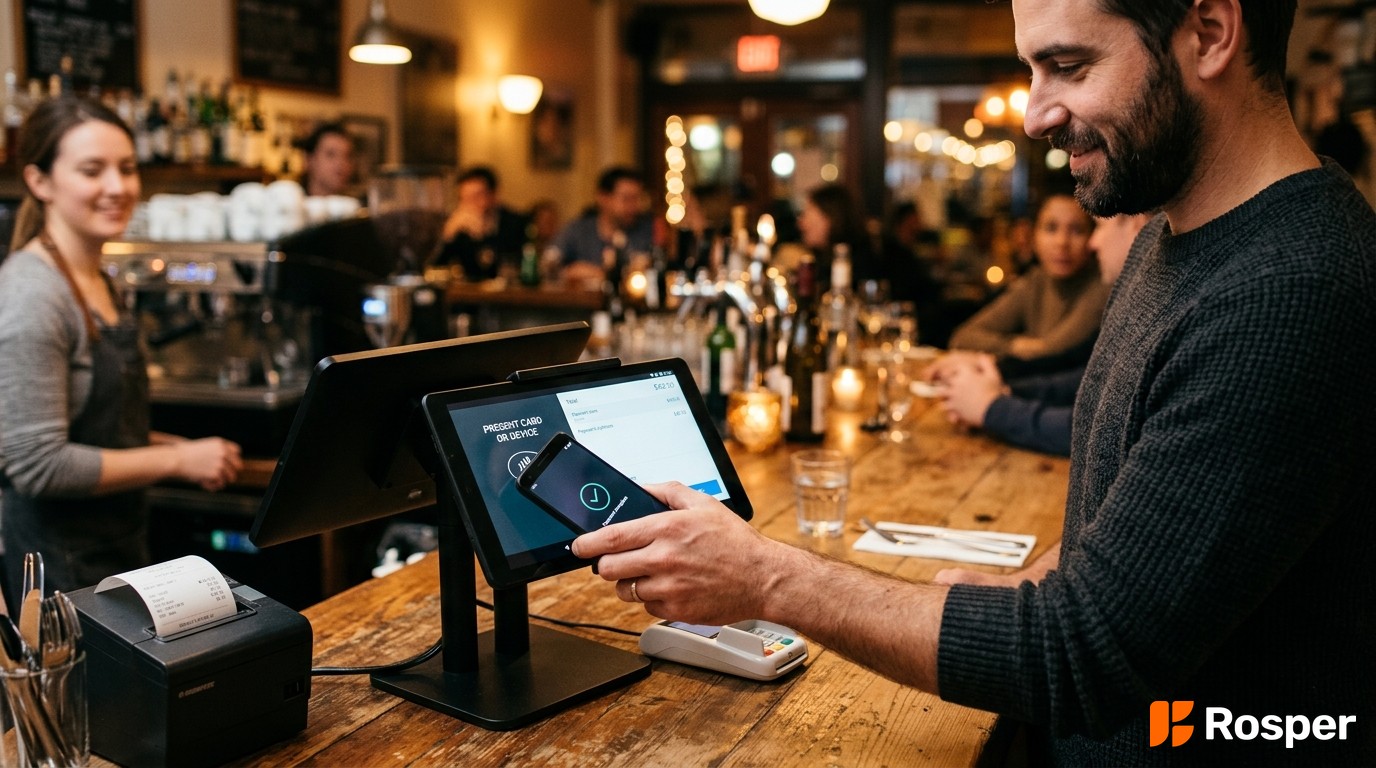
A tap-to-pay restaurant counter is now the default rather than the upgrade. Tap-to-pay volumes now outrun cash and swipe in most North American full-service and quick-service checkouts, and the underlying technology stack, EMV chip, NFC contactless, and mobile wallet, has settled into a clear pattern. This guide is for restaurant owners and operations leads who want to understand what each payment technology actually does, what the terminal needs to support it, and how a modern SUNMI counter or handheld handles the flow.
The short version. EMV chip is the certified contact standard, NFC is the certified contactless antenna, tap-to-pay is the umbrella name for NFC transactions on cards or mobile wallets, and SoftPOS is the modern acceptance mode that runs the certified kernel on the terminal itself. Rosper is the authorized SUNMI distributor for North America and stocks the certified counter, handheld, and self-service devices for all three modes.
Key Takeaways
- EMV chip is the current certified contact standard, and it is the reason a magnetic stripe swipe is now the fallback path rather than the default.
- NFC is the certified contactless antenna standard, and tap-to-pay is the customer-facing name for NFC transactions on cards and mobile wallets.
- Mobile wallets, Apple Pay, Google Pay, and Samsung Wallet, all ride the same NFC rails as a contactless card.
- SoftPOS turns a certified device into the payment terminal itself, replacing a paired PIN pad on assisted retail and self-service checkouts.
- SUNMI CPad Pay, D3 Pro guest display, Flex 3, V3 PLUS Scanner, and V3 MIX ship EMV and NFC certified for North America.
EMV Chip, the Certified Contact Standard
EMV chip is the certified standard for contact card payment. It replaced magnetic stripe as the default for card-present transactions because the chip generates a unique cryptogram per transaction, which drops most of the counterfeit fraud that swipe supported. The EMV standard is maintained by EMVCo, which is jointly owned by the major card networks.
For a restaurant, EMV chip acceptance is the baseline that every counter and handheld terminal must meet. Magnetic stripe swipe is now the fallback path used when a chip fails to read or when a legacy card is presented. Any current SUNMI terminal, from CPad Pay 11 to the P3H handheld, carries the chip interface and the certified EMV Level 1 and Level 2 stack that acquirers require.
The other important thing to know about EMV. The certification lives on the device and on the kernel software. A terminal that has been sourced outside authorized distribution can fall off the certified device listing that the acquirer validates against. That is a compliance risk masked as a hardware discount, which is why authorized distribution matters here.
NFC and Tap-to-Pay Restaurant Checkout, the Certified Contactless Standard
NFC, Near Field Communication, is the short-range radio standard that carries contactless card and mobile wallet transactions. When a customer taps a card, a phone, or a smartwatch on a terminal, the transaction rides an NFC link. The certified spec is called EMVCo PCD Level 1 for the antenna and RF stack.
Tap-to-pay is the customer-facing marketing name for NFC transactions. It covers plastic contactless cards, mobile wallets like Apple Pay, Google Pay, and Samsung Wallet, and the growing set of loyalty and closed-loop tokens that ride the same rails. From the customer view all of these are a tap. From the terminal view all of these are an NFC session managed by the same certified kernel.
The practical implication for a restaurant is that any current SUNMI terminal that ships EMVCo PCD Level 1 accepts every mainstream contactless payment mode a US or Canadian customer will present. The CPad Pay 11, the D3 Pro guest display with Tap on Glass, and the Flex 3 self-service surface all qualify, as do the V3 PLUS Scanner and V3 MIX handhelds. To spec a counter setup that covers EMV plus NFC, request a quote and specify station count.
Planning Contactless Checkout for a Restaurant?
Share your order workflow, payment processor, countertop or handheld use, location count, and launch date, your destination, and target date. Rosper will confirm a contactless restaurant checkout hardware configuration, current warehouse availability, and a quote with a realistic lead time. For a multi-site deployment, include the site count and rollout schedule so we can plan staging and kitting.
Mobile Wallets and How They Ride NFC
Apple Pay, Google Pay, and Samsung Wallet are card networks running on NFC rails. When a customer taps a phone at the terminal, the wallet presents a tokenized version of the underlying card and the transaction settles through the same acquirer path as a physical contactless card. There is no separate acceptance certification for mobile wallets. If the terminal accepts a contactless card at EMVCo PCD Level 1, it accepts the wallet.
For a customer, mobile wallet payments carry the added authentication layer from the phone, Face ID, fingerprint, or PIN. For the restaurant, mobile wallets shift the fraud liability model slightly toward the network because the token is bound to the phone. The result is a faster tap and a lower chargeback rate on wallet transactions, which is why the tap-to-pay volume through wallets has climbed steadily.
For self-service kiosks the interaction has an important detail. Apple Wallet uses a protocol extension called VAS, Value Added Services, that lets the terminal push loyalty and stored-value tokens back to the wallet in the same tap. SUNMI V3 PLUS Scanner carries Apple VAS support, which is why it appears in both restaurant delivery and self-service ticketing use cases.
SoftPOS, the Terminal on the Terminal
SoftPOS is the modern acceptance mode where the certified payment kernel runs on the merchant device itself, not on a paired external PIN pad. That means an assisted retail tablet or a self-service kiosk can accept a tap directly on the same screen the customer ordered on, no dongle required.
For a restaurant, SoftPOS matters most in three places. First, on a counter tablet where an assisted checkout wants to skip a paired peripheral. Second, on a customer-facing display where the guest taps on a Tap on Glass zone. Third, on a self-service kiosk where under-glass NFC is the only reliable geometry. SUNMI CPad Pay covers the assisted case, the D3 Pro guest display covers the customer-facing case, and the Flex 3 covers the self-service case.
The compliance perimeter for SoftPOS is a combination of PCI PTS 6.x for the device, EMVCo PCD Level 1 for the antenna, and an acquirer-approved kernel for the software. The PCI Security Standards Council lists the current device certifications that acquirers validate against.
Tap-to-Pay Restaurant Deployment Checklist
- Confirm EMV chip acceptance on every counter and handheld terminal in the bundle.
- Confirm EMVCo PCD Level 1 NFC on every terminal that will accept a tap or a wallet.
- Match antenna geometry to workflow, edge NFC for counter and handheld, Tap on Glass for guest display, under-glass NFC for self-service.
- Confirm the acquirer kernel is available on the device SKU before rollout.
- Buy through the authorized SUNMI distributor to preserve certification and warranty.
- Confirm US and Canada stock and lead time before committing rollout dates.
Source Contactless-Ready POS Hardware from Rosper
Rosper is the authorized SUNMI distributor for North America. We stock the SUNMI CPad Pay, D3 Pro guest display, Flex 3, V3 PLUS Scanner, and V3 MIX across 8 US warehouses plus a Canadian hub, coordinate the SUNMI warranty and RMA process locally, and support restaurants and ISV partners with certified acquirer kernel setup. Most orders arrive in 2 to 7 business days. To scope an EMV, NFC, and tap-to-pay setup for your restaurant, contact us and we will match SUNMI SKUs to your acquirer and station layout.
Rosper is SUNMI’s authorized distributor for the United States and Canada. Our team helps buyers match SUNMI devices, compatible accessories and deployment services to the workflow, confirm exact configurations and current warehouse availability, and coordinate shipping, staging, kitting and warranty support for pilots or multi-location rollouts. Contact our sales team for configuration guidance or to check current stock.
Frequently Asked Questions
What is the difference between EMV, NFC, and tap-to-pay?
EMV is the certified standard for contact chip card transactions maintained by EMVCo. NFC, Near Field Communication, is the certified short-range radio antenna standard that carries contactless transactions. Tap-to-pay is the customer-facing marketing name for NFC transactions on plastic contactless cards, mobile wallets, and smartwatches. All three settle through the same acquirer path when the terminal is EMVCo certified.
Do SUNMI POS terminals accept Apple Pay and Google Pay?
Yes. Any SUNMI terminal that carries EMVCo PCD Level 1 NFC accepts Apple Pay, Google Pay, and Samsung Wallet. The wallet presents a tokenized version of the underlying card and the transaction rides the same NFC rails as a contactless card. That covers the CPad Pay 11, D3 Pro guest display, Flex 3, V3 PLUS Scanner, and V3 MIX in the current lineup.
What is SoftPOS and how does it change a restaurant checkout?
SoftPOS runs the certified payment kernel on the merchant device itself instead of on a paired external PIN pad. A tablet at the counter, a guest display at the customer side, or a self-service kiosk can accept a tap directly on the same screen, no dongle required. For restaurants that reduces station clutter and simplifies the payment stack to one device per checkout.
Do I need PCI PTS 6.x on my new restaurant POS?
For any new payment terminal purchase in 2026, PCI PTS 6.x is the target. Older versions may still support legacy hardware for a defined support window, but new deployments should qualify on 6.x to avoid a forced mid-lifecycle refresh. In the SUNMI lineup the CPad Pay 11 and the P3H handheld both carry current PCI PTS 6.x certification.
Where can restaurants buy contactless-ready SUNMI POS in the US and Canada?
Buy through Rosper as the authorized SUNMI distributor for North America. Rosper stocks the CPad Pay, D3 Pro guest display, Flex 3, V3 PLUS Scanner, and V3 MIX across 8 US warehouses plus a Canadian hub. Most orders arrive in 2 to 7 business days, and buying through the authorized channel preserves EMVCo, PCI PTS, and SUNMI warranty coverage.
For the device options behind a tap-to-pay restaurant counter, see our SUNMI SoftPOS tap-to-pay devices.
Related reading: PCI PTS certified Android payment terminals.