
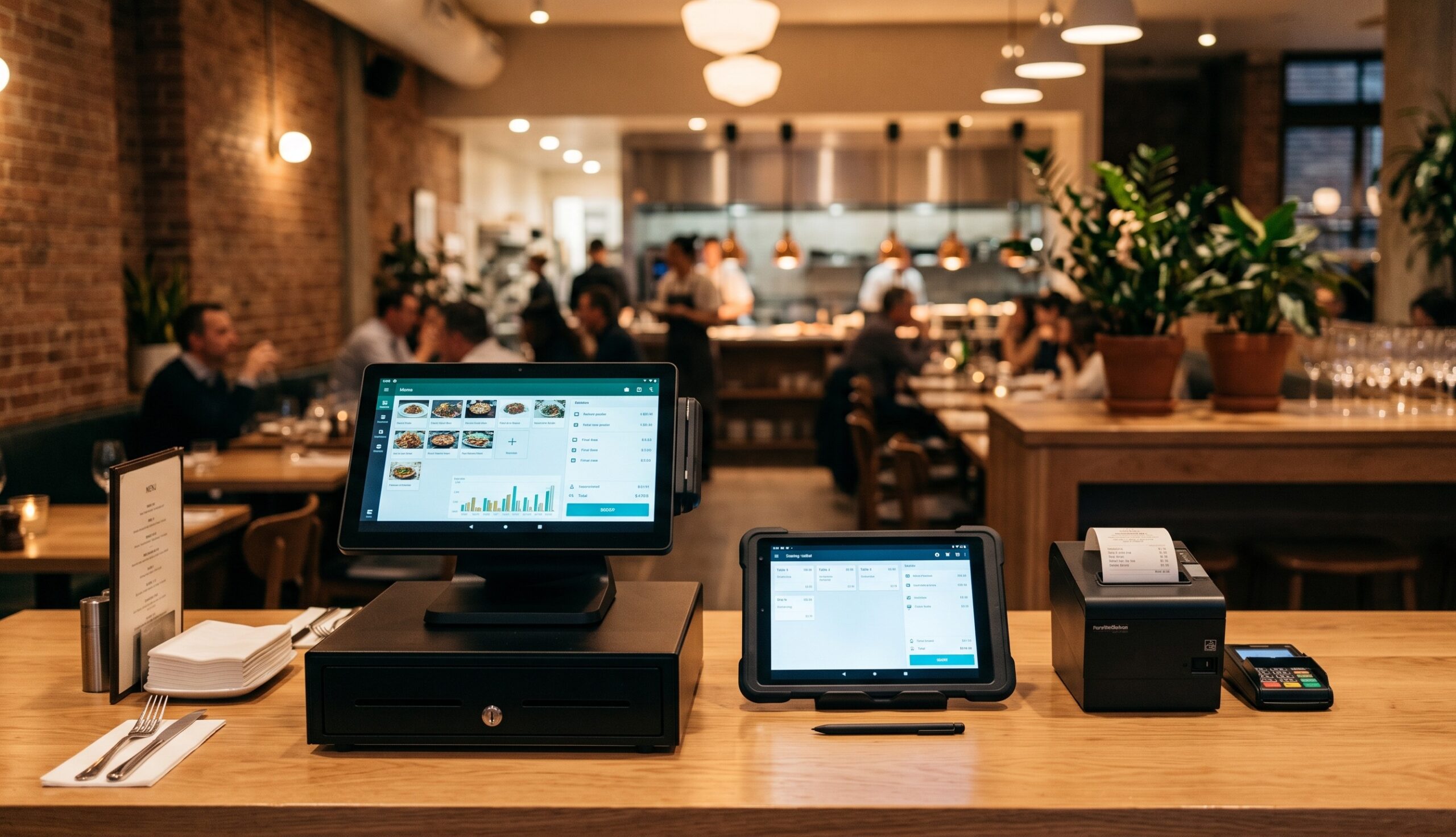
Best POS hardware 2026: Key takeaways
- Match the station to the venue type, not the brand. Counter-only QSR, full-service restaurant, salon, c-store, and pop-up retail each have a different SUNMI primary station – this guide maps all five.
- Android with GMS is the default in 2026. US and Canadian operators standardize on Android 13 GMS so cloud POS apps install from Play Store and MDM stays vanilla – SUNMI is the largest Android POS vendor with a North American distributor footprint.
- Payments certifications drive long-term fleet value. PCI PTS 6.x devices are the floor for any 2026-2030 plan – select stations against the PCI Council device list, not vendor marketing.
- Modular outperforms all-in-one as venues scale. Once a single venue exceeds 60 seats or 200 daily transactions, splitting counter, KDS, kitchen printer, and tableside into separate SUNMI stations consistently beats a single all-in-one terminal on uptime.
Best POS hardware in 2026 means SUNMI Android stations for most US and Canadian operators. This buyer’s guide covers the best POS hardware for restaurants, retail, salons, and self-order kiosks, how to spec the best POS hardware against PCI PTS 6.x certification, and how Rosper procures the best POS hardware in 2-business-day SLA.
This guide is for US and Canadian operators evaluating POS hardware in 2026. It is organized by hardware category, not by brand. Each section names the credible options, explains where each one fits best, and calls out the trade-offs honestly. We sell SUNMI hardware at Rosper as the authorized US and Canadian distributor, so you will see SUNMI mentioned often, but the goal is to help you make a defensible hardware decision, not to push every operator toward the same SKU.
If you only have five minutes, jump to the TL;DR section at the bottom for the short version by use case.
The four questions every buyer should answer first
Before comparing any specific hardware, settle four questions:
-
Who is your POS software vendor? Some POS software vendors require their own bundled hardware. Toast hardware only runs Toast software. Square Register only runs Square. Clover only runs the Clover stack. If you already know your POS software is Square, your hardware choice is mostly made. If you want to keep your software options open or use an open Android POS stack, you need hardware that runs Android, like SUNMI.
-
What is your payment processing relationship? Some hardware-software bundles force a specific payment processor. Clover devices route payments through Fiserv. Square hardware processes payments through Square. Independent Android hardware like SUNMI lets you pick your own acquirer and EMV terminal.
-
What is your form-factor constraint? Counter footprint, standing kiosk floor space, food truck mobility, in-aisle handheld, table-side handheld, kitchen station, drive-thru order point. Each has a different hardware category.
-
What is your three-year TCO budget? Hardware purchase price is one component. Per-device monthly software fees, payment processing markups, replacement and warranty cost, MDM and support cost, and software vendor switching cost all stack on top. Do the math out to 36 months before signing.
If you cannot answer all four questions, you are not ready to buy hardware. Start with the software and processor decisions, then come back.
Desktop POS terminals
The category leader for fixed-counter installations in restaurants and full-service retail. Single device, dual-screen, mounted permanently on the counter, paired with a cash drawer and an external printer or kitchen printer.
SUNMI T3 family (T3 Pro, T3, T3 Lite). The current best-in-class Android desktop POS. 15.6-inch FHD main display, 10.1-inch customer-facing secondary display, built-in 80 mm printer, expandable port array, RJ11 and RJ12 for legacy peripherals. Runs SUNMI OS based on Android. Three-year main-unit warranty. Pairs with any Android POS software. Sold through Rosper in the US and Canada.
Toast hardware (Toast Flex, Toast Go). Solid build. Locked to Toast software. Per-device monthly fee paid to Toast. Right choice if you have already committed to Toast as your POS vendor and want a turnkey hardware-software-payments package.
Clover Station Duo and Station Solo. Comparable Android-based hardware. Locked to Clover’s software and Fiserv as the acquirer. Per-device monthly fee. Right choice if you are committed to Clover.
Square Register. Single-device counter POS bundled with Square software and payments. Comparable hardware spec. Locked to Square’s stack. Easiest setup story; least flexibility on software and processor.
Verdict for desktop POS: If you have a POS software vendor and want a turnkey bundle, pick the matching hardware (Toast hardware for Toast, Clover for Clover, Square for Square). If you want hardware independence and a lower three-year TCO, the SUNMI T3 family is the strongest Android-based independent option.
Compact desktop POS and all-in-ones
A class below full desktop POS. Compact footprint, often with a built-in printer and scanner, suited to coffee shops, small retail, food trucks, and pop-ups.
SUNMI D3 Mini. Reviewed in detail in our D3 Mini review. 10.1-inch main display, built-in 58 mm or 80 mm printer, NFC, scanner, optional battery on the 58 mm variant. Runs Android, no vendor lock-in. Our pick for cafés, food trucks, and small retail counters that want a real POS terminal without committing to a specific software vendor.
Clover Mini. Tablet-on-a-base architecture. Built-in printer in the base, customer-facing screen. Locked to Clover software and Fiserv processing. Per-device monthly fee. Comparable hardware to the D3 Mini, but the lock-in and monthly fees push three-year TCO higher.
Square Terminal. Compact handheld-class device with built-in printer. Bundled with Square software and payments. Right for very small operators who want one box for everything. Limited port expansion.
Verdict for compact POS: SUNMI D3 Mini for operators who want hardware independence. Clover Mini or Square Terminal for operators who want a turnkey software bundle and accept the per-device fees.
Self-order kiosks
A growing category driven by labor cost and customer preference for self-service. Two physical formats: standing (21.5-inch or larger) and compact counter-top (15.6-inch).
SUNMI K2 (standing) and K2 Mini (compact). Both are Android-based self-service kiosks. The K2 is the standing pedestal kiosk for high-volume QSR lobbies. The K2 Mini sits on a counter, weighs 8 to 10.5 kg, and supports attended-mode rotation for staff use during peak hours. Read our K2 Mini for restaurants guide for the deeper restaurant fit.
Toast Kiosk. Standing kiosk locked to Toast software. Right if you are a Toast restaurant.
Square Kiosk. Square’s iPad-on-stand-based kiosk, bundled with Square software. Right for very small QSR operators on the Square stack.
Third-party kiosk vendors. Many regional POS software vendors ship their own branded kiosks, usually SUNMI or other Android hardware re-skinned. The hardware quality is typically comparable to SUNMI direct. The lock-in is to the specific software vendor.
Verdict for self-order kiosks: SUNMI K2 or K2 Mini through Rosper for operators who want hardware that survives a software vendor switch. Toast Kiosk or Square Kiosk if you are committed to those POS stacks.
Handheld POS terminals
In-aisle retail, table-side restaurant ordering, mobile payments, on-demand inventory checks, and delivery confirmation.
SUNMI V3 Mix, V2 Pro, V2s, M3 Pro. The Android handheld lineup. V2s for compact retail handheld payment. V3 Mix for full-feature handheld with built-in printer. M3 Pro for rugged handheld scanning in warehouse and logistics. SUNMI’s handheld category is the strongest in the independent Android hardware market. Read our best Android handheld for warehouse guide for the logistics-specific story.
Toast Go. Handheld at-table POS bundled with Toast. Right for Toast restaurants doing at-table ordering.
Square Terminal. Doubles as a handheld in small format. Bundled with Square.
Verfone and Ingenico handheld payment terminals. Pure payment terminals (no POS app), locked to specific acquirers. Right for payment-only use cases on existing POS software.
Verdict for handhelds: SUNMI V-family or M-family for Android-based independent handhelds. Toast Go or Square Terminal for bundled stacks. Verifone or Ingenico for payment-only handhelds tied to a specific acquirer.
Payment terminals (EMV PIN pads)
For operators running an external EMV terminal alongside a POS, not built into the POS device itself.
SUNMI P2 Pro and P3 Family. Android-based payment terminals with EMV and PCI PTS certification. Runs payment apps from multiple acquirers. Increasingly the choice for operators who want a single Android payment device that switches between acquirers, rather than locking themselves to one. Read our SUNMI vs PAX vs Ingenico comparison for the deeper payment terminal story.
PAX A920, A77, A50. Established Android-based payment terminal line. Comparable certification. Often bundled with specific acquirers who provision PAX hardware.
Ingenico Lane and Move series. Mostly Linux-based legacy payment terminals. Strong installed base. Slower software update cadence than Android-based competitors.
Verifone V200c, P400, X990. Legacy payment terminal line. Strong with US acquirers.
Verdict for payment terminals: SUNMI P-family or PAX for Android-based modern payment terminals. Ingenico and Verifone for operators whose acquirer specifies their hardware.
Three-year TCO is the metric that matters
Hardware purchase price is the first number on every quote. It is not the number that matters most over three years. Operators who get this wrong end up over-paying for “cheap” hardware bundled with expensive monthly fees.
The total cost of ownership for a POS terminal over three years typically includes:
- Hardware purchase price. One-time.
- Per-device monthly software fee. Often 30 to 70 USD per device per month for bundled vendors (Toast, Clover, Square). Zero for hardware-independent stacks where you pay the POS software vendor directly.
- Per-transaction payment processing markup. Bundled vendors typically take a higher markup on payment processing than independent acquirers. The compounded cost over three years can exceed the hardware price.
- Replacement and warranty costs. SUNMI’s 3-year main-unit warranty (1-year wear parts) coordinated through Rosper is the strongest in the category. Verify the warranty schedule for each brand at purchase, not after the device fails.
- MDM and support cost. SUNMI Partner Portal MDM is included with the hardware. Some other brands charge separately for MDM.
- Switching cost. If you change POS software vendors in year two, can you keep the hardware? On bundled stacks, no. On independent Android hardware, yes.
Run the numbers out to 36 months. The cheapest hardware up front is often the most expensive over three years, and vice versa.
TL;DR by use case
- Restaurant counter POS, single location, want simple turnkey: Square Register or Clover Station. Accept the lock-in.
- Restaurant counter POS, multi-location, want hardware independence: SUNMI T3 family through Rosper.
- Coffee shop, café, food truck: SUNMI D3 Mini (58 mm with battery for mobile, 80 mm for fixed counter).
- QSR self-order kiosk lobby: SUNMI K2 (standing) or K2 Mini (compact) through Rosper.
- Small QSR or fast-casual counter kiosk: SUNMI K2 Mini through Rosper.
- At-table handheld for full-service restaurant: SUNMI V-family for Android-independent; Toast Go if you are a Toast restaurant.
- In-aisle retail handheld: SUNMI V2s or M3 family through Rosper.
- Warehouse and logistics handheld: SUNMI M3 family through Rosper.
- External EMV payment terminal: SUNMI P-family or PAX A-family.
Ready to size a 2026 POS hardware deployment
If you are evaluating POS hardware for a US or Canadian deployment in 2026 and want a sales engineer to walk through your specific use case, Rosper can scope the hardware, stand up your MDM, pair your printers and kitchen devices, and ship pre-provisioned units that boot directly into your chosen POS app on first power-on. Start with our products catalog and send a note to [email protected] with your store count, vertical, and target go-live date.
Frequently asked questions
Q: What is the best POS hardware for restaurants in 2026?
For multi-location restaurants that want hardware independence from POS software, the SUNMI T3 family is the strongest Android-based desktop POS. For single-location operators committed to Toast, Clover, or Square, the matching bundled hardware is the simplest path. For self-order kiosks, SUNMI K2 or K2 Mini. For at-table handheld ordering, SUNMI V-family or Toast Go.
Q: What is the cheapest POS hardware over three years?
Cheapest over three years is rarely the cheapest up front. Independent Android hardware like SUNMI, paired with your chosen POS software and acquirer, typically beats bundled hardware-software stacks on three-year total cost because there are no per-device monthly software fees paid to the hardware vendor.
Q: Can I use SUNMI hardware with my existing POS software?
Yes, if your POS software has an Android app. The SUNMI hardware lineup runs SUNMI OS based on Android. Most modern POS software vendors ship an Android app that runs on SUNMI hardware. Check with your POS vendor before purchase to confirm app compatibility.
Q: What POS hardware works for both retail and restaurants?
The SUNMI T3 family is the most common cross-vertical desktop POS. The D3 Mini works for both small retail and small restaurant operators. The K2 Mini works as a self-order kiosk for restaurants and a self-checkout kiosk for small retail. The handheld V-family and M-family cross vertical based on the software you run.
Q: Do I need MDM for POS hardware?
For more than three or four devices across multiple sites, yes. MDM lets you push software updates, lock devices into kiosk mode, deploy app updates, and pull diagnostic logs centrally. SUNMI Partner Portal MDM is included with SUNMI hardware purchased through Rosper. Other brands may charge separately for MDM.
Q: How long is the warranty on SUNMI POS hardware?
SUNMI Gen2 and Gen3 hardware ships with a 3-year main-unit hardware warranty. Wear parts including thermal printer heads carry a 1-year warranty. Gen1 hardware ships with a 1-year warranty. SUNMI provides the warranty and Rosper coordinates RMA in the US and Canada. Full schedule at rospertech.com/warranty.
Further reading
- SUNMI K2 Mini for restaurants
- SUNMI D3 Mini review 2026
- SUNMI vs PAX vs Ingenico payment terminal comparison
- Best Android handheld for warehouse 2026
- Android POS vs iPad POS for Canadian businesses
- Rosper warranty page
Further reading: See PCI Security Standards Council device list for primary-source detail.