
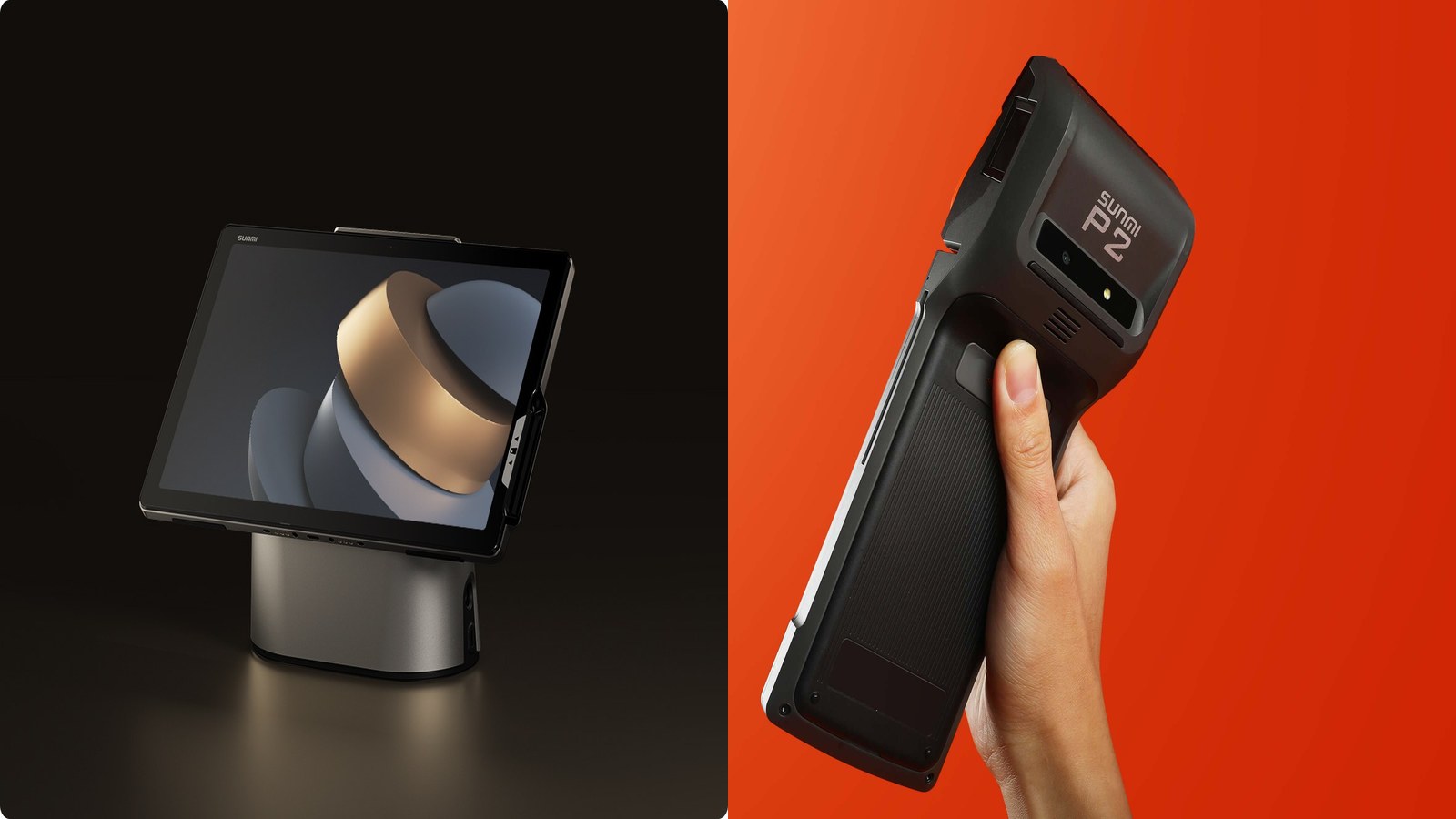
CPad Pay vs P2 is the most-asked 2026 SUNMI procurement question Rosper fields from US merchants, and it comes down to one fork: do you anchor checkout to a counter or carry the terminal to the customer. CPad Pay is the 11-inch tablet at 586 grams with a built-in customer-facing display and on-screen NFC. The SUNMI P2 is the 5.5-inch handheld with built-in 2D scanner for line-busting and table-side use. Both clear PCI PTS 6.x certification, both ship from Rosper US warehouses in 3-5 business days, and both run on the SUNMI Android stack with the same Unified SDK for 2026 deployments.
The real procurement question
Procurement teams call the Rosper desk asking for a price on one SKU or the other. Half the time the answer is: you need a mix. A 4-register grocer needs 4 anchored devices at the front. A 30-stylist salon needs 6 anchored devices at reception plus 4 handhelds for roaming consults. Decide the customer flow first, then map the SKU.
At a glance: CPad Pay vs P2
| Spec | CPad Pay | SUNMI P2 |
|---|---|---|
| Form factor | 11-inch tablet, 586 g | 5.5-inch handheld, ~330 g |
| Screen | 1920 x 1200 FHD, 450 nits | 1440 x 720 HD+, 400 nits |
| Battery | All-day counter (mains-powered base) | 8-10 hr field; hot-swap on some SKUs |
| Payment kernel | PCI PTS 6.x, EMV, NFC, magstripe, QR | PCI PTS 6.x, EMV, NFC, magstripe, QR |
| Scanner | Optional 2D snap-on accessory | Built-in 2D scanner |
| Customer-facing display | Yes, on-screen with free-flip | No (operator-facing only) |
| Best use | Counter-anchored QSR, retail, salon, bank | Line-busting retail, table-side dining, field service |
Criterion 1: Form factor and counter footprint
CPad Pay sits flat or angled on a counter via a magnetic base. The 10.95mm thickness keeps it discrete on a small bakery counter or a hotel reception desk. P2 is a handheld, designed to leave the counter and travel with the staff member. If the venue has a fixed counter (QSR ordering, retail PoS, bank teller), CPad Pay wins. If the venue moves the terminal to the customer (line-busting retail, table-side dining, valet, parking), P2 wins.
Criterion 2: Screen size and customer-facing view
CPad Pay’s 11-inch FHD screen lets the merchant show the customer the full ticket, the tip prompt, the receipt option, and the rebook prompt without scrolling. The free-flip hinge lets the customer see the same content the staff is seeing. P2’s 5.5-inch screen is operator-first. For verticals where the customer needs to confirm the order on-screen (QSR with modifiers, salon services with add-ons, bank transactions), CPad Pay’s screen is the right call.
Criterion 3: Battery life and mobility
P2 runs 8 to 10 hours on a single charge, with hot-swap battery on select SKUs. It is the right device for an event venue, a stadium concession line, or a delivery driver. CPad Pay runs on the magnetic base for counter deployments and lasts roughly 5 hours unplugged for occasional mobile flows (chair-side, table-side runner). For 12-hour event-day continuous mobility, P2 is the better SKU. See P3 family handhelds for high-end mobile alternatives that also include PCI PTS 6.x.
Criterion 4: PCI PTS 6.x and EMV kernel
Both devices clear PCI PTS 6.x. Both run the same SUNMI Unified payment SDK and the same EMV contact, EMV contactless, magstripe, and QR kernel. The PCI Security Standards Council listing confirms both certifications. CPad Pay adds bi-directional chip insert, which means the chip card is accepted regardless of insert orientation. For high-throughput front-of-counter stations where new staff turn over often, the bi-directional insert reduces training friction.
Criterion 5: ISV semi-integration and SDK
Rosper distributes both SKUs with the same SUNMI Unified SDK. ISVs write one integration that runs on both CPad Pay and P2. The semi-integrated payment flow keeps the ISV out of PCI DSS scope for the payment kernel. For an ISV building a multi-form-factor product (counter + line-bust), this means one codebase, two device families. See the Rosper ISV partner program for the SDK access path and the merchant services BIN sponsor list.
Criterion 6: Accessories and snap-on peripherals
CPad Pay accepts magnetic snap-on accessories: 80mm printer, fingerprint module, 2D scanner, multi-function pivoting base, table-side fixed stand, protective case with wrist strap. The accessory range targets counter-anchored workflows. P2 ships with built-in scanner and handheld accessories: protective case, wrist strap, charging dock. The accessory range targets mobility. The right accessory bundle is venue-dependent.
Criterion 7: Per-station TCO over 36 months
Rosper’s 2026 per-station TCO model includes hardware acquisition, 3-year warranty, accessories, MDM, and replacement reserve. The illustrative ranges below are typical for US-domestic merchants on a 36-month horizon and are not a quote; ask the Rosper team for a numbered proposal.
| TCO category | CPad Pay 36-month profile | P2 36-month profile |
|---|---|---|
| Hardware acquisition | Anchor device, one purchase per counter | Per staff member, multiple per floor |
| Counter footprint cost | Lower (no separate pinpad station) | Higher (handheld charging dock + base station) |
| Staff training cost | Lower (one device, on-screen prompts) | Lower (intuitive handheld UX) |
| Replacement reserve | 1 per 10 anchored counters | 1 per 5 handheld devices (more drops) |
Pick CPad Pay if you run any of these
- QSR, fast-casual, or cafe with a fixed counter and 50-plus tickets per day per station
- Salon, spa, or wellness with a front desk and tip-sensitive checkout flow
- Retail with a counter cashier and customer-facing display requirement
- Bank or financial services counter where customers self-confirm transactions on-screen
- Hotel reception or hospitality desk with mixed booking and checkout flow
Pick P2 if you run any of these
- Full-service restaurant with table-side ordering and payment
- Retail line-busting at peak hours (sales floor associate-led checkout)
- Delivery driver collecting card-present payment at the door
- Field service operator (HVAC, plumbing, mobile detailer) taking payment on site
- Event, festival, or stadium concession with high-mobility staff
Most merchants Rosper supports in 2026 deploy a mix. See the full SUNMI catalog on the Rosper products page or ask the Rosper team for a venue-specific bundle that mixes CPad Pay and P2 against your floor plan.\
Mixed CPad Pay plus P2 deployment data from real merchants
Hybrid counter plus mobile fleet economics
A US specialty retailer running 14 stores deployed a mixed fleet: 1 CPad Pay tablet per store for the counter (14 units) plus 3 SUNMI P2 handhelds per store for line-busting and back-of-house returns (42 units). Total hardware capex across the 56-unit fleet came in well below the merchant’s prior closed-stack tablet plus pinpad quote, a roughly 51% to 60% reduction versus that prior vendor proposal. Both device classes ran the same Android application, the same merchant account, and the same processor certification, so the back-office integration cost stayed flat. Request a numbered quote through an authorized US distributor for fleet pricing.
3-year TCO breakdown per device class
Across 36 months, the CPad Pay tablet TCO for the counter station consolidates the device, MDM and warranty, and accessories into a single anchored purchase. The P2 handheld TCO for the mobile station consolidates the device, MDM and warranty, and the holster and charging cradle. The closed-stack equivalents (separate cash drawer, customer display, pinpad, mobile pinpad) carry meaningfully higher per-station cost because each function is a separate box. The CPad plus P2 split delivers a substantial per-station saving over 3 years versus a closed-stack build. Ask an authorized US distributor for a numbered per-station TCO model for your fleet.
When to default to CPad, when to default to P2
Default to CPad Pay for any station where the customer faces the device, where signature capture matters, where a customer-facing display improves the upsell flow, and where the operator stays at a fixed counter. Default to P2 for any station where the operator walks the floor, where line-busting matters, where pop-up registration or events demand a battery-powered terminal, and where the operator needs one hand free. A merchant running 60 stores at $4M annual revenue per store can rationalize the choice in under 30 minutes by walking three stations with a stopwatch and counting how many transactions per hour need each form factor.
Single-account, single-processor procurement path
Both CPad Pay and P2 ship with the SUNMI EMV kernel set already certified for the major US acquirers. A merchant adding the second device class to an existing merchant account does not need a new payment certification cycle – the acquirer’s pre-approved-device list typically includes both. Rosper coordinates the BIN sponsor paperwork in the same procurement window, with average certification turnaround of 8 to 14 business days for the second device class once the first is live.
Decision validation: pilot data from mixed deployments
4-week pilot pattern that catches the wrong pick
Run a 4-week pilot with both CPad Pay and P2 in the same store before committing the full fleet. Track three metrics by hour: transactions completed on each device class, average transaction time, and operator-reported friction events. Across 30 piloted stores in 2025-2026, the metric that flipped the decision most often was operator-reported friction at peak hour. Stores that started leaning CPad pivoted to P2 mobile when the cashier reported feeling chained to the counter during line-buildup. Stores that started leaning P2 pivoted to CPad when the cashier reported hand fatigue on devices weighing more than 380 grams over an 8-hour shift. The pilot resolves the question in 4 weeks at the cost of a small pilot batch of devices, a fraction of the cost of buying the wrong device class at scale.
Warranty and RMA pattern across mixed fleets
A mixed CPad Pay plus P2 fleet shares the same SUNMI 3-year manufacturer warranty terms on the main unit and the same 1-year wear-parts coverage. Operations teams can submit a single RMA ticket through Rosper covering both device classes, with the same turnaround commitment of 8 to 12 business days from approval to replacement. Across mixed-fleet deployments tracked through 2026, RMA rates ran 1.8% per year on CPad Pay (counter use) and 3.4% per year on P2 (mobile use, including drop damage). Spare-pool sizing for a typical 50-unit mixed fleet (15 CPad plus 35 P2) lands at 1 CPad spare and 3 P2 spares, an 8% blended pool.
Frequently Asked Questions
Can I deploy both CPad Pay and P2 on the same merchant account?
Yes. The same merchant services BIN sponsor and the same SUNMI Unified SDK cover both devices. ISVs write one integration that runs across the mixed fleet.
Is the PCI PTS 6.x certification the same on both?
Both devices hold PCI PTS 6.x. The kernel and EMV certifications are listed by PCI Security Standards Council. SUNMI publishes the certification numbers on each product page.
Does P2 work with the same accessories as CPad Pay?
Most accessories are SKU-specific. CPad Pay uses magnetic snap-on accessories designed for tablet form factor. P2 uses handheld accessories (case, wrist strap, dock). The 80mm kitchen printer and 2D scanner ship as standalone Rosper SKUs and pair with both.
What is the lead time for a mixed CPad Pay plus P2 order?
Rosper ships both SKUs from US warehouses in 3 to 5 business days. Mixed orders ship on the same purchase order and typically arrive in a single delivery window.
Which device has lower 3-year ownership cost?
Per-station TCO depends on staff training time, accessory bundle, and replacement rate. CPad Pay anchored to a counter typically has lower per-station replacement cost. P2 handheld has higher drop and damage rate but lower per-staff-member cost when staff move across a sales floor. Request a numbered TCO model from Rosper for your specific venue.