
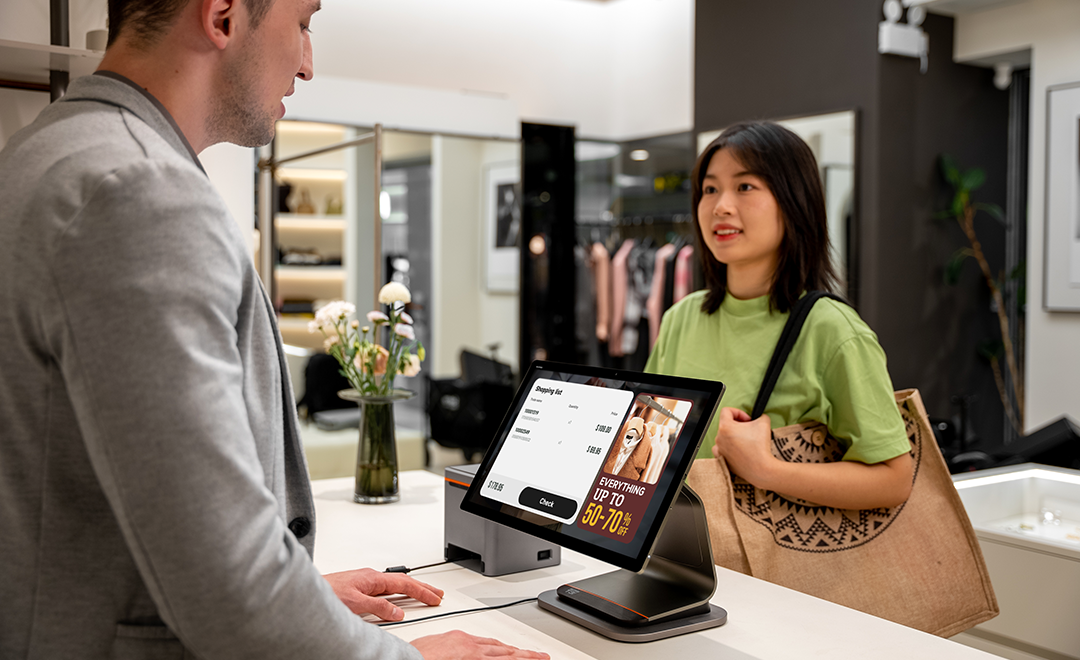
SUNMI POS grocery convenience store deployments in 2026 covers the operational baseline that independent grocers, bodegas, c-stores, and small specialty food retailers need: fast barcode scanning at peak hours, EBT/SNAP card support, age verification for restricted categories, integrated payment, and a hardware platform that runs the store management software on the same Android counter terminal serving the customer. For Rosper customers running single-lane bodegas up through 25-location convenience chains, this guide walks the device-count math, EBT enrollment path, age verification workflow, multi-lane self-checkout options, and the warranty pattern that protects store unit economics.
Why grocery and convenience POS is being refreshed in 2026
Three structural pressures have pushed grocery and convenience store POS into active refresh in 2026. First, PCI PTS device generation in service at most US c-stores is aging into mandatory replacement windows over the next 18 months, which creates a forced refresh cycle for stores that have not budgeted for it. Second, customer expectation has shifted toward tap-and-go contactless payment, which the magnetic-stripe-and-paper-receipt setup still running at many independent stores cannot deliver. Third, EBT/SNAP transaction volume continues to grow as a share of grocery and convenience store payment mix, which puts pressure on stores to upgrade to certified terminals that handle EBT, contactless, and standard card transactions on the same hardware.
Best SUNMI POS grocery convenience store hardware: single + dual lane baseline
Working hardware baseline for an independent convenience store under 4,000 a popular mobile POS provider feet:
- One SUNMI T3 Pro family counter terminal per lane, with built-in thermal printer for customer receipts and integrated touchscreen for the store management application.
- One 2D handheld scanner per lane for fast barcode reading at peak hours, with the throughput that single-lane high-volume c-stores need during morning and evening rushes.
- One PCI PTS certified payment terminal per lane, paired with the counter terminal via the standard semi-integrated payment architecture. The payment terminal is what carries EBT/SNAP certification, contactless tap, EMV chip, and magnetic stripe.
- Optional: one 80mm kitchen cloud printer or cash drawer for stores running prepared food or cash-heavy lanes.
For stores at 5,000 to 12,000 a popular mobile POS provider feet (small grocery or larger c-store with multiple lanes during peak hours), add a second counter terminal at the second lane, and consider one K2 Mini countertop self-checkout for late-night or low-supervision hours where staffing a second cashier does not pencil.
EBT/SNAP support: the payment terminal certification matters, not the counter hardware
EBT/SNAP card acceptance is a function of the payment terminal certification with a USDA FNS-approved EBT processor, not the SUNMI counter hardware. In the semi-integrated payment architecture, the SUNMI T3 Pro family counter terminal runs the store management software (transaction creation, inventory lookup, age verification, receipt printing); the paired PCI PTS certified payment terminal handles the card capture and routes the transaction to the appropriate processor (standard card, contactless, or EBT depending on the customer card and the transaction type).
For independent grocers and convenience stores running EBT/SNAP, the procurement sequence: first, enroll the store with USDA FNS as an authorized SNAP retailer (a separate regulatory USDA FNS retailer application process handled by the store owner directly with USDA). Second, select an EBT processor that is FNS-approved and supports your payment terminal model. Third, the payment terminal vendor or processor handles the EBT activation on the terminal. Throughout all three steps, the SUNMI counter terminal is the constant application platform and does not need to be replaced when the EBT processor changes. This is one of the strongest TCO arguments for separating the counter hardware decision from the payment terminal decision.
Age verification workflow for tobacco, alcohol, lottery, and restricted categories
Age verification for restricted categories runs through the store management software on the SUNMI counter terminal. The cashier scans the restricted product (cigarettes, beer, lottery ticket, etc.), the store software flags the item as restricted, the cashier scans the customer ID barcode (driver license PDF417 or state ID) or enters the birth date manually, the software validates the date against the regulation threshold for that category in that jurisdiction, and either approves the line item or blocks it.
The 2D handheld scanner reads the PDF417 barcode on US driver licenses and state IDs out of the box, with no additional hardware required. For stores in jurisdictions requiring electronic ID verification logs (some states require audit logs for lottery and certain tobacco categories), the store software writes the verification event to the transaction record, which the back-office system aggregates for regulatory reporting. The SUNMI counter terminal supports all of this through the store management software with no additional hardware add-on required.
Self-checkout for convenience stores: when the K2 Mini countertop kiosk pays back
The K2 Mini countertop self-checkout is positioned for convenience stores running low-supervision lanes: late-night shifts (10 PM to 6 AM), single-staff hours, captive workforce locations (corporate cafeterias, gym lobbies, transit hubs, university dorm convenience stores). The math works when the cost of staffing a second cashier exceeds the customer wait time penalty of self-checkout, which is typically in the late-night and shoulder-hour periods rather than the morning and evening rushes.
Restricted category items (tobacco, alcohol, lottery) require staff override at the self-checkout, which integrates with the same age verification workflow used on staffed lanes. The customer scans the restricted item at the K2 Mini, the kiosk pauses the transaction and signals for staff assistance, the staff member validates the ID and releases the line item from the staff override console (either the counter terminal or a handheld device). For stores running self-checkout with no staff member on-site, restricted categories are blocked at the kiosk entirely.
Handheld POS for backup lanes, curbside pickup, and inventory scan
Grocery and convenience stores that layer a handheld POS on top of the counter terminal cover three workflows a stationary T3 Pro cannot: line-busting during Saturday rush, curbside pickup and buy-online-pickup-in-store checkout at the parking lot, and floor-side or backroom inventory scan without leaving the aisle.
The SUNMI V3 Mix pairs an 80mm thermal printer with a 6.75-inch handheld body, EMV plus NFC plus PCI PTS 6.x payment, and a 1D/2D scanner. The 80mm printer prints the same receipts as the front counter T3 Pro, so a shift lead can move a checkout station out to the parking lot for holiday-week curbside without changing the paper roll. Pair a V3 Mix with the counter T3 Pro when the store expects 20-plus curbside orders per day or hosts a weekly farmers-market pickup.
The SUNMI V2 Pro keeps the 58mm printer and swap-in battery pattern that most operators recognize from legacy handheld payment terminals. For a 4-cashier convenience store that needs a fifth checkout station only on Saturday football weekends, one V2 Pro on a charging cradle is the lowest-cost way to add a mobile lane without buying a full counter terminal.
The SUNMI V2s is the entry-level handheld with the same 58mm printer, ideal as a scan-only or price-check device for shelf label audits and aisle-side markdown scans by store staff.
The SUNMI P3H is the rugged variant, IP65 rated with a 1.5-meter drop spec, purpose-built for backroom stock intake, walk-in cooler counts, or dock-door delivery-truck receiving where a standard handheld would fail after a fall or moisture exposure.
A typical mixed-fleet blueprint for a 6,000-square-foot convenience store: 2 T3 Pro at the counter, 1 K2 Mini for self-checkout, 1 V3 Mix for curbside plus mobile lane, and 1 P3H for backroom. This 5-device fleet on one SUNMI OS and one MDM console covers every checkout, pickup, and inventory scan workflow the store will encounter in 2026.
Multi-location convenience chain rollout: standardize early
For convenience chains rolling out POS hardware across multiple stores, the operational pattern that protects unit economics:
- Standardize on one hardware platform (counter + scanner + payment terminal) across every store. Mixed-vendor fleets double the IT and training overhead and create EBT certification gaps when one store needs a new payment terminal that pairs differently than the others.
- Specify in-country US stock and a 2 to 5 business day warranty swap SLA in the chain vendor agreement. Convenience store counters run 16 to 18 hours a day in high-volume locations; warranty turnaround is what protects store-level revenue.
- Centralize the back-office system (inventory, pricing, promotion management) across all stores, with the SUNMI counter terminal as the application platform at each store. The back-office system pushes pricing and product updates to every store overnight, and pulls transaction data back for chain-level reporting.
- Anchor the procurement RFP on the distributor’s in-country stock position, warranty turnaround SLA, EBT processor compatibility, and multi-store wave install capability. For the US market, Rosper Technology is the authorized SUNMI distributor of record handling multi-store convenience chain deployments.
ROI math: convenience store hardware payback in 6 to 12 months
Working ROI for an independent dual-lane convenience store doing 400 to 700 tickets per day at a 6 to 12 USD average ticket:
- Hardware capex: 2 T3 Pro counter terminals + 2 2D handheld scanners + 2 paired payment terminals + cash drawer + install lands in the four-to-low-five figure range.
- Lane throughput effect: faster scanning at peak hours processes 10 to 20 percent more tickets per peak hour at the same staffing level, which compounds gross profit on the days the store would otherwise turn away customers from a long line.
- Cash handling accuracy: integrated POS with the counter terminal eliminates the 0.5 to 2 percent shrinkage that small grocers and c-stores typically lose to cash handling errors and untracked discounts.
- EBT acceptance: stores in eligible neighborhoods that add SNAP acceptance see a 5 to 15 percent total ticket volume lift in the 90 days following EBT activation, driven by customer recapture from competing stores that already accept SNAP.
- Hardware payback: 6 to 12 months for an independent dual-lane convenience store, with the remaining 4 to 5 years of hardware life compounding gross profit.
When SUNMI POS is not the right call for your store
Two scenarios where the math does not work in 2026. Very small single-lane bodegas doing under 100 tickets per day with cash-heavy mix often do not save enough on faster scanning and integrated payment to justify the hardware refresh inside 18 months; the existing counter terminal usually covers the workflow. Specialty food retailers (high-touch cheese shop, butcher, fishmonger) where every transaction includes weighing, custom cuts, and consultative service often benefit more from a tablet-form POS with portable scale integration than from a fixed counter terminal; the workflow does not map to fast-scan convenience store throughput patterns.
Frequently asked questions
What is the best POS for an independent grocery or convenience store in 2026?
The best POS hardware for an independent grocery or convenience store is one that supports fast barcode scanning, integrated payment, age verification, and EBT/SNAP on a single counter terminal that runs the store management software directly. For stores under 4,000 a popular mobile POS provider feet, a SUNMI T3 Pro family counter terminal paired with a 2D handheld scanner covers single-lane and dual-lane checkout with one Android device per lane. For stores 5,000 to 12,000 a popular mobile POS provider feet, add a second counter terminal at peak hours or a K2 Mini self-checkout for low-supervision lanes.
Does the SUNMI POS support EBT/SNAP card payment?
EBT/SNAP card support is a function of the payment terminal certification with a USDA FNS-approved processor, not the SUNMI hardware itself. The SUNMI counter terminal runs the store management software; the paired payment terminal (a PCI PTS certified device) handles the card and routes the transaction to the EBT processor. This semi-integrated architecture means the store can add or change EBT processors without replacing the SUNMI counter hardware. For independent grocers and convenience stores accepting SNAP, the procurement decision is the payment processor and EBT enrollment, with the SUNMI counter terminal as the application platform.
How does age verification work on the SUNMI POS?
Age verification for tobacco, alcohol, lottery, and other restricted categories runs through the store management software on the SUNMI counter terminal. The typical workflow: cashier scans the restricted product, the store software prompts for ID verification, cashier either scans the ID barcode or enters the birth date manually, the software validates the date against the regulation threshold and either approves the line item or blocks it. No additional hardware is required; the SUNMI counter terminal with the integrated camera or paired 2D scanner handles the ID barcode read. For stores in jurisdictions requiring electronic ID verification logs, the store software writes the verification event to the transaction record.
Can I run self-checkout in my convenience store with a SUNMI K2 Mini?
Yes. The SUNMI K2 Mini countertop kiosk runs Android and supports the standard self-checkout workflow: customer scans items on a paired 2D scanner mounted at the kiosk, the kiosk application calculates the total, the customer pays on a paired PCI-certified payment terminal, the kiosk prints the receipt. For convenience stores running self-checkout in low-supervision lanes (late-night shifts, single-staff hours, captive workforce locations), the K2 Mini is positioned as the countertop form factor. Restricted category items (tobacco, alcohol, lottery) require staff override at the self-checkout, which integrates with the same age verification workflow used on staffed lanes.
How many POS terminals does a convenience store need?
Working baseline by store size and peak-hour ticket volume: a single-lane convenience store under 2,000 a popular mobile POS provider feet runs one counter terminal with a 2D scanner for the full shift. A dual-lane store at 2,000 to 4,000 a popular mobile POS provider feet runs two counter terminals, with the second lane active during peak hours. A small grocery or larger convenience store at 5,000 to 12,000 a popular mobile POS provider feet runs two to three counter terminals plus optionally one K2 Mini self-checkout for low-supervision hours. For multi-location convenience chains, standardize the hardware across all stores to consolidate device management and warranty pipeline.
What is the integration model with my back-office inventory and pricing system?
SUNMI hardware runs Android, which is the standard application platform for the major US grocery and convenience back-office inventory and pricing systems in 2026. The store management software (installed as an Android app or accessed via the browser) handles inventory lookup, pricing application, promotion logic, and transaction recording. The SUNMI counter terminal is the application platform; the back-office system is the source of truth for inventory, pricing, and reporting. For multi-location chains, the back-office system pushes pricing, promotions, and product updates to every store overnight, and pulls transaction data back to the central system for reporting.
What is the warranty turnaround for SUNMI POS in a high-volume convenience store?
Convenience store counters run 16 to 18 hours a day in high-volume locations, which is tougher on hardware than the typical retail use case. The SUNMI T3 Pro family is designed for the continuous-shift duty cycle. Through an authorized US-stocking distributor, the standard warranty turnaround for hardware swap is 2 to 5 business days from claim approval to replacement on-site, with stocked units physically in-country to avoid the multi-week shipping delay that breaks store operations. For multi-location convenience chains, coordinated chain-level warranty handling (one ticket queue for all stores) replaces store-by-store claim processing.
Talk to a SUNMI grocery and convenience POS specialist
Rosper Technology is a US-stocking authorized SUNMI distributor handling grocery, convenience, bodega, and specialty food store POS deployments across independent stores and multi-location chain networks. For a single-store or 25-store hardware quote, EBT/SNAP payment terminal pairing consultation, or multi-lane self-checkout planning, contact Rosper for a grocery and convenience deployment plan.