
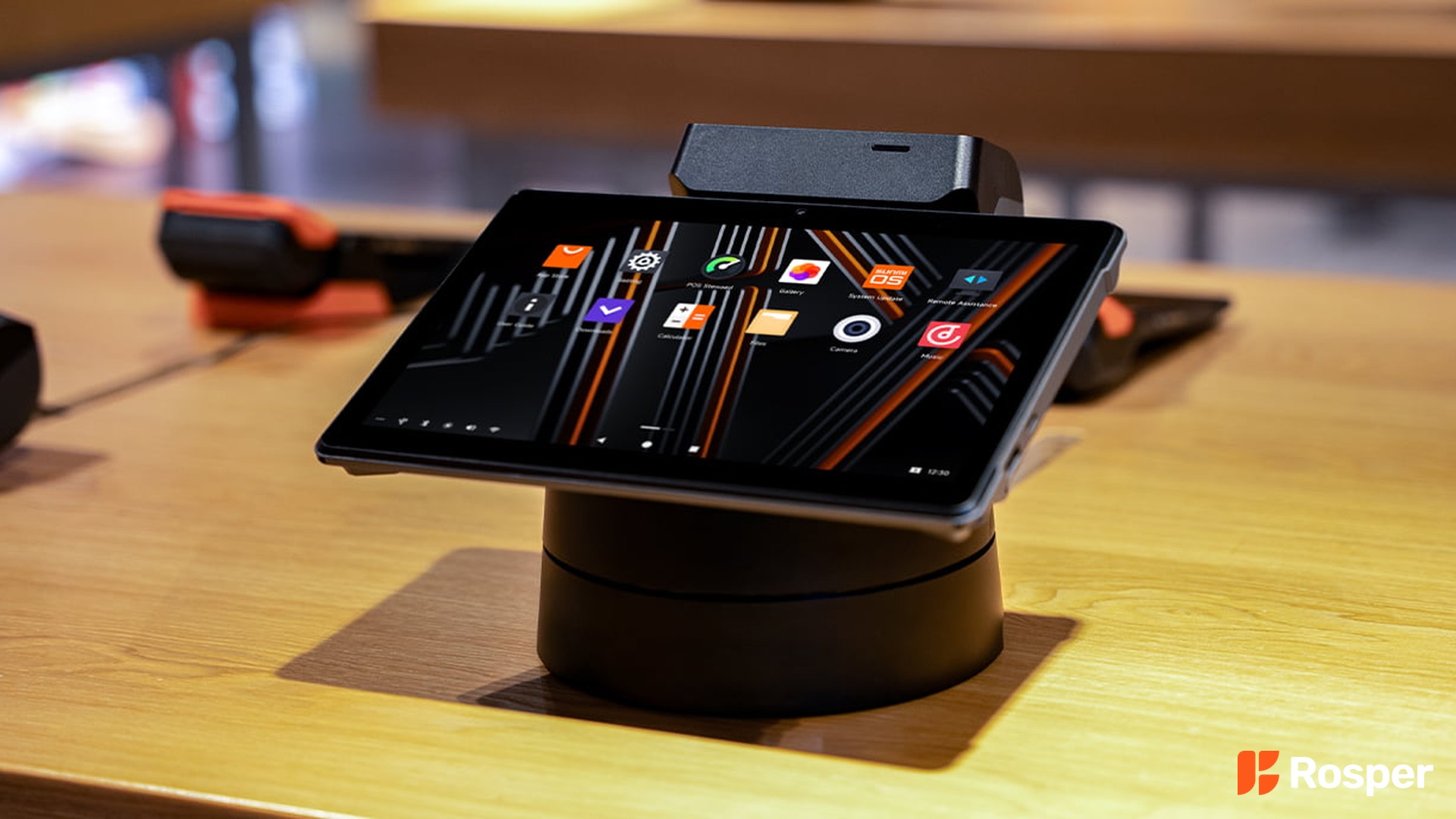
Stripe’s Terminal documentation lists exactly two countertop devices under Tap to Pay on Android, and both of them are SUNMI. The SUNMI V3 Mix is one of the two. The same page sets 10 hard device requirements the SDK checks before it will connect, covering Android version, security patch age, keystore hardware, bootloader state, root status, developer options, and Google Mobile Services certification. Those rules are why hardware eligibility belongs at the front of an integration plan rather than at the end of one.
The V3 Mix is a 10.1 inch Android terminal with a built-in thermal receipt printer, a professional 2D scanner, on-screen NFC, and a battery that comes out without tools. It is designed to work two ways: in the hand at a table or in an aisle, and locked into a powered cradle at a counter. This guide covers what the hardware actually does, why it clears Stripe’s countertop bar, which cradle and display part numbers match which workflow, and the 7 checks worth running before a purchase order goes out.
Key Takeaways
- Stripe’s supported device list for Tap to Pay on Android names two countertop models, both from SUNMI, and the V3 Mix is one of them. Stripe documents the list as illustrative rather than exhaustive.
- P06080020 is the stocked North American part number: 10.1 inch display, 80 mm printer, US 4G, NFC, fingerprint, GMS-EDLA, 4 GB RAM and 32 GB storage.
- The 7.2 V 2600 mAh lithium battery is removable, so a depleted unit can be swapped and back on the floor instead of being tethered to a charger for the rest of a shift.
- Two cradles are catalogued. C14004084 swivels and carries RJ45, RJ12, RJ11 and 2 USB Type A. C14004085 is fixed and carries RJ45, RJ12 and 3 USB Type A.
- The 6.7 inch guest display ships in two builds, C02020009 with NFC and C02020010 without, so the part number decides whether a customer can tap on the display side of the counter.
- The V3 Mix is a Gen 3 device with a 3 year manufacturer warranty from SUNMI. Batteries, printer components and chargers are wear parts covered for 1 year.
What the SUNMI V3 Mix Is Built to Do
Most hardware decisions in food service and specialty retail come down to a single unresolved question: is this a counter device or a floor device. Buying for one usually means buying a second unit for the other, which doubles the part numbers, the spares shelf, the mounting hardware, and the software builds that have to be certified.
The V3 Mix answers that by putting the printer inside the mobile device rather than beside the fixed one. A server can take an order at the table, tap a card on the screen, and hand over a printed receipt without walking back to a station. The same unit drops into a powered cradle at the counter, where the RJ12 port drives a cash drawer and the RJ45 port puts the terminal on wired Ethernet for the busy hours. The device does not change roles by being reconfigured. It changes roles by being picked up or set down.
Two details matter more in practice than the spec sheet suggests. The fingerprint reader is specified for device login only, not for payment authorization, which makes it a shift-handover tool rather than a security control on the transaction. And the front-facing camera is paired with a separate 0.3 MP fixed-focus camera dedicated to reading QR code payments, so wallet-presented codes do not compete with the 2D scanner that staff use on product barcodes.
SUNMI V3 Mix Specifications at a Glance
The figures below come from the published specification for the V3 Mix. Full configuration detail sits on the Rosper V3 Mix product page, and SUNMI publishes the platform overview on the SUNMI V3 MIX product page.
| Specification | SUNMI V3 Mix |
|---|---|
| Display | 10.1 inch HD IPS, 1280 x 800 |
| Operating system | SUNMI OS 4.0, based on Android 13 |
| Processor | Qualcomm hexa-core, 2.4 GHz and 1.9 GHz |
| Memory | 4 GB RAM, 32 GB storage, microSD slot |
| Printer | Integrated thermal, 70 mm/s. 58 mm and 80 mm versions exist; 80 mm is the stocked North American build |
| Scanner | Professional 1D and 2D barcode scanner |
| NFC | On-screen reader. Type A and B, Mifare, FeliCa. ISO/IEC 14443 and ISO 15693 compliant |
| Cellular | US 4G, dual nano SIM slots |
| Wi-Fi | IEEE 802.11 a/b/g/n/ac, 2.4 GHz and 5 GHz |
| Bluetooth | 2.1, 3.0 and 4.2, with BLE |
| Battery | Removable lithium, 7.2 V / 2600 mAh |
| Cameras | 2 MP front, plus 0.3 MP fixed focus for QR code payment |
| Biometrics | Fingerprint reader, for login only |
| Card slots | PSAM slot compliant with ISO 7816, 3.0 V / 1.8 V |
| Positioning | GPS and AGPS |
| Dimensions | 246 x 231 x 73 mm |
| Weight | 670 g for the 58 mm build |
| Environment | Operating 0 C to 45 C, storage -20 C to 60 C |
Scoping a V3 Mix deployment?
Send your site count, printer width, and cradle preference and get a configuration sheet with matching accessory part numbers. Request a quote.
Why Stripe Lists the SUNMI V3 Mix as a Countertop Tap to Pay Device
Tap to Pay on Android turns the terminal itself into the contactless reader, with no separate card reader in the bill of materials. Stripe gates that capability behind a device eligibility check, and the Stripe Terminal documentation for Tap to Pay publishes both the criteria and a set of device types it has validated. Under Countertop, that page lists SUNMI and names the D3 MINI and the V3 MIX. Stripe is explicit that the table shows supported device types and is not a closed list, so eligibility still has to be confirmed against the build that is actually shipping.
The criteria explain why a mobile terminal with a printer ends up in a countertop category at all. Stripe requires an ARM-based processor and a working integrated NFC sensor, which the Qualcomm hexa-core platform and the on-screen reader satisfy. It requires Android 13 or later, which SUNMI OS 4.0 is based on. It requires Google Mobile Services with the Play Store installed, which is what the GMS-EDLA designation in the P06080020 specification refers to. And it requires an unrooted device with a locked bootloader, unmodified manufacturer firmware, developer options disabled, and a security update from the past 12 months.
One criterion runs the other way and is easy to misread. Stripe excludes devices that are certified PCI PTS payment devices. A hardened pinpad is disqualified from Tap to Pay on Android by design, because the software attestation model assumes a general-purpose device. The V3 Mix is a smart mobile terminal rather than a certified pinpad, which is precisely why it qualifies. Teams that need chip insert with PIN on a certified pinpad are looking at a different hardware class and a different Stripe integration path, a decision covered in more depth in our guide to Stripe Tap to Pay on SUNMI hardware.
It is also worth separating platform support from processor support. Appearing on Stripe’s device list means the SDK will connect. It does not decide which acquirer, gateway, or payment application a merchant ends up using. The broader picture of which SUNMI models carry on-device contactless acceptance is set out in what SoftPOS is and which SUNMI devices support tap-to-pay.
The Removable Battery Changes the Shift Math
A 7.2 V 2600 mAh lithium battery that comes out is a small spec line with an outsized operational effect. On a sealed device, a unit that runs low during a dinner rush is out of service until it has charged, which means the deployment has to be sized for peak concurrent devices plus a charging buffer. On the V3 Mix, the same situation is a battery swap, and the sizing question becomes how many charged packs are on the shelf rather than how many spare terminals are in the cabinet.
That difference shows up in two places on a purchase order. It usually lowers the device count needed for a given number of simultaneous users, and it adds a consumable line that has to be refreshed on a cycle. Batteries are classified as wear parts, so they carry 1 year of coverage while the terminal itself carries 3. A fleet planned around swappable packs should treat spare batteries as a recurring line item, not a one-time accessory, and should plan a replacement cycle rather than waiting for runtime complaints to surface from the floor.
Cradles, Guest Displays and Carry Accessories by Part Number
The accessory choice is where a V3 Mix deployment stops being generic. Two cradles, two guest displays, and two wall mounts are catalogued, and the differences between the pairs are functional rather than cosmetic.
| Part number | Accessory | What it adds |
|---|---|---|
| C14004084 | MIX Function Cradle | Swivel base with RJ45 LAN, RJ12 cash drawer, RJ11, 2 USB Type A, and power. Rotates the screen toward the customer for confirmation and signature |
| C14004085 | MIX Cradle | Fixed base with RJ45 LAN, RJ12 cash drawer, 3 USB Type A, and power. One extra USB port, no rotation |
| C02020009 | MIX USB Display | 6.7 inch guest touchscreen over USB Type-C, with NFC. Lets the customer tap on the display rather than on the staff-facing terminal |
| C02020010 | MIX USB Display | 6.7 inch guest touchscreen over USB Type-C, without NFC and without a camera |
| C02020011 | MIX Wall Mount | USB Type-C, RJ45 with PoE, and USB Type A. Single-cable option where a power outlet is awkward |
| C02020012 | MIX Wall Mount | USB Type-C, RJ45 and USB Type A, without PoE |
| C11000002 | MIX Hand Band | Carry strap for extended handheld use |
Three practical notes. C14004084, C14004085 and C02020009 are the options currently catalogued as in stock, and the remaining part numbers should be confirmed at quote rather than assumed. SUNMI also lists a shoulder strap for the platform, while the carry accessory currently catalogued at Rosper is the hand band. And the swivel decision is worth making deliberately: rotating a 10.1 inch screen toward a guest is the cheapest way to handle tip prompts and signature capture, but it occupies counter depth that a fixed cradle does not.
Three Deployment Patterns That Fit the V3 Mix
Full-service dining with tableside close. The server carries the terminal with a hand band, fires the order from the table, and closes out on the spot with an on-screen tap and a printed receipt. A single swivel cradle at the host stand or service bar handles the cash drawer, wired Ethernet, and charging between shifts. This is the pattern that removes the most walking from a shift, and it is the one where the integrated printer earns its place, since a mobile terminal without a printer sends the server back to a station anyway. Wider hardware planning for this environment sits in our restaurant solutions overview.
Single-counter retail with queue busting. The terminal lives in a fixed cradle with the guest display attached, running as a normal counter station most of the day. During a rush, it lifts out and works the line on 4G or Wi-Fi so customers pay before they reach the counter. The 2D scanner handles product barcodes on the floor, which is what separates this from a phone-plus-reader setup.
Events, markets and mobile service. Ticketing desks, pop-up stands, farmers markets, and field service routes all share the same constraint: no reliable power and no reliable network. The 4G build with dual nano SIM slots covers the network side, and the removable battery covers the power side. Teams running this pattern across a route should look at the operational detail in our guide to handheld POS terminals for delivery and field service teams.
7 Checks Before You Order the SUNMI V3 Mix
Every item below has caused a real delay on a hardware order at some point. Running them before the purchase order is signed is faster than running them after the pallets land.
- Confirm the part number and the printer width. P06080020 is the stocked North American build with the 80 mm printer, US 4G, NFC, fingerprint and GMS-EDLA. Receipt stock, drawer templates and printer drivers are all width-dependent, so a late switch is not free.
- Confirm GMS certification if tap acceptance is in scope. Manufacturers ship both GMS and non-GMS builds of the same model. A non-GMS unit will fail Google’s attestation, and the failure appears at integration time as an attestation error rather than at the ordering stage. The distinction between GMS and EDLA licensing is worth understanding first, and we cover it in the EDLA vs GMS rollout checklist.
- Confirm the Android version and the security patch policy. Stripe requires Android 13 or later plus a security update from within the last 12 months. That is not a one-time check at delivery. It is an ongoing patch commitment that has to be handled by device management for the life of the fleet.
- Decide swivel or fixed before the counters are built. C14004084 rotates and gives up one USB port. C14004085 stays put and keeps three. Counter depth, guest-facing tip prompts, and how many wired peripherals hang off the station decide which one is right, and changing later means new hardware, not a setting.
- Decide whether the guest display needs NFC. C02020009 includes it, C02020010 does not. If the intended flow is the customer tapping on their own screen rather than reaching across to the staff terminal, the part number is the decision.
- Budget spare batteries as a recurring line. The pack is removable and is classified as a wear part with 1 year of coverage against the device’s 3. Size the spares by concurrent users and peak hours, and set a replacement cycle rather than reacting to complaints.
- Confirm carrier bands and the Wi-Fi fallback. The stocked configuration is a US 4G build with dual nano SIM slots. Cellular plans, band compatibility, and what the device does when the signal drops should all be settled before a pilot, particularly for event and market deployments where the network is the weakest link.
Warranty and Sourcing in the US and Canada
The V3 Mix is a Gen 3 SUNMI product, which places it in the 3 year manufacturer warranty tier. Coverage is provided by SUNMI, and Rosper coordinates claims on the customer’s behalf so a North American buyer has a single point of contact rather than an international support queue. Wear parts are the exception and are covered for 1 year regardless of generation, which includes the removable battery, printer components and chargers. Warranty begins at device activation, or automatically 90 days after the manufacturing date if a unit is never activated, so units held in a staging room still consume coverage. Full terms are published on the Rosper warranty page.
On sourcing, Rosper is the authorized SUNMI distributor for North America and ships from 8 warehouses across the US and Canada, with most orders arriving in 2 to 7 business days. For a multi-site rollout, the practical step is to lock the terminal part number and the cradle and display part numbers as one configuration sheet, so every location receives an identical build and the software team certifies against one hardware target instead of several.
Frequently Asked Questions
What is the SUNMI V3 Mix?
The SUNMI V3 Mix is a 10.1 inch Android smart mobile terminal with an integrated thermal receipt printer, a professional 1D and 2D barcode scanner, on-screen NFC, and a removable 7.2 V 2600 mAh battery. It runs SUNMI OS 4.0 based on Android 13 on a Qualcomm hexa-core processor with 4 GB of RAM and 32 GB of storage. It is designed to work handheld for tableside and mobile checkout, and docked in a powered cradle for counter operation.
Does the SUNMI V3 Mix support Stripe Tap to Pay?
Stripe’s Terminal documentation for Tap to Pay on Android lists the V3 MIX under the Countertop device type, alongside the SUNMI D3 MINI. Stripe describes the table as a set of supported device types rather than a closed list, and enforces 10 device requirements at connection time, including Android 13 or later, Google Mobile Services with the Play Store installed, an unrooted device with a locked bootloader, developer options disabled, and a security update from the past 12 months. Device eligibility should be confirmed against the specific build being deployed.
Which SUNMI V3 Mix part number ships in North America?
P06080020 is the stocked North American configuration. It is specified as a 10.1 inch V3 MIX with 4 GB of RAM and 32 GB of storage, an 80 mm printer, a 2 MP front camera, US 4G, NFC, a fingerprint reader, GMS-EDLA certification, and a US power adapter. Other regional or fiscal builds of the V3 MIX exist, so the part number should be confirmed on the quote rather than assumed from the model name.
Can the battery on the SUNMI V3 Mix be replaced?
Yes. The V3 Mix uses a removable 7.2 V 2600 mAh lithium battery, so a depleted unit can be swapped with a charged pack instead of being taken out of service to charge. Batteries are classified as wear parts and carry 1 year of warranty coverage, while the terminal itself carries 3 years. Fleets planned around swapping should budget spare packs as a recurring line item and set a replacement cycle.
What accessories are available for the SUNMI V3 Mix?
The catalogued MIX accessories are two cradles, C14004084 with swivel plus RJ45, RJ12, RJ11 and 2 USB Type A, and C14004085 fixed with RJ45, RJ12 and 3 USB Type A. There are two 6.7 inch USB guest displays, C02020009 with NFC and C02020010 without. There are two wall mounts, C02020011 with PoE on RJ45 and C02020012 without. A MIX Hand Band, C11000002, covers extended handheld use. SUNMI also lists a shoulder strap for the platform.
What warranty comes with the SUNMI V3 Mix?
The V3 MIX is a Gen 3 SUNMI product with a 3 year manufacturer warranty provided by SUNMI. Wear parts, including the battery, printer components and chargers, are covered for 1 year regardless of generation. Coverage starts at device activation, or automatically 90 days after the manufacturing date if the device is never activated. Rosper coordinates warranty claims with SUNMI for customers in the US and Canada.
Next Step
If the workflow is already clear, the ordering decision reduces to four lines: the terminal part number, the cradle, whether the guest display needs NFC, and how many spare batteries the shift pattern requires. If the workflow is still open, start by writing down what the device has to do in the first and last 30 seconds of a transaction, and the configuration will follow from that. The full SUNMI mobile range is on the Rosper products catalogue.